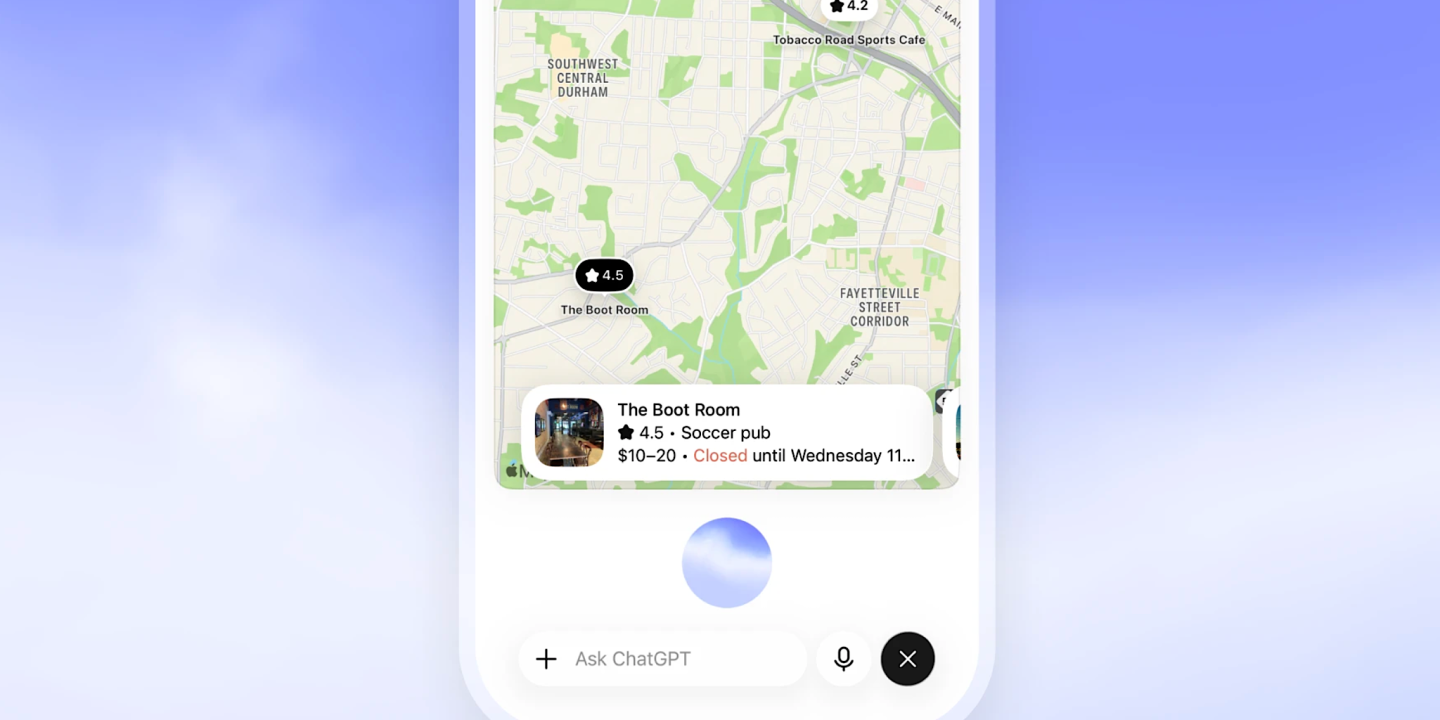
OpenAI has begun rolling out GPT-Live, a new generation of voice models that power ChatGPT Voice. During a conversation, GPT-Live can hand a question to its latest frontier model, such as GPT-5.5, for heavier reasoning or a web search.
What Launched
GPT-Live-1 becomes the default model powering ChatGPT Voice for Go, Plus, and Pro users, and GPT-Live-1 mini becomes the default for Free users.
OpenAI describes the models as full-duplex, meaning they can take in audio and produce speech at the same time, interrupt less, and wait when a user pauses.
Search and Visual Answers Move Into the Conversation
When a spoken question needs deeper reasoning or current information, GPT-Live can hand it to a frontier model, GPT-5.5 at launch, and bring the answer back into the conversation.
ChatGPT Voice can also show visual cards for topics like weather, stocks, and sports, and OpenAI said Voice continues to support search, memory, images, and file uploads. Users can set a reasoning level, with Instant for fast replies and Medium or High for more involved questions. OpenAI said Instant replies and the mini model run on GPT-5.5 Instant, while Medium and High use GPT-5.5 Thinking.
How OpenAI Measured It
In OpenAI’s own head-to-head evaluations, GPT-Live-1 and GPT-Live-1 mini were preferred over its Advanced Voice Mode in conversations lasting five to ten minutes. OpenAI said the evaluations looked at overall preference, turn-taking, interruptions, conversational flow, and how natural the interactions felt. The company said more than 150 million people talk to ChatGPT each week using features like Voice and Dictation.
What It Doesn’t Do Yet
At launch, GPT-Live does not support voice with video or screen sharing in ChatGPT. OpenAI said it is working to add those capabilities, and that its earlier Standard and Advanced Voice Modes stay available where video and screen sharing are supported.
Why This Matters
Now, when you ask a question aloud, you might see an answer directly in the voice flow, sometimes accompanied by a visual card on the screen. This provides ChatGPT with another way to present an answer without visiting a source site. Since the reasoning and search process happens behind the scenes on GPT-5.5, what shows up there depends on how the model retrieves information and cites its sources.
Looking Ahead
OpenAI said the rollout is beginning globally, and that video and screen sharing are not in this release but are being worked on.
OpenAI’s post doesn’t say how GPT-Live handles citations when it answers a spoken question from a GPT-5.5 web search. ChatGPT’s text answers show source links next to the response. Whether a spoken answer names its sources, shows them on screen, or leaves them out is the detail to watch. That’s what decides whether a search inside a voice conversation can still send a reader to your site.
Featured Image: OpenAI
Generative AI,News#OpenAI #GPTLive #Brings #Search #ChatGPT #Voice #sejournal #MattGSouthern1783536062

Recent Post



Gallery






Featured Videos