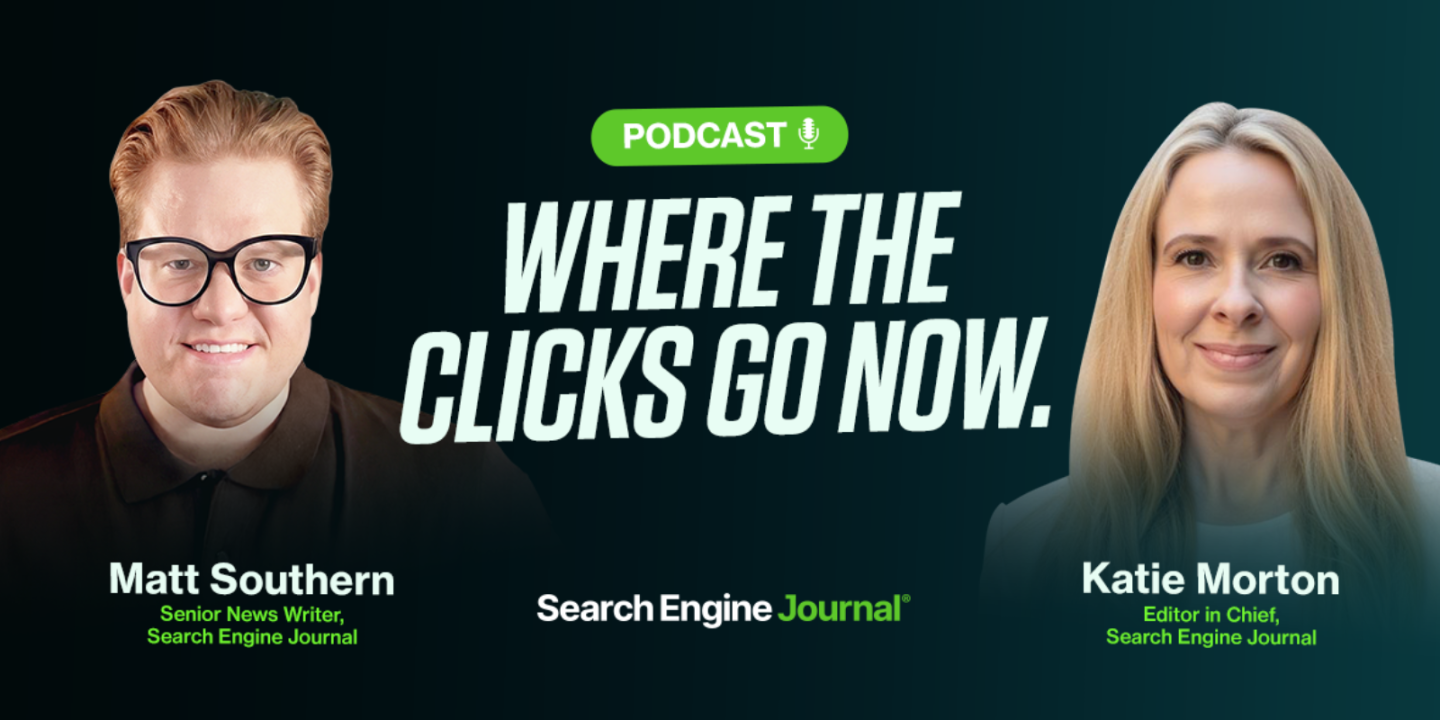
Katie Morton, editor-in-chief of Search Engine Journal, and I recorded the debut episode of Search Engine Journal’s revamped podcast, focusing on a recurring theme in our coverage. We discussed how clicks are declining on the open web, a trend many in search have noticed. We argue that much of this attention hasn’t vanished but has shifted to areas not easily tracked by standard analytics. Listen to the complete episode here.
[04 : 28] — Introduction: The Disappearing Clicks
[05 : 09] — Where to Invest Your Marketing Resources?
[09 : 14] — How to Measure Performance Beyond Clicks
[13 : 49] — Where Is Search Traffic Going?
[16 : 41] — What Does Visibility Mean Now?
[21 : 11] — Resetting Goals for Content Leaders
Where Searches Are Landing Now
Most searches nowadays often don’t lead directly to a click on the open web. According to Rand Fishkin’s analysis of Similarweb clickstream data, about 68% of U.S. Google searches in the first four months of 2026 end without any click at all. Only around a quarter actually take users to an external website. The rest either conclude without a click, lead to another Google search, or direct users to a Google-owned property or paid result.
That attention is collecting in a few places. A lot of it never leaves Google, held by AI Overviews, Business Profiles, Maps listings, and newer surfaces like Ask Maps that point people toward specific businesses. Community platforms are showing up in the results more often, too.
After May’s core update, SE Ranking’s tracking showed Reddit gaining top-three positions across all 20 niches it follows. Google’s partnership with Reddit has been in place for a while, and Google has leaned harder into forum results, though I wouldn’t say the deal alone explains the movement.
Then there’s a narrower set of sites that still reliably pull organic traffic. Transactional, local, and branded searches keep sending clicks. What’s getting hit hardest is lifestyle content, wire-service journalism, and utility pages like weather and TV listings, which are the kind of thing an AI Overview can answer without sending a click anywhere.
Katie added that much of what leaves the open web lands on social platforms and video, where AI can’t easily replicate the formats. Younger audiences, in particular, are spending their time there rather than on traditional sites, and YouTube holds their attention across age ranges.
The Content Bets That Stopped Paying Off
Many blogs try to cover every related topic with generic content, which worked when Google indexed them all and drove traffic. Now, they face tougher competition from similar pages and AI summaries that answer directly in search results. Focusing on volume alone no longer works.
Google’s Danny Sullivan drew that line at Search Central Live Toronto this spring, separating commodity content from the kind of work only your business and your experience can produce. The listicle that could come from anywhere sits on one side. What only you can say sits on the other. The topic matters less than which side of that line your content falls on.
John Mueller made a related point on Reddit. For a new site, the audience work comes first, and search visibility may follow once you’ve built something worth finding. Starting with “how do I rank” is the wrong place to start.
Katie tied this back to business fit. SEJ doesn’t take every client who waves money, because off-topic or low-quality sponsors can cost you your audience’s trust. For her, it stayed simple:
It always comes down to authenticity. You want to provide value, you want to serve your audience. It has to be this mutually beneficial thing.
Old-school SEO principles never die, and firsthand experience is the one thing AI can’t replicate.
Measuring Visibility When The Click Never Comes
The challenge now is that the numbers you once relied on have become harder to interpret. Raw traffic used to be a clear indicator, but today, your brand can appear throughout search results and still not show up in your analytics, especially if it didn’t lead to a click.
Branded search is a signal to monitor alongside citation tracking. Repeated exposure in AI answers may lead to more branded queries. Search Console’s branded queries filter makes these changes easier to identify.
Another change involves shifting from links to mentions. Unlinked mentions may matter in ways that a typical link report can’t detect. For example, a brand might be referenced in a Reddit thread, which a chatbot later relies on for a recommendation, even though there’s no hyperlink in the chain. If you only count links, you might overlook this.
Katie described the reader’s side from shopping for merino wool travel clothes:
I’m seeing brand names, but I’m not always clicking during the research process. I’m seeing brand names mentioned over again on the SERP and Reddit and in Claude, my preferred AI chatbot … eventually it will trigger a branded search, and then I’ll go directly to someone’s website, and they would probably have no idea how I found them.
That’s the attribution gap a lot of ecommerce is living in: Direct traffic they can’t tie back to a source. Her advice was to track where you’re being cited, keep a brand presence on Reddit, and make your content crawlable by AI.
No click doesn’t mean no value. Our argument on the episode was that if your content helped form the answer someone got, you may be in the consideration set even when no referral follows.
Resetting The Scoreboard As A Content Leader
Katie emphasized that proving value as a content leader begins with identifying your “north star.” She pointed out that revenue and the bottom line are central, but it’s equally important for editorial and marketing to work hand in hand with the business strategy while still putting the audience first. Ultimately, it involves keeping content aligned with the business model, which also means being selective about customers to maintain the audience’s respect.
Part of the strategy involves niching down. SEJ improved its contributor program by becoming more selective about writers, prioritizing genuine expertise over self-promotion.
My piece of this is the scoreboard. When clicks stop being the main number, you make the clicks you do get count for more. If the only metric you report is organic sessions, and Google’s sending a smaller share of searches to the open web, that line is going to keep sliding. Keep the declining sessions in view and set them alongside the growing signals, like branded search queries and mentions.
Catch The Full Conversation
This leaves content teams with a harder measurement job, and a more honest one.
A wider scoreboard can highlight value that a sessions-only report might miss. While it won’t undo the revenue loss caused by traffic that doesn’t return, managing both aspects together is truly the key to success now.
More Resources:
Featured Image: Paulo Bobita/Search Engine Journal
SEJ Podcast,SEO,SEO Strategy#Search #Attention #amp #Measure #sejournal #MattGSouthern1784038885