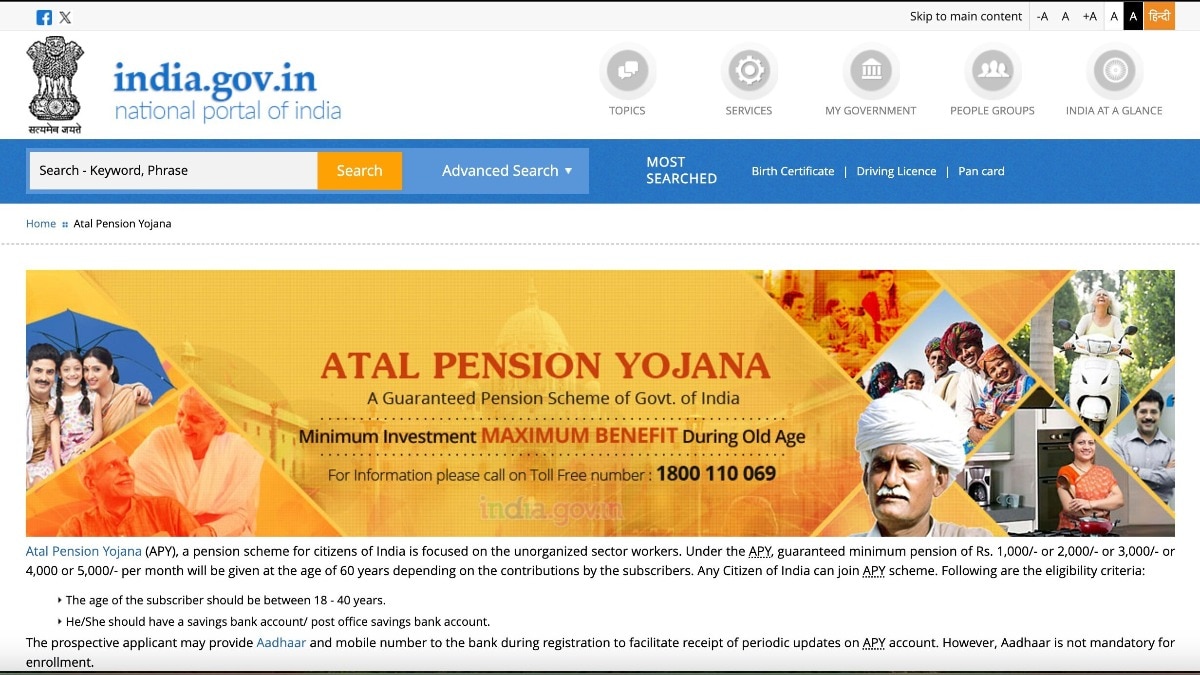
The Union Cabinet, chaired by Prime Minister Narendra Modi, on Wednesday approved the continuation of the Atal Pension Yojana (APY) until the end of the 2030-31 financial year, extending government support for the scheme’s outreach, development and financial viability. The decision underscores the government’s focus on strengthening social security for unorganised and low-income workers and expanding pension coverage across the country.
As part of the approval, the government will continue funding promotional and developmental initiatives aimed at increasing awareness and participation in APY, particularly among workers in the unorganised sector. These efforts include large-scale outreach programmes, capacity-building for implementing institutions and measures to improve service delivery. The Cabinet also cleared the continuation of gap funding to meet the scheme’s viability requirements and ensure its long-term sustainability.
Officials said the move is expected to reinforce old-age income security for millions of workers who lack access to formal pension systems. By sustaining government support, the scheme is positioned to play a larger role in enhancing financial inclusion and advancing the broader objective of building a pensioned society. The decision also aligns with the government’s long-term development vision under Viksit Bharat @2047, which emphasises inclusive and sustainable social security frameworks.
Atal Pension Yojana
Launched on May 9, 2015, the Atal Pension Yojana was designed to provide assured pension benefits to workers in the unorganised sector, including daily wage earners, self-employed individuals and others outside formal employment structures.
Atal pension amount
Under the Atal Pension Yojana, subscribers are assured a minimum monthly pension of ₹1,000 on reaching the age of 60. Depending on the contribution level and the pension slab chosen at the time of enrolment, beneficiaries can opt for higher payouts of ₹2,000, ₹3,000, ₹4,000 or up to ₹5,000 per month. The final pension amount is directly linked to the subscriber’s age at entry and the size of contributions made during the accumulation phase.
Over the years, APY has emerged as a key pillar of India’s social security architecture. As of January 19, 2026, the scheme had enrolled more than 8.66 crore subscribers, reflecting steady growth and widespread adoption across states. The government noted that maintaining this momentum requires continued investment in awareness campaigns and institutional capacity, particularly in rural and semi-urban areas where pension penetration remains limited.
The extension up to 2030–31 provides policy certainty for subscribers and implementing agencies, while also allowing the government to address operational challenges and evolving demographic needs. Continued gap funding will help absorb financial pressures arising from guaranteed pension commitments, ensuring that the scheme remains fiscally viable over the long term.
With India’s workforce still dominated by the unorganised sector, policymakers believe sustained support for APY is critical to safeguarding incomes in old age. The Cabinet’s decision signals a reaffirmation of the government’s commitment to inclusive growth, financial security and long-term social welfare for vulnerable sections of society.
Atal pension yojna, government of India, cabinet Atal Pension Yojana scheme#Budget #Union #Cabinet #approves #extension #Atal #Pension #Yojana #FY311769049736

approves
Atal
Atal pension yojna
Budget
Cabinet
cabinet Atal Pension Yojana scheme
extension
FY31
government of India
Pension
Union
Yojana
Recent Post



Gallery






Featured Videos