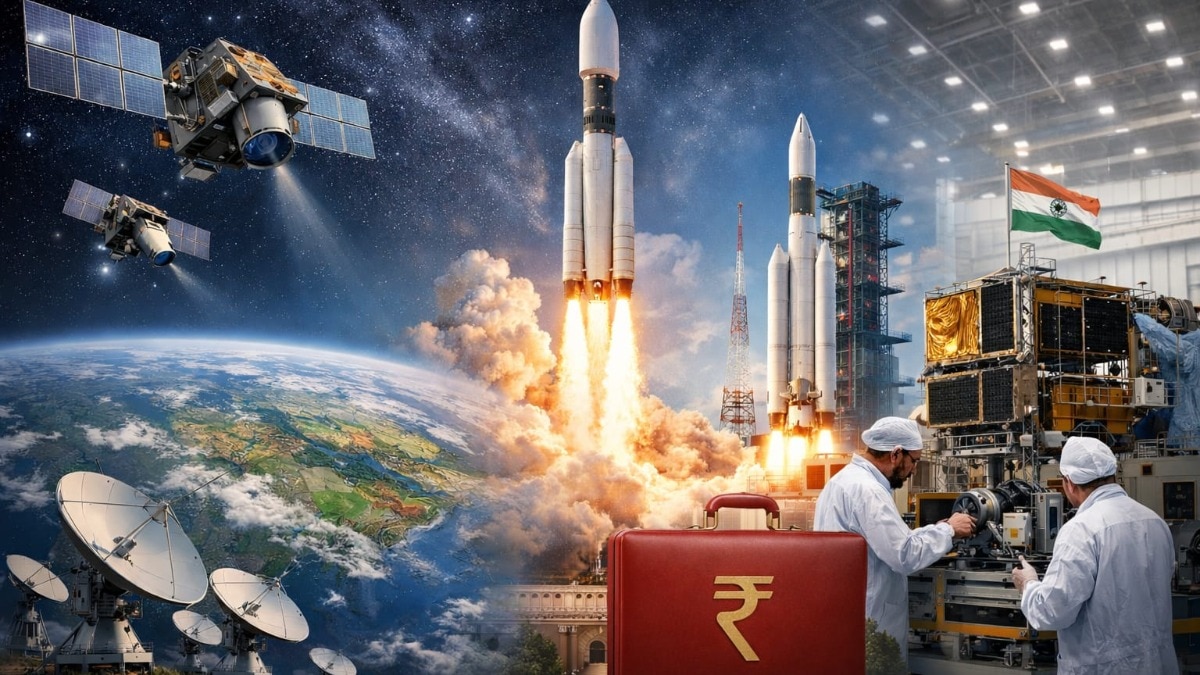
As Budget 2026 approaches, India’s private space startups are calling for predictable government procurement, targeted tax reforms and manufacturing incentives to help scale Earth observation (EO) constellations, satellite factories and launch services.
The demands come after last year’s Budget raised the Department of Space allocation by nearly 14% to Rs 13,416.20 crore to support flagship missions such as Chandrayaan-4 and the Venus Orbiter Mission. While India is already recognised as a dependable, low-cost global launch hub, founders say technical excellence alone will not translate into market leadership without sustained commercial demand and lower structural costs.
Predictable EO data contracts
Awais Ahmed, founder and CEO of Pixxel, said a major constraint for EO companies is the lack of long-term demand certainty.
“A major unlock would be a predictable, long-term government procurement program for both satellites and EO data. If ministries and PSUs could commit to multi-year data purchase agreements across agriculture, environment, infrastructure and disaster management, it would give companies like Pixxel the confidence to scale faster,” Ahmed told Business Today.
He added that “clear budgets for buying commercial EO data, transparent tenders, and faster contracting cycles would help move from pilot projects to national-scale usage. This directly supports building larger constellations and ensures sovereign, reliable access to high-quality Earth intelligence.”
Earlier in January, Pixxel signed an agreement with the Indian National Space Promotion and Authorisation Centre (IN-SPACe) to build and operate India’s first privately led national EO constellation under a public-private partnership framework.
The planetary intelligence startup will lead a consortium of four Indian space companies, Pixxel, Dhruva Space, PierSight and SatSure, to design, build, own and operate the country’s first private-led national satellite system. The consortium plans to invest more than Rs 1,200 crore over the next five years to deploy a 12-satellite constellation.
Also read: Budget 2026 must scale IndiaAI Mission to keep pace with surging AI compute demand: Yotta CEO Sunil Gupta
Tax relief and manufacturing incentives
Spacetech startups also flagged indirect taxes and component classification as major cost bottlenecks.
“Ground infrastructure, such as antennas, Radio Frequency (RF) systems, compute, storage and testing equipment, accounts for a significant portion of the operating costs of both satellites and platforms like Aurora,” Ahmed said.
“GST exemptions or input tax credits on this equipment would reduce upfront capital strain and free up resources to invest more into software, analytics and faster iteration cycles,” Ahmed told Business Today.
For manufacturing, Ahmed said similar relief on test and integration equipment would make satellite production in India more competitive globally.
From a regulatory standpoint, Keyur Gandhi, Director, Space Regulatory and Commercialisation at Dhruva Space, called for clearer tax classification. “This year, our focus should be on addressing structural cost disadvantages that hinder the economic viability of domestic space manufacturing,” Gandhi told Business Today.
He urged the government to introduce “dedicated, granular HSN/SAC codes for space-grade components and services, distinct from general aerospace or electronics,” saying this would “reduce GST burdens, unblock input tax credits, and provide clarity on domestic value addition and import dependence.”
Gandhi also advocated extending SEZ-equivalent benefits, including zero-rated GST, duty-free procurement and streamlined customs, to authorised space-tech manufacturers. “These are not large subsidies, but targeted tax and classification reforms that can meaningfully improve ease of doing business, attract private and foreign investment, and accelerate India’s ambition to scale its space economy,” he said.
Launch startup Skyroot Aerospace echoed the need for deeper localisation.
“For Vikram-1, over 90% of the value is already derived from the local ecosystem. It should be India’s consistent policy to push that number to 100%,” said Pawan Kumar Chandana, co-founder and CEO of Skyroot Aerospace.
Funding and FDI reforms
Beyond taxes, startups are seeking targeted funding for advanced missions.
Pixxel’s Ahmed said “grants or targeted co-funding programs for commercial Earth Observation missions, especially for advanced sensors like hyperspectral,” along with “support for technology demonstration missions, risk-sharing for first-of-a-kind payloads, and low-interest financing for constellation deployment,” would help companies scale without over-relying on venture capital.
On foreign capital, Ahmed said, “Clearer, faster FDI approvals and fewer restrictions for non-sensitive applications would make it easier to bring in strategic investors, technology partners and distribution allies.”
Skyroot, meanwhile, is pushing for broader manufacturing incentives such as production-linked incentives (PLI) for space.
“If India is to truly become a major market player in the global space economy, we need a vibrant space-tech industry that regularly launches rockets, builds its own satellites and constellations,” Chandana said. A PLI extension to space “would definitely accelerate this journey,” he added.
Union Budget, Budget 2026, Spacetech startups, Pixxel, Dhruva Space, Skyroot Aerospace, spacetech FDI, spacetech budget expectations, PLI, PLI scheme, production linked incentive scheme#Budget #Indias #space #startups #longterm #deals #taxes #PLI #support1769578451

Budget
budget 2026
deals
Dhruva Space
Indias
longterm
Pixxel
PLI
PLI scheme
production linked incentive scheme
Skyroot Aerospace
Space
spacetech budget expectations
spacetech FDI
Spacetech startups
StartUps
Support
taxes
union budget