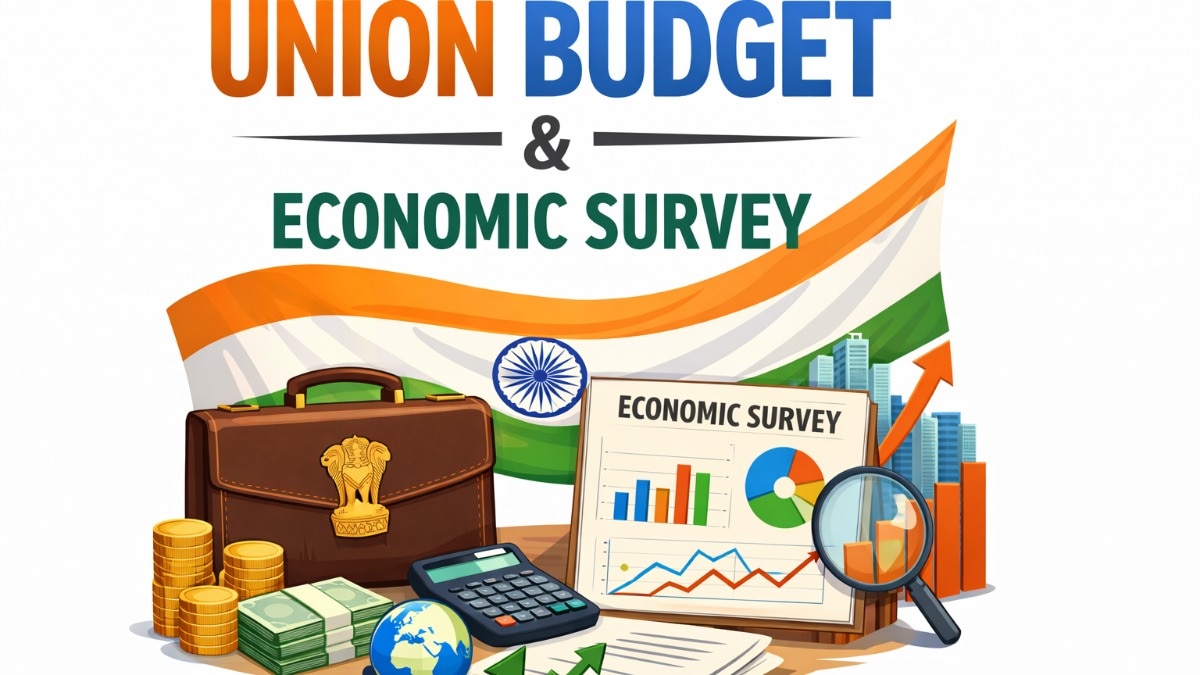
Finance Minister Nirmala Sitharaman will present the Union Budget 2026-27 in Parliament on Sunday, February 1, 2026, at 11 am. Ahead of the Budget speech, the Economic Survey 2024-25 offers early signals on the government’s policy priorities, with fiscal consolidation and employment generation emerging as key focus areas as India looks to sustain growth while maintaining macroeconomic stability.
The Economic Survey 2025-26 offers a cautiously optimistic view of India’s economic prospects. While it acknowledges that the economy is on a resilient growth path, it underlines that sustaining this momentum will require the upcoming Union Budget to tackle key structural challenges. Acting as a policy roadmap, the Survey signals that the Budget is likely to focus on fiscal consolidation, employment generation and strengthening manufacturing to achieve the 7-8% annual growth required for Viksit Bharat 2047.
Based on the Economic Survey 2024-25, here are the key expectations for the Budget:
1. Structural Reforms and Deregulation (Ease of Doing Business 2.0)
- Focus on MSMEs: The Survey highlights that easing regulatory hurdles is crucial for Micro, Small and Medium Enterprises (MSMEs) to expand operations and integrate more fully into the formal economy.
- Regulatory Simplification: The Budget is expected to prioritise lowering compliance burdens, rationalising labour regulations and pursuing land reforms to improve the overall investment climate.
2. Employment and Skill Development
- Job Creation focus: Employment is described as an “existential priority” in the Survey, suggesting the Budget may place greater emphasis on labour-intensive sectors.
- Industry-Academia Collaboration: Policies aimed at improving workforce skills to better match industry requirements are expected, particularly in emerging areas such as Artificial Intelligence (AI).
3. Investment and Infrastructure
- Capital Expenditure (Capex): Continued strong backing for infrastructure development is anticipated to maintain growth momentum, with an increased focus on public-private partnerships (PPPs).
- Manufacturing Boost: The Budget is likely to stress strengthening domestic manufacturing and reducing import reliance, especially in sectors such as electronics and critical minerals.
4. Agriculture and Rural Demand
- Productivity Improvement: Noting that India’s crop yields lag behind global peers, the Survey points to the need for greater attention on farm productivity, technology adoption and crop diversification.
- Allied Sectors: The Budget may increase emphasis on animal husbandry, dairying and fisheries to create additional income avenues for farmers.
5. Fiscal Policy and Inflation
- Credible Consolidation: The Survey reiterates a commitment to bringing the fiscal deficit below 4.5% of GDP over the coming years.
- Food Inflation Management: Measures to stabilise food prices through improved storage, logistics and supply-chain management are likely to feature.
6. Green Energy and Climate Change
- Climate Finance: The Survey notes that domestic resources alone will not be sufficient for climate action, indicating a need for a clear green finance taxonomy in the Budget.
- Energy Transition: Greater focus on renewable energy, including solar power and green hydrogen, is expected to align with India’s net-zero target by 2070.
Inflation, Fiscal Policy, Employment, Economic Survey, Green Energy, Fiscal consolidation, Economic Survey 2024-25, Investment ,Infrastructure, budget, budget 2026, Climate Change, budget news, union budget, budget updates, 2026 budget, finance minister, budget latest news, india budget, nirmala sitharaman, fm nirmala sitharaman, budget 2026 expectations,Deregulation Agriculture,
#Union #Budget #Ease #Business #manufacturing #boost #Economic #Survey039s #projections #ahead #Sitharaman039s #speech1769908434

2026 budget
ahead
Boost
Budget
budget 2026
budget 2026 expectations
budget latest news
budget news
budget updates
Business
Climate Change
Deregulation Agriculture
ease
Economic
Economic Survey
Economic Survey 2024-25
Employment
finance minister
Fiscal consolidation
Fiscal Policy
fm nirmala sitharaman
green energy
india budget
Inflation
Infrastructure
investment
Manufacturing
nirmala sitharaman
projections
Sitharaman039s
speech
Survey039s
Union
union budget