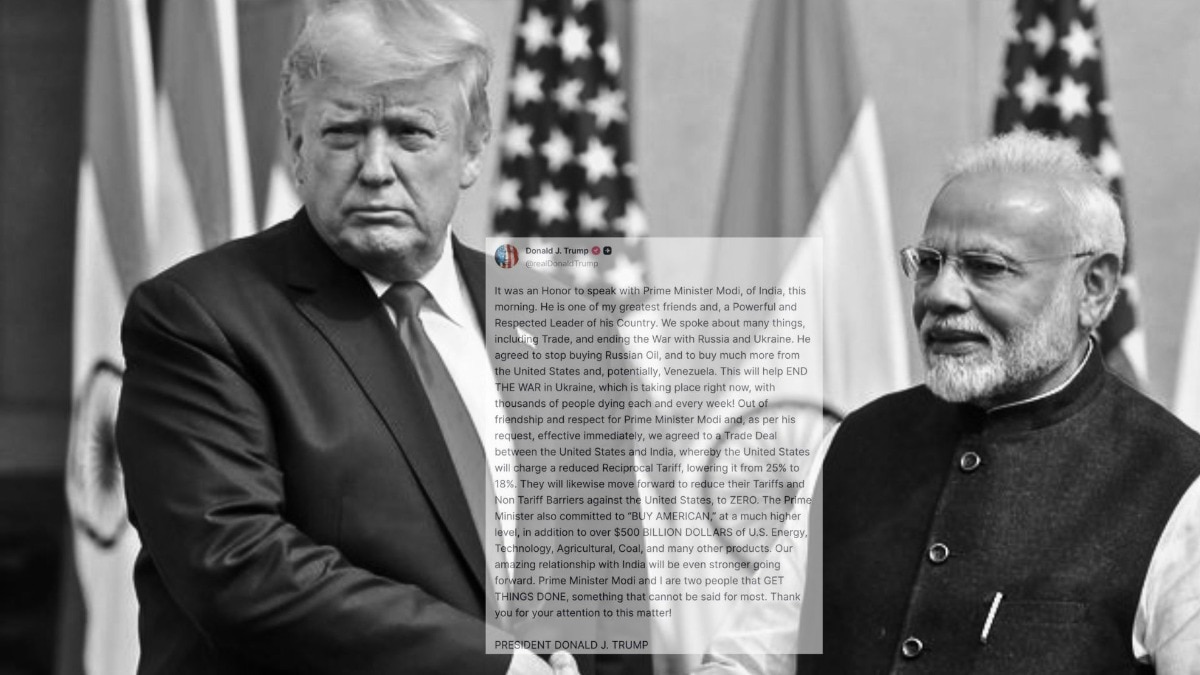
India could reduce its annual fuel import bill by as much as $3 billion by shifting crude oil sourcing away from Russia towards Venezuelan heavy crude, according to an SBI Research report, highlighting a key macroeconomic benefit emerging from the India-US trade deal. The estimate assumes discounts of $10–12 per barrel on Venezuelan heavy crude (Merey 16), which could offset the loss of discounted Russian oil without materially impacting domestic inflation.
The report notes that India’s dependence on Russian crude rose sharply after 2020, driven by deep discounts following Western sanctions on Moscow. Russia’s share in India’s oil imports crossed 30% in FY25, up from negligible levels before the Ukraine war. However, SBI Research argues that India now has the flexibility to diversify its crude basket, with supplies available from nearly 40 countries, including Venezuela, Iraq, Saudi Arabia, the UAE, the US and West Africa.
18% tariff is a major positive
This potential oil-saving comes alongside broader gains from the India–US trade agreement, under which Washington has reduced tariffs on Indian goods to 18%, down sharply from the earlier level of up to 50%. SBI Research describes the 18% tariff as a major positive for India, restoring competitiveness for Indian exports and placing the country among the lowest-tariff Asian exporters to the US.
Post-deal, India now enjoys a clear tariff advantage over key Asian peers, including Vietnam and several Southeast Asian economies. This improved relative positioning is expected to support Indian exporters across sectors such as gems and jewellery, textiles, leather, chemicals, seafood and engineering goods, which the report identifies as major beneficiaries of the tariff reset.
Indian experts
Importantly, SBI Research notes that Indian exports had already demonstrated resilience even under the earlier punitive tariff regime. Despite facing tariffs as high as 50%, exports to the US nearly matched a hypothetical no-tariff scenario, underscoring strong demand fundamentals. The US now accounts for around 20% of India’s total exports in FY25 and FY26 (year-to-date), reflecting deepening trade integration.
Fuel domestic inflation
On the macroeconomic front, the report highlights that the trade deal is unlikely to fuel domestic inflation, particularly from the energy side. Even if India reduces reliance on Russian oil, alternative sourcing options and discounted heavy crude ensure that energy costs remain manageable. As a result, the benefits of higher exports and trade competitiveness are not expected to come at the cost of price stability.
However, SBI Research cautions that the success of the deal partly hinges on continued diversification away from Russian oil. While volumes of Russian crude have already begun to decline, the transition will involve multiple sourcing combinations depending on price discounts, shipping costs, refinery configurations and geopolitical developments.
Sensitive domestic sectors
The report also underscores the need to protect sensitive domestic sectors, particularly agriculture and dairy. It highlights India’s dominant global position in milk production and stresses that safeguarding the dairy sector remains strategically important for livelihoods, food security and rural incomes. Trade liberalisation, SBI Research notes, must therefore be calibrated to preserve these core strengths.
Currency markets
Currency markets have already responded positively. Following the deal announcement, the rupee strengthened to around Rs 90.27 per dollar, appreciating by over one rupee, reflecting improved investor sentiment and expectations of stronger export inflows.
Overall, SBI Research views the India-US trade agreement as a net positive for India’s economy, combining lower tariffs, improved export competitiveness, diversified energy sourcing and minimal inflation risks. If executed carefully, the deal could strengthen India’s external balance while supporting growth across manufacturing, exports and energy security.
India US trade deal SBI report, oil sourcing shift India fuel import bill, India fuel import bill $3 billion savings, Russian crude replacement India, Venezuelan heavy crude Merey 16 India, India oil diversification strategy, SBI Research India US tariffs, 18 percent US tariff impact on India,#Oil #sourcing #shift #Venezuela #Indias #fuel #import #bill #SBI #Report1770133272

18 percent US tariff impact on India
bill
fuel
Import
India fuel import bill $3 billion savings
India oil diversification strategy
India US trade deal SBI report
Indias
oil
oil sourcing shift India fuel import bill
Report
Russian crude replacement India
SBI
SBI Research India US tariffs
shift
sourcing
Venezuela
Venezuelan heavy crude Merey 16 India
Recent Post



Gallery






Featured Videos