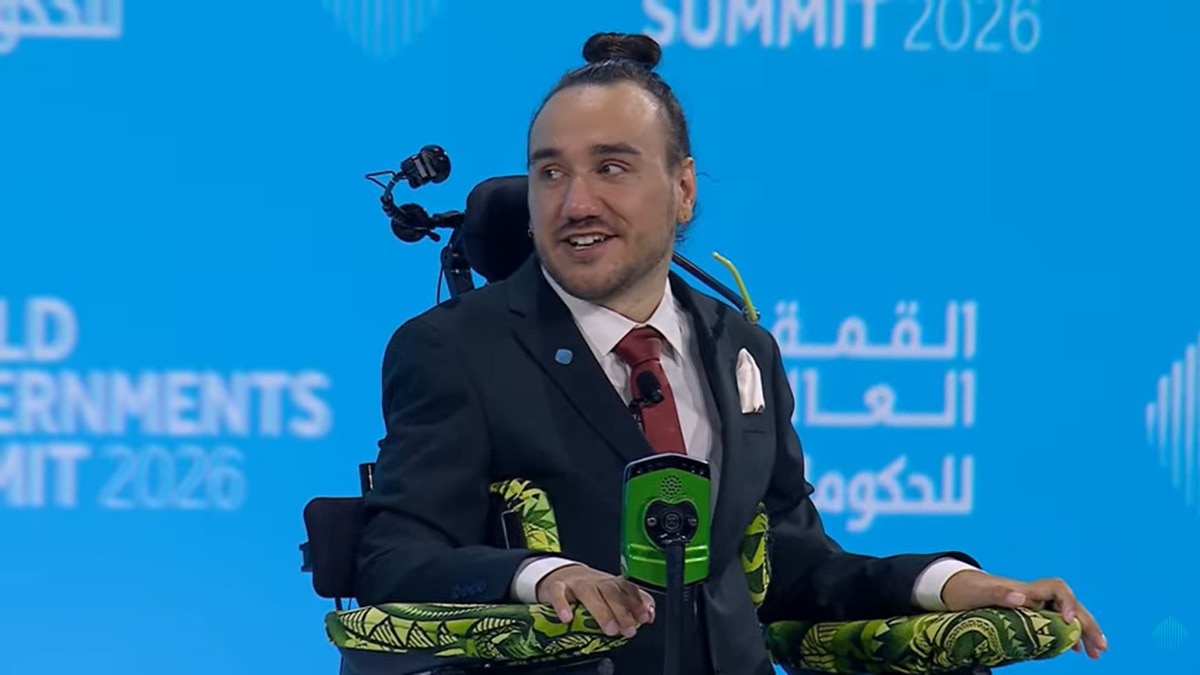
Noland Arbaugh, the first recipient of a brain-computer interface (BCI) implant from Neuralink, said the technology has helped him regain independence after being paralysed from the shoulders down by a spinal cord injury.
Speaking at the World Governments Summit in Dubai, Arbaugh described how the implant allows him to control a computer using only his thoughts, opening up new possibilities for work, education and daily life.
The system involves a chip fitted into the skull with 64 threads, each carrying multiple electrodes embedded in the motor cortex of the brain. Arbaugh explained that while he can no longer physically move, the neural signals associated with movement remain active.
“I can’t really move, but all the signals are still there. When we did an FMRI, it’s just what lit up most on the scans. And so now I can control the computer with my thoughts.”
He said one of the first things he did after receiving the implant was return to a pastime he enjoyed before his accident.
“I just played video games for hours, and it was great.”
Since then, Arbaugh has begun using the technology for far more than gaming. He now operates a computer hands-free, with applications spanning social media, emails, interviews and scheduling. The newfound independence has also enabled him to resume his studies.
“I took 22 credit hours. I got a 4.0. So I was much more capable.”
Arbaugh said he now hopes to pursue neuroscience, with plans to complete a master’s degree and eventually work toward a PhD.
Looking ahead, he expressed optimism about the broader potential of brain-computer interfaces, including the possibility of restoring movement for people with spinal cord injuries.
“I think there will come a day when people can come into a hospital with spinal cord injury and walk out the next day,” Arbaugh said. “I think, in my estimation, 10 to 20 years, it’s possible.”
He also highlighted the implant’s ability to connect via Bluetooth, which could allow users to control everyday devices such as wheelchairs using their minds.
“As long as the app is uploaded on your device, you’d be able to connect to it and control it,” he added.
As the technology evolves, Arbaugh stressed the importance of consent and autonomy, urging developers to keep people with disabilities at the centre of innovation.
“It’s about helping people first and not getting caught up in how much the technology can do.”
Neuralink, Neuralink BCI, BCI implant, Noland Arbaugh Neuralink, BCI implant, #World #Governments #Summit #Neuralinks #implant #patient #brain #chip #helped #reclaim #independence1770200298

BCI implant
brain
chip
Governments
helped
implant
independence
Neuralink
Neuralink BCI
Neuralinks
Noland Arbaugh Neuralink
patient
reclaim
Summit
World