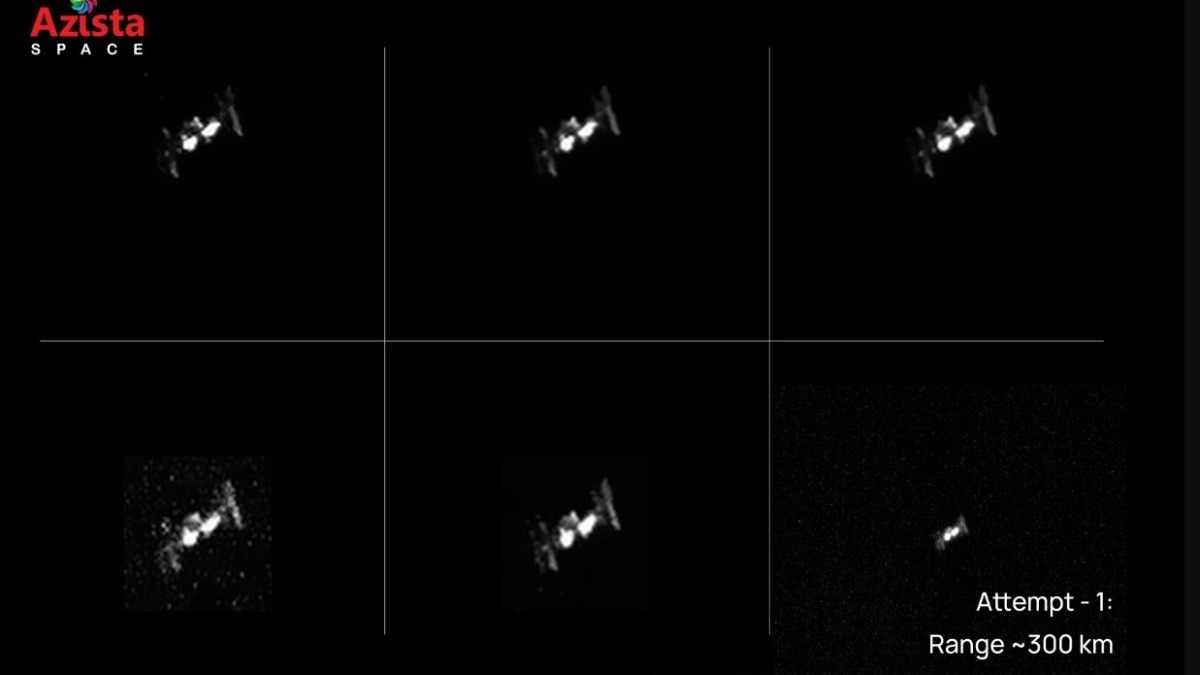
Hyderabad-based Azista Space has successfully imaged the International Space Station (ISS) from its own satellite in orbit, marking a first for India’s private space sector and a key step toward building indigenous space situational awareness capabilities.
The demonstration, conducted on February 3, involved Azista’s Earth-observation satellite AFR tracking and imaging the ISS during two separate passes under near-horizon, sunlit conditions.
Often referred to in the industry as “in-orbit snooping” or space watch, the capability allows one satellite to detect, track and image another object in orbit. Such technologies are increasingly important as Earth’s orbits become crowded with commercial satellites, military platforms and debris.
Imaging a fast-moving target in space
Azista said AFR successfully tracked and imaged the ISS at distances of roughly 300 kilometres in the first attempt and about 245 kilometres in the second. Across the two passes, the satellite captured 15 distinct frames, achieving a ground sampling resolution of about 2.2 metres.
Ground sampling resolution refers to how much physical distance on the target corresponds to a single pixel in the image. At roughly 2.2 metres, the images were sufficient to clearly resolve the ISS’s core structure, validating the sensor’s pointing accuracy and tracking algorithms.
According to the company, both attempts achieved 100% success.
“AFR today supports multiple customers with advanced imaging and remote-sensing solutions and has successfully demonstrated Non-Earth Imaging (NEI) using fully indigenous algorithms and electro-optical systems developed in India,” Srinivas Reddy, managing director of Azista Space, said in a statement. “These technologies form the backbone of our NEI and SSA payloads, enabling precise tracking and characterisation of objects in orbit.”
Non-Earth Imaging refers to observing objects in space rather than imaging the Earth’s surface. Unlike conventional Earth-observation missions, NEI requires satellites to track fast-moving targets against a dark background, often at oblique angles and under rapidly changing lighting conditions.
Why space situational awareness matters
The demonstration is a step toward building space situational awareness (SSA), which involves keeping track of satellites, rocket bodies and debris as they move through orbit.
As satellite numbers grow and geopolitical competition extends into orbit, SSA has become critical for avoiding collisions, protecting national space assets and identifying potentially hostile activity such as close-approach manoeuvres or signal interference.
India currently operates multiple satellites across communications, navigation, Earth observation and strategic missions. Together, these assets represent investments worth thousands of crores of rupees, making timely awareness of nearby orbital activity increasingly important.
While government agencies such as ISRO have previously demonstrated advanced rendezvous, proximity operations and tracking capabilities, Azista’s achievement signals the entry of India’s private sector into a domain traditionally dominated by states.
A small satellite with strategic ambitions
AFR itself weighs about 80 kilograms, placing it in the small-satellite category. Azista describes it as the first satellite in its size and performance class to be designed, built and operated entirely by private industry in India.
The satellite was launched in June 2023 aboard a Falcon 9 rocket as part of SpaceX’s Transporter-8 mission. It has since completed about 2.5 years in orbit and continues to operate nominally, with roughly the same amount of mission life remaining.
Beyond SSA demonstrations, AFR already supports naval surveillance, night-time imaging and video imaging for civilian and defence customers, according to the company.
Pushing toward sharper imagery
Azista said it is now developing next-generation indigenous electro-optical payloads capable of producing images of objects like the ISS at resolutions as fine as 25 centimetres, nearly an order of magnitude sharper than the current demonstration.
Those payloads are expected to be produced at the company’s upcoming electro-optical payload manufacturing facility in Ahmedabad.
“By designing and producing these payloads domestically, we are strengthening India’s ability to independently monitor its space assets, assess potential threats, and safeguard national interests in space without reliance on external systems,” Reddy said.
azista space, space situational awareness, spacetech, space tech startups, ISRO, satellite #Azista #Space #images #International #Space #Station #orbit #boosts #Indias #spacewatch #capabilities1770629405

Azista
azista space
Boosts
capabilities
images
Indias
International
Isro
orbit
satellite
Space
space situational awareness
space tech startups
spacetech
spacewatch
Station