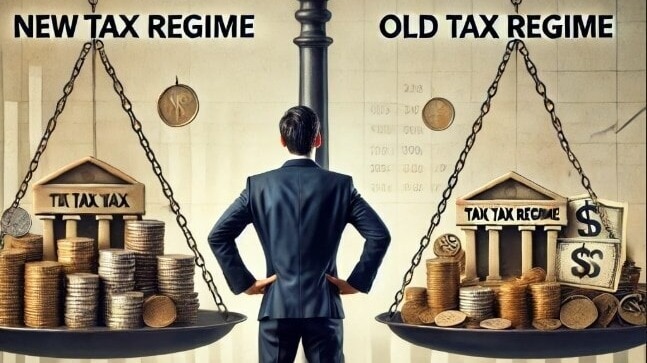
Draft income tax rules: The government has indicated that India’s old tax regime will continue to coexist with the new system, even as a large majority of taxpayers have migrated to the simplified structure. The draft Income-tax Rules, 2026, proposed to take effect from April 1, 2026, and retain several key benefits associated with the old regime, suggesting there is no immediate plan to phase it out.
Tax authorities have reiterated that taxpayers will continue to have the freedom to choose between the two regimes. While the government expects more individuals to eventually shift to the new regime, it has made clear that no sunset date has been fixed for the old system, recognising that certain deductions and exemptions still make it more attractive for many taxpayers.
“The option is available. We are not imposing anything. But we hope and are sure taxpayers will find value in the new regime and move on to it,” Ravi Agrawal, Chairman of the Central Board of Direct Taxes (CBDT), told the Indian Express.
He added that the government would assess the relevance of the old tax regime over time but stressed that no sunset date has been fixed. “The choice is always there for the taxpayer. We don’t have a sunset in mind. Taxpayers have their own reasons to be in the old regime, such as certain deductions that they find more beneficial, even if the new slabs are more attractive,” he said.
Released by the Income Tax Department for public consultation, the draft rules lay down the operational framework for the New Income Tax Act, 2025, which will replace the six-decade-old Income Tax Act, 1961. A key highlight is simplification: the number of rules has been cut to 333 from 511, while forms have been reduced to 190 from 399. However, when it comes to exemptions, allowances and perquisites, the draft rules reflect continuity rather than disruption.
Notably, the draft rules do not draw a sharp distinction between the old and new tax regimes for salary-related benefits. This effectively allows both systems to coexist, preserving the relevance of the old regime for taxpayers who rely on exemptions and deductions.
Old Tax Regime benefits
Several old-regime style benefits continue almost unchanged. These include tax-free employer gifts up to ₹15,000 a year, free meals and refreshments at the workplace within prescribed limits, interest-free or concessional employer loans up to ₹2 lakh, laptops and computers provided for official use, and reimbursement of official travel and work-related expenses with proper documentation. Medical benefits have also been retained, with detailed provisions covering treatment for specified serious diseases in approved hospitals.
Medical exemption rules
The level of detail in the medical exemption rules, covering hospital eligibility, infrastructure norms and an expanded list of diseases, suggests a regulatory intent to preserve these benefits rather than dilute them. Such granular drafting is typically seen as a sign of policy stability.
HRA exemption rules
One of the most significant changes favouring the old regime relates to House Rent Allowance (HRA). The draft rules expand the list of cities eligible for a 50% HRA exemption to include Bengaluru, Hyderabad, Pune and Ahmedabad, in addition to Mumbai, Delhi, Kolkata and Chennai. Other cities will continue to attract a 40% limit. Under the revised framework, HRA exemption will be the lowest of actual HRA received, rent paid minus 10% of salary, or the applicable percentage of salary based on city classification.
Children’s education allowance
Long-pending revisions to allowances have also been proposed. Children’s education allowance has been raised sharply to Rs 3,000 per month per child (for up to two children), while hostel allowance has been increased to Rs 9,000 per month per child. Transport allowance for employees who are blind, deaf and mute, or orthopedically handicapped has been significantly enhanced, with higher limits for metro and non-metro cities, adjusted for dearness allowance.
Foreign tax credit
The draft rules also tighten compliance on foreign income. Claims for foreign tax credit will require certification by a chartered accountant in cases involving companies or where foreign tax paid exceeds Rs 1 lakh, with verification of income, tax payments and treaty eligibility.
For decades, the old tax regime has appealed to middle-class taxpayers due to deductions under sections such as 80C, 80D, HRA, LTA, and benefits on home and education loans. By retaining and updating many of these provisions, the draft rules suggest that the government is recalibrating the old regime to make it more inflation-adjusted and practical, rather than preparing for its sunset.
old tax regime, new draft income tax rules 2026, Does the draft propose removal of old tax regime benefits, Which taxpayers benefit most from the old tax regime, Is the old tax regime still optional, Will ITR filing change for old tax regime taxpayers, old tax regime, advantage old tax regime, old tax regime benefits, draft income tax rules, income tax rules 2026, draft income tax rules 2026, old vs new tax regime, old tax regime exemptions, old tax regime deductions#Advantage #Tax #Regime #Draft #income #tax #rules #system #relevant #taxpayers #note1770777156

advantage
advantage old tax regime
Does the draft propose removal of old tax regime benefits
Draft
Draft Income Tax Rules 2026
Draft Income-tax Rules
Income
Income-tax Rules 2026
Is the old tax regime still optional
new draft income tax rules 2026
Note
old tax regime
old tax regime benefits
old tax regime deductions
old tax regime exemptions
old vs new tax regime
Regime
relevant
Rules
System
Tax
taxpayers
Which taxpayers benefit most from the old tax regime
Will ITR filing change for old tax regime taxpayers