
A couple of weeks ago, I reported that Bing was beta testing a new AI performance report within Bing Webmaster Tools. These reports are now available as a public preview for all to see.
Plus, Bing Webmaster Tools has a whole new slick design. I actually like it a lot.
Microsoft’s Krishna Madhavan, Meenaz Merchant, Fabrice Canel, and Saral Nigam announced:
We are happy to introduce AI Performance in Bing Webmaster Tools, a new set of insights that shows how publisher content appears across Microsoft Copilot, AI-generated summaries in Bing, and select partner integrations. For the first time, you can understand how often your content is cited in generative answers, with clear visibility into which URLs are referenced and how citation activity changes over time.
I was not able to show you what that report looked like, until now, because now anyone can see it at bing.com/webmasters/aiperformance. Here is a screenshot:
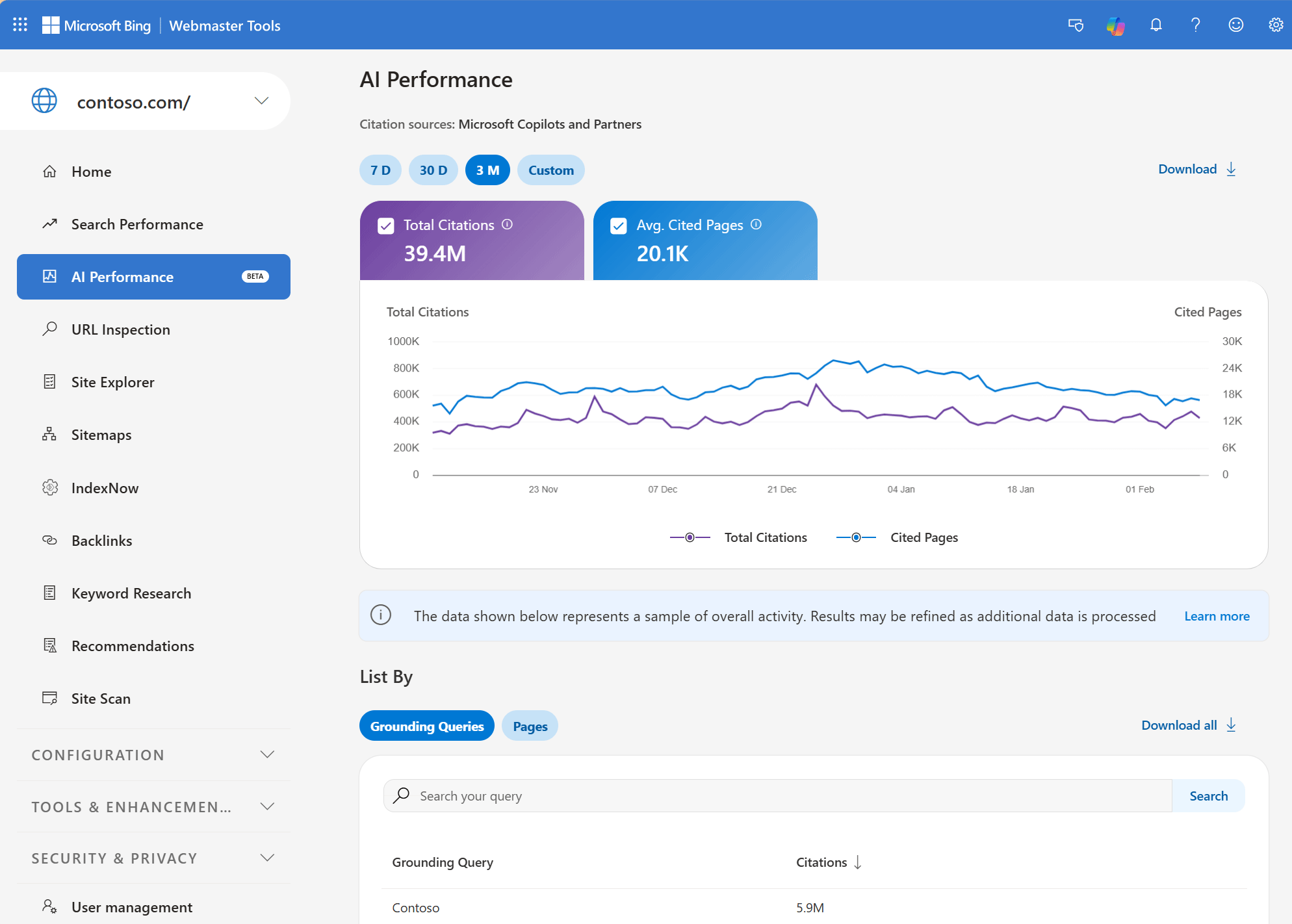
Here is what you see:
- Total Citations: Shows the total number of citations that are displayed as sources in AI-generated answers during the selected time frame. This highlights how often your content is referenced by AI systems, without indicating placement or presentation within a specific answer.
- Average Cited Pages: Shows the average number of unique pages from your site that are displayed as sources in AI-generated answers per day over the selected time range. Because the data is aggregated across supported AI surfaces, average cited pages reflect overall citation patterns and does not indicate ranking, authority, or the role of any page within an individual answer.
- Grounding queries: Shows the key phrases the AI used when retrieving content that was referenced in AI-generated answers. The data shown represents a sample of overall citation activity. We will continue to refine this metric as additional data is processed.
- Page-level citation activity: Shows citation counts for specific URLs from your site, making it easy to see which individual pages are most often referenced across AI-generated answers during the selected date range. This reflects how often pages are cited, not page importance, ranking, or placement.
- Visibility trends over time: The timeline shows how citation activity for your site changes over time across supported AI experiences, making it easier to spot trends at a glance.
And nope, no click data, as I said a couple of weeks ago.
The grounding queries is confusing folks – but those do not seem to be the actual queries users are searching but what Bing uses to “retrieving content that was referenced in AI-generated answers.” So Copilot takes your long query and then breaks it down into shorter ones, it is probably that. But it also seems like that metric is stil being refined by Bing.
Plus, this data is not in the API yet. Fabrice Canel from Microsoft said on X, “With this preview, the data is not yet available via the API. Enabling data in our API is on our backlog, and we’ll take your feedback along with others, into account when prioritizing next release.”
Fabrice Canel from Microsoft said on X, “We just dropped the AI Performance report into public preview in Bing Webmaster Tools.” He did hint that more data is coming, he said, “It’s just a preview, you will get more in 2026.”
Some industry reaction:
OK, they are rolling it out. Here’s the announcement: Introducing AI Performance in Bing Webmaster Tools Public Preview pic.twitter.com/rfsnXkvwG8
— Glenn Gabe (@glenngabe) February 10, 2026
Bing is now giving you grounding queries in Bing Webmaster tools!! Just confirmed, now I gotta understand what we’re getting from them, what it means and how to use it.
Great work @facan and team. I remember when @rustybrick showed that this might be… pic.twitter.com/6QDmsvWmiq
— Wil Reynolds (@wilreynolds) February 10, 2026
We’re excited to share new insights that bring more transparency to the web ecosystem. Publishers can now see how their content shows up in the AI era URLs, grounding queries, and page‑level performance.
GEO meets SEO, power your strategy with real signals https://t.co/FFRAnZkWRC— Fabrice Canel (@facan) February 10, 2026
Getting our first look at real 1st party AI performance data from Bing/CoPilot.
I really hope Google / GPT follows. We need this sort of reporting.https://t.co/YTUFvXLFUW
I just wish Bing/CoPilot actually had users like Google / GPT. pic.twitter.com/mImkWJJKTT
— imnotadoctor (@imnotadoctor) February 10, 2026
🚨 Microsoft is Introducing AI Performance in @bing Webmaster Tools: A new set of insights that shows how sites content appears across Microsoft Copilot, AI-generated summaries in Bing, and select partner integrations 👇
This is the first official AI search visibility… pic.twitter.com/35aRoLVSbD
— Aleyda Solis 🕊️ (@aleyda) February 10, 2026
Microsoft Bing Webmaster Tools has always been more useful and efficient than Google Search Console, and once again, they’ve proven their commitment to transparency.
Microsoft Bing has just launched the AI Performance Dashboard, which introduces “citations” and “cited pages”… pic.twitter.com/hcMOhncW1G
— Koray Tuğberk GÜBÜR (@KorayGubur) February 10, 2026
Google Search Console : We’ve given users a new favicon and custom citations.
Bing Webmaster Tools: Hold my beer… pic.twitter.com/dfn1pJpkzQ
— Nikki Pilkington – non-wanky SEO (@NikkiPilkington) February 11, 2026
Forum discussion at X.
#Bing #Webmaster #Tools #Rolls #Performance #Report #Design1770835458