WooCommerce is approaching a turning point in 2026 thanks to the Model Context Protocol and the convergence of open source technologies that enable it to function as a layer any AI system can plug into, helping store owners and consumers accomplish more with less friction. Automattic’s Director Of Engineering AI, James LePage, discussed what’s possible right now, what’s coming in the near future, and why the current limitations are temporary.
WooCommerce
Because WooCommerce is built on WordPress and is highly extensible through plugins, APIs, and now MCP, it is rapidly evolving into a coordination layer where AI-based systems can plug in and work together through it. Automattic’s James LePage describes this approach as one in which WooCommerce fits perfectly in the center.
Model Context Protocol
Model Context Protocol is an open standard that enables platforms like WooCommerce to connect their capabilities to AI systems, making AI-powered features possible.
While MCP sounds like an API, which enables software systems to communicate, the key difference is that an API handles predefined requests, whereas MCP enables platforms like WooCommerce to support a broader range of AI interactions without building custom integrations for each one.
WooCommerce Sits In The Middle
ACP (Agentic Commerce Protocol), developed by OpenAI and Stripe, enables an AI agent to handle product, discovery, checkout, and payments from a chat interface like ChatGPT.
The UCP (Universal Commerce Protocol), an open source solution developed by Shopify and Google, provides a way for checkouts to happen through a buy button throughout Google’s AI and Search ecosystem as well as Anthropic’s Claude, regardless of whether the transaction is happening on a WooCommerce store or any other shopping platform. A developer only has to implement a UCP-compliant MCP Server for WooCommerce.
WooCommerce sits in the middle of those protocols, where their integrations come together.
Enablement Strategy For WooCommerce
LePage described a practical perspective for how AI fits into the WooCommerce platform through MCP. He calls this approach enablement.
He explains this approach:
“What’s interesting about that is it follows a strategy that we’re taking at WooCommerce, which is what I refer to as enablement, where WooCommerce is this core software, this core way that you run a digital business online.
And we want to make sure that core software is available and always in the middle of whatever’s happening in AI.
So we want to build AI features for it. We want to make it really easy for others to build AI features for it. But we absolutely want to make sure it will meet you wherever your AI tools are, wherever the best financial analysis AI tool exists, wherever the best general chatbot exists.
So to us, MCP represents a really strong opportunity there.”
Because MCP is flexible to whatever AI platform a user is on, WooCommerce is able to remain in the middle, regardless of which AI system a user subscribes to.
Practical Use Of AI In WooCommerce
LePage brought attention to practical uses of AI right now, where users can leverage ChatGPT Connectors and Claude Code from within WooCommerce in order to have multiple apps and AI communicate with each other to accomplish various tasks.
He explains:
“What’s also cool is if you use ChatGPT with connectors, if you use Cloud Code with their MCP support, there’s a lot of opportunity that you get when you add multiple pieces of software to one session.
So if I take my WooCommerce stuff and I take QuickBooks and I take X, Y, and Z, I can interact with all of them in a conversational manner.
And that’s got me very excited, but it’s also got all the merchants really excited.”
AI Is Developer-Facing Infrastructure
While profound AI implementations are quickly coming together for WooCommerce, LePage indicated that, at this moment, the current work is foundational, providing the building blocks that developers and agencies use to make it all work rather than delivering out-of-the-box merchant features today.
The question asked in the podcast was:
“…is that where we are with WooCommerce and AI at the moment is that you do need really a developer to hook it all up and make it work?”
LePage answered:
“So I’d say yes, if you want a really robust AI implementation that’s built and fits like a glove on your store and does everything that you ever want, the pieces are there.”
He later said that there are plugins that can implement some of those functionalities.
Sidekick-Type Functionality
LePage offered an exciting preview of what’s in store in the near future for WooCommerce when asked if WooCommerce will ship with deep native integration of AI similar to Shopify’s Sidekick AI assistant.
Shopify Sidekick is an AI assistant that can be invoked at various points in the store management workflow, enabling store owners to perform creative tasks like transforming product images or creating email marketing campaigns to handling common store management tasks.
The question asked was:
“One thing I’d love to know is what is planned for Core, possibly WordPress as a whole, certainly WooCommerce, in terms of like an interface built into Core, like how Shopify has Sidekick where wherever you are, you can just type what you want and it will do it for you.”
LePage answered that this kind of AI integration will likely be in the form of an extension, explaining that integrating this kind of functionality within core would be good, but doing it with a plugin would be great. He explained that all the pieces for doing this will be in place within core in version 7, which will be released on April 9, 2026.
He shared that WooCommerce will be an orchestration layer, where WooCommerce sits in the middle, directing and coordinating multiple services, tools, and data sources.
He explained:
“…it will work if we made it a very basic implementation in core, or as even like a very basic plugin, but it will be great when we can plug it into things like WooCommerce Analytics, when we can plug it into much more complex orchestration workflows under the hood to go and do things like really bulk product optimization and catalog stuff and analytics and deep number crunching, all of the fun stuff that we’re actually working on as we speak.
So you will see AI support in terms of this Sidekick-type implementation coming out from Automattic in this extension territory. And that extension also housing additional AI features to make it a much more approachable AI experience to merchants.”
Consumer-Facing AI In WooCommerce Stores
Another area discussed in the podcast was consumer-facing AI implementations that introduce more personalization and chat interfaces for retrieving order information or product selection.
At this point, the podcast jumps into agentic AI shopping, which is projected to become a thing between the near future and 2030.
But at the end, LePage circles back to affirming WordPress’s role as the orchestration layer intended to support whatever functionality and vision emerge.
LePage shared:
“These building blocks are intended to make WordPress into a platform where a developer can build any AI solution.”
WordPress and WooCommerce are very much in transition to providing the option of becoming an orchestration layer. While other content management systems are a little further down the road with these kinds of functionalities, WordPress and WooCommerce have a huge developer ecosystem that is already innovating new features that will become more powerful and useful in the very near future.
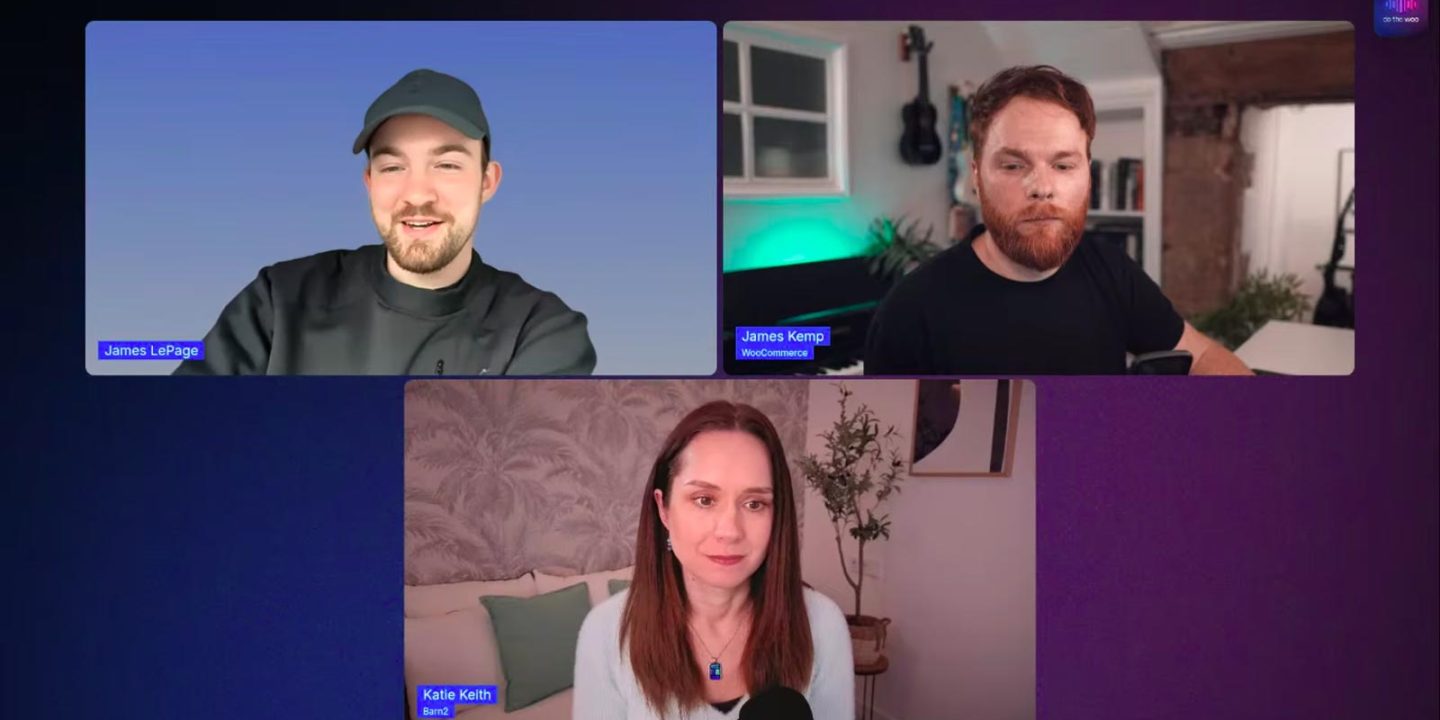
Watch the Do the Woo podcast with hosts Katie Keith and James Kemp:
AI Meets Woo: the Future of Ecommerce is Already Here
Featured Image/Screenshot Of Do the Woo Podcast
News,WordPress#WooCommerce #Gain #SidekickType #Extensions #sejournal #martinibuster1771329236

Recent Post



Gallery






Featured Videos