This post was sponsored by WP Engine. The opinions expressed in this article are the sponsor’s own.
In the race for audience attention, digital marketers at media companies often have one hand tied behind their backs. The mission is clear: drive sustainable revenue, increase engagement, and stay ahead of technological disruptions such as LLMs and AI agents.
Yet, for many media organizations, execution is throttled by a “Sticky-taped stack,” which is a fragile, patchwork legacy CMS structure and ad-hoc plugins. For a digital marketing leader, this isn’t just a technical headache; it’s a direct hit to the bottom line.
It’s time to examine the Fragmentation Tax, and why a new publishing standard is required to reclaim growth.
Fragmentation Tax: How A Siloed CMS, Disconnected Data & Tech Debt Are Costing You Growth
The Fragmentation Tax is the hidden cost of operational inefficiency. It drains budgets, burns out teams, and stunts the ability to scale. For digital marketing and growth leads, this tax is paid in three distinct “currencies”:
1. Siloed Data & Strategic Blindness.
When your ad server, subscriber database, and content tools exist as siloed work streams, you lose the ability to see the full picture of the reader’s journey.
Without integrated attribution, marketers are forced to make strategic pivots based on vanity metrics like generic pageviews rather than true business intelligence, such as conversion funnels or long-term reader retention.
2. The Editorial Velocity Gap.
In the era of breaking news, being second is often the same as being last. If an editorial team is forced into complex, manual workflows because of a fragmented tech stack, content reaches the market too late to capture peak search volume or social trends. This friction creates a culture of caution precisely when marketing needs a culture of velocity to capture organic traffic.
3. Tech Debt vs. Innovation.
Tech debt is the future cost of rework created by choosing “quick-and-dirty” solutions. This is a silent killer of marketing budgets. Every hour an engineering team spends fixing plugin conflicts or managing security fires caused by a cobbled-together infrastructure is an hour stolen from innovation.
The 4 Publishing Pillars That Improve SEO & Monetization
To stop paying this tax, media organizations are moving away from treating their workflows as a collection of disparate parts. Instead, they are adopting a unified system that eliminates the friction between engineering, editorial, and growth.
A modern publishing standard addresses these marketing hurdles through four key operational pillars:
Pillar 1: Automated Governance (Built-In SEO & Tracking Integrity)
Marketing integrity relies on consistency.
In a fragmented system, SEO metadata, tracking pixels, and brand standards are often managed manually, leading to human error.
A unified approach embeds governance directly into the workflow.
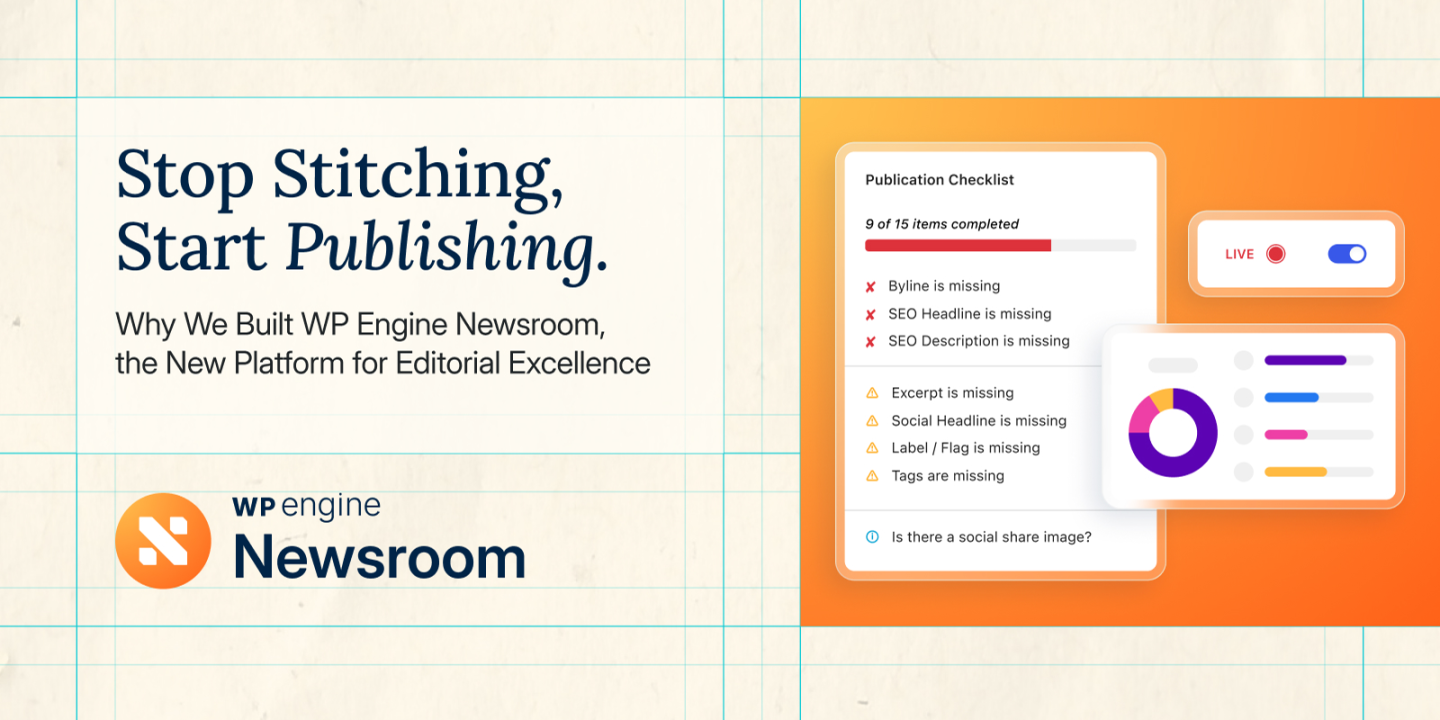
By using automated checklists, organizations ensure that no article goes live until it meets defined standards, protecting the brand and ensuring every piece of content is optimized for discovery from the moment of publication.
Pillar 2: Fearless Iteration (Continuous SEO & CRO Optimization Without Risk)
High-traffic articles are a marketer’s most valuable asset. However, in a legacy stack, updating a live story to include, for instance, a Call-to-Action (CTA), is often a high-risk maneuver that could break site layouts.
A modern unified approach allows for “staged” edits, enabling teams to draft and review iterations on live content without forcing those changes live immediately. This allows for a continuous improvement cycle that protects the user experience and site uptime.
Pillar 3: Cross-Functional Collaboration (Reducing Workflow Bottlenecks Between Editorial, SEO & Engineering)
Any type of technology disruption requires a team to collaborate in real-time. The “Sticky-taped” approach often forces teams to work in separate tools, creating bottlenecks.
A modern unified standard utilizes collaborative editing, separating editorial functions into distinct areas for text, media, and metadata. This allows an SEO specialist or a growth marketer to optimize a story simultaneously with the journalist, ensuring the content is “market-ready” the instant it’s finished.
Pillar 4: Native Breaking News Capabilities (Capturing Real-Time Search Demand)
Late-breaking or real-time events, such as global geopolitical shifts or live sports, require in-the-moment storytelling to keep audiences informed, engaged, and on-site. Traditionally, “Live Blogs” relied on clunky third-party embeds that fragmented user data and slowed page loads.
A unified standard treats breaking news as a native capability, enabling rapid-fire updates that keep the audience glued to the brand’s own domain, maximizing ad impressions and subscription opportunities.
Conclusion: Trading Toil for Agility
Ultimately, shifting to a unified standard is about reducing inefficiencies caused by “fighting the tools.” By removing the technical toil that typically hides insights in siloed tools, media organizations can finally trade operational friction for strategic agility.
When your site’s foundation is solid and fast, editors can hit “publish” without worrying about things breaking. At the same time, marketers can test new ways to grow the audience without waiting weeks for developers to update code. This setup clears the way for everyone to move faster and focus on what actually matters: telling great stories and connecting with readers.
The era of stitching software together with “sticky tape” is over. For modern media companies to thrive amid constant digital disruption, infrastructure must be a launchpad, not a hindrance. By eliminating the Fragmentation Tax, marketing leaders can finally stop surviving and start growing.
Jason Konen is director of product management at WP Engine, a global web enablement company that empowers companies and agencies of all sizes to build, power, manage, and optimize their WordPressⓇ websites and applications with confidence.
Break Free from the Fragmentation Tax
Image Credits
Featured Image: Image by WP Engine. Used with permission.
In-Post Images: Image by WP Engine. Used with permission.
SEO,Sponsored Posts,Technical SEO,Vertical SEO,WordPress#Pillars #Turn #StickyTaped #Tech #Stack #Modern #Publishing #Engine1771358713