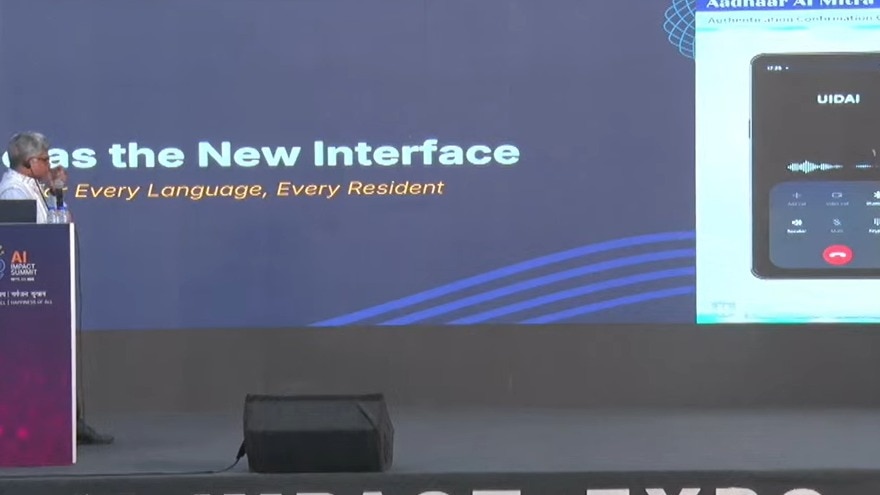
Barada Prasad Sabut, Head of Engineering of the Unique Identification Authority of India (UIDAI) on Wednesday, spoke about what he described as an “identity paradox” emerging in the age of Artificial Intelligence, warning that rapidly advancing deception technologies could challenge trust in digital identity systems.
Speaking at the AI Impact Summit 2026, Sabut said identity verification for centuries relied on physical presence — seeing a person, matching a signature on a cheque or verifying a photograph on an identity card. However, he noted that AI has industrialised deception.
“With the advent of internet, identity verification shifted from physical domain to a remote kind of verification. The verifiability context came into the play. Like if I can verify a biometric which is being offered whether in front of an assisted mode or in a remote process, I trust that person. Along with the verifiability also came deception,” the UIDAI official said.
He, however, acknowledged that a certain amount of deception had always existed. “When the physical presence was getting trusted, that time also deception was there. With the remote verification also deception was there. But what happened with AI? The deception technique became industrialised – the way the fake voice fake biometrics fake facial image that is getting generated. I wouldn’t be wrong if I say that the deception technology has matured well and well ahead of it the time,” he added.
Sabut said inclusivity remains one of the hardest challenges for any identity platform, particularly Aadhaar, which forms the foundation of India’s digital public infrastructure.
He noted that UIDAI’s AI models are trained on India’s diverse demographics to reduce bias, but acknowledged that certain groups are still unable to fully access features such as face authentication.
He called for industry collaboration to make such technologies more inclusive.
On privacy concerns, Sabut said that while UIDAI holds one of the world’s largest biometric databases, covering more than 140 crore Aadhaar holders, the data is not freely available for training AI models.
He emphasised that the authority follows principles of data minimisation and has guardrails in place to ensure responsible use. He also urged the technology community to develop privacy-preserving solutions that can enable innovation without compromising citizen data.
Sabut underlined that trust is central to Aadhaar’s functioning, as banks and other authentication user agencies rely on UIDAI’s responses for verification.
As AI evolves, he said, that trust must not only be preserved but strengthened, even as the system operates at population scale and with minimal latency.
Highlighting UIDAI’s own use of AI, Sabut said the authority began leveraging the technology in 2019, including deploying fingerprint liveness detection at scale. Today, every fingerprint submitted for authentication undergoes liveness checks. AI is also being used to detect fraud in biometric capture, including fingerprint, face and iris data.
He added that traditional biometric deduplication technologies are increasingly being replaced by AI-based machine learning models, which must be secure, unbiased and reliable.
Sabut also spoke about challenges in verifying documents submitted during enrolment and updates, especially given the diversity of languages. He said AI-driven document processing and optical character recognition tools are being explored to ensure accurate and trusted onboarding.
On the voice front, he said UIDAI is using sovereign AI models developed in India to communicate with residents in their local languages and dialects.
In cases of suspicious authentication attempts, the system can reach out to residents through voice-based confirmation to verify whether the activity is genuine.
Calling AI both a threat and an opportunity, Sabut said UIDAI is seeking closer collaboration with industry partners to develop next-generation fraud detection systems and ensure that India’s identity platform remains secure in the face of evolving AI-driven risks.
UIDAI, Aadhaar, artificial intelligence, digital identity, biometric security, AI fraud detection, India digital infrastructure, identity verification, data privacy, AI challenges, AI inclusivity, voice authentication#039AI #industrialised #deception039 #UIDAI #official #Impact #Summit1771441463

039AI
Aadhaar
AI challenges
AI fraud detection
AI inclusivity
Artificial intelligence
biometric security
data privacy
deception039
digital identity
identity verification
Impact
India digital infrastructure
industrialised
Official
Summit
UIDAI
voice authentication
Recent Post



Gallery






Featured Videos