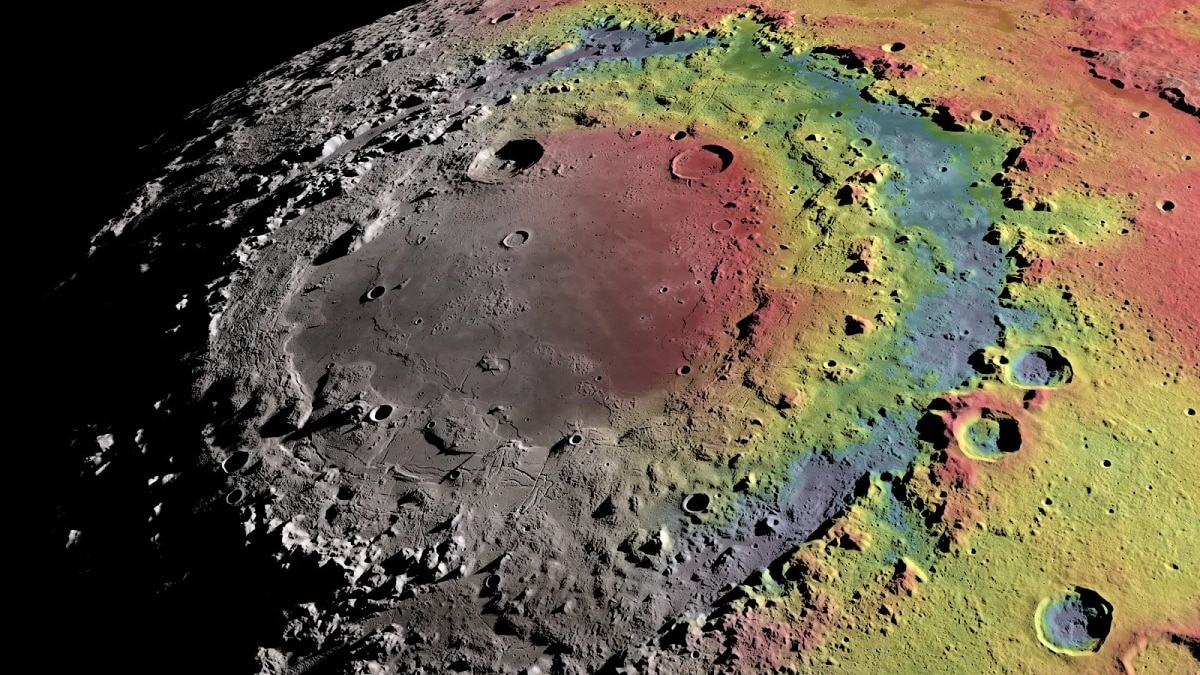
In a historic moment for lunar exploration, astronauts aboard the Artemis II mission have captured the first-ever images of the Moon’s dramatic Orientale Basin taken by human observers. The photographs, taken on April 5, 2026, reveal the enormous impact structure on the Moon’s far western limb, marking a milestone in humanity’s renewed return to deep-space exploration.
The images were shared by NASA on its social media platform X, highlighting the scientific significance of the sighting.
“History in the making. In this new image from our @NASAArtemis II crew, you can see Orientale basin on the right edge of the lunar disk. This mission marks the first time the entire basin has been seen with human eyes,” the agency wrote.
A rare view of a lunar giant
The Orientale Basin, often referred as the “Grand Canyon of the Moon,” is one of the largest and best-preserved impact basins in the solar system. Spanning roughly 950 km, the immense structure sits near the Moon’s western edge, making it difficult to observe fully from Earth.
Also read: Why NASA’s Artemis II crew calls their Orion spacecraft ‘Integrity’
While robotic spacecraft have previously imaged the region, the view captured during the Artemis II flyby marks the first time astronauts have directly seen and photographed the entire basin.
For scientists, the moment is more than symbolic — it provides a unique observational perspective that could help refine understanding of lunar geology and the violent impacts that shaped the early solar system.
Relic of the solar system’s violent past
The basin formed approximately 3.8 billion years ago, during the final phase of the period known as the Late Heavy Bombardment, when asteroids and comets frequently struck the inner planets.
Unlike simple craters, the Orientale Basin is a multi-ring impact structure, resembling a giant bullseye across the lunar surface. Scientists believe its concentric rings formed after a colossal asteroid — estimated to be about 40 miles (64 km) wide — slammed into the Moon.
Also read: From Apollo’s last step to Artemis’ next leap
Computer models suggest the impact blasted around 816,000 cubic miles (3.4 million cubic kilometres) of lunar material into space — roughly 135 times the combined volume of Earth’s Great Lakes.
The force of the collision caused the Moon’s crust to rebound violently. The original crater collapsed almost instantly, producing the distinctive rings seen today.
A cosmic tidal wave
Researchers estimate that debris thrown into the sky during the impact surged upward as high as 100 kilometres above the lunar surface — more than 11 times the height of Mount Everest.
The ejected material then fell back in a massive cascade, generating deep faults that may have cut through the Moon’s crust and reached its mantle. The lunar surface continued to oscillate like liquid for nearly two hours, gradually settling into the basin’s outer rings.
The innermost ring is believed to have formed when a towering central peak — created immediately after the impact — collapsed under its own immense weight.
A window into lunar evolution
Today, the basin’s floor is believed to be covered with solidified impact melt, material that was once molten during the catastrophic collision. Scientists consider Orientale one of the most important natural laboratories for studying how large impact basins form and how planetary surfaces evolve.
Because the structure remains unusually well preserved, researchers say it offers a rare glimpse into processes that shaped not just the Moon, but rocky worlds across the solar system.
With the Artemis II astronauts now documenting the region directly, scientists hope the observations will guide future missions — including potential landing sites under NASA’s broader Artemis programme.
Artemis II mission, Orientale Basin, NASA Artemis program, Moon impact basin, lunar exploration, Late Heavy Bombardment, Moon geology discovery, human view of the Moon, Artemis astronauts, Moon flyby mission#History #making #Artemis #captures #human #images #Moons #Orientale #Basin1775418717

Artemis
Artemis astronauts
Artemis II mission
basin
captures
history
human
human view of the Moon
images
Late Heavy Bombardment
lunar exploration
making
Moon flyby mission
Moon geology discovery
Moon impact basin
Moons
NASA Artemis program
Orientale
Orientale Basin