Creating video content takes time and budget, so understanding how it performs is critical.
YouTube’s native analytics in YouTube Studio are robust, but they’re locked behind account access. That can make reporting difficult — especially when you need to share data or don’t have direct login access.
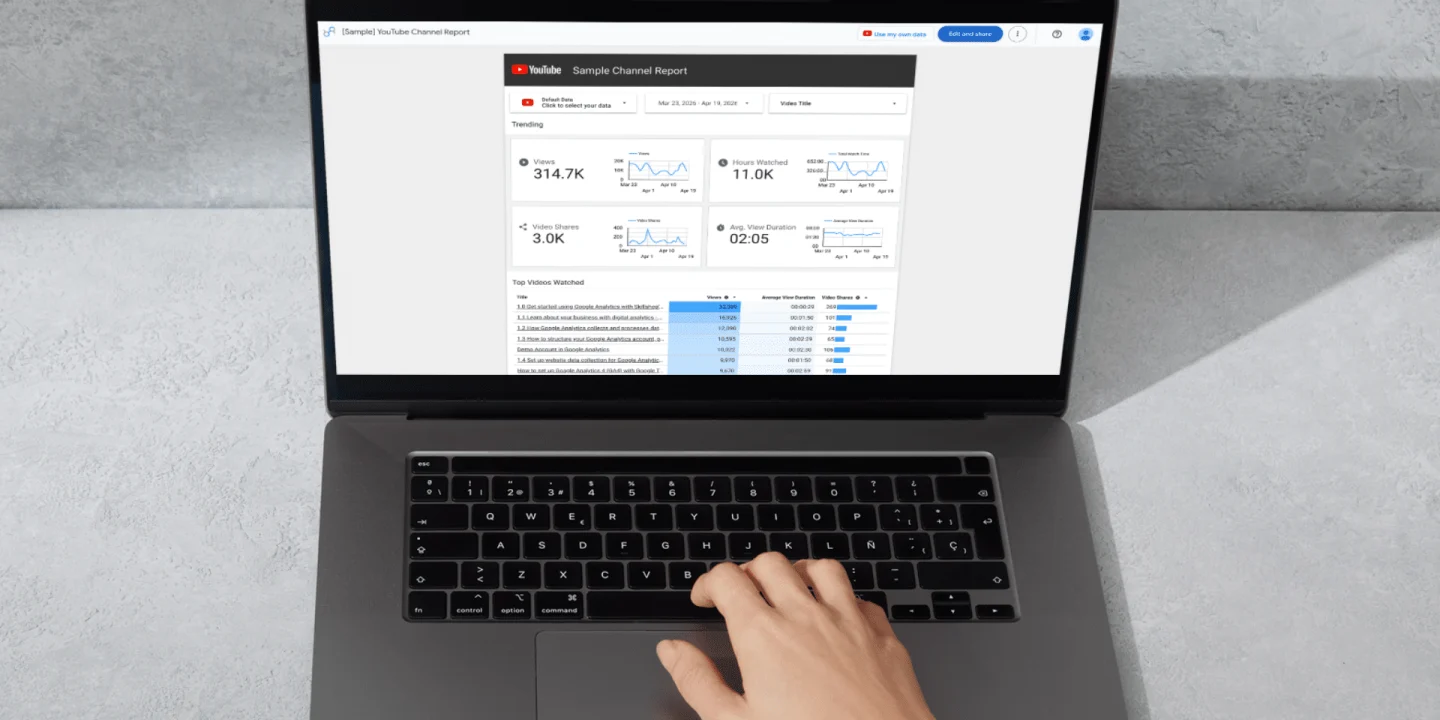
Moving that data into Google Data Studio (formerly Looker Studio) makes it easier to analyze and distribute.
With Data Studio, you can:
- Pull YouTube data into reports you already use.
- Schedule automated updates for stakeholders.
- Customize dashboards around the metrics that matter.
- Track performance without relying on backend access.
Here’s how to pull your YouTube analytics into a Data Studio report.
Using a template or starting from scratch
You have two options when setting up a YouTube report in Data Studio.
- If you want something quick and easy, you can use Google’s YouTube Analytics template from their template gallery. It’s a great place to start because it provides a clean, well-designed report with foundational metrics and puts you in a good position to understand which metrics are available. But know that this template has problems you’ll need to fix, which I’ll discuss below.
- The other option is to create a report from scratch, which is a great choice if you already have a report you want to add a new YouTube Analytics page to, or if you just want to learn how to use Data Studio.
The information below will help you do both.
Your customers search everywhere. Make sure your brand shows up.
The SEO toolkit you know, plus the AI visibility data you need.
Start Free Trial
Get started with

If you’re not the YouTube account owner
If you’re setting up this report for a client, or if you’re not the owner of the YouTube account, you’re going to run into an issue where the YouTube account doesn’t show up as a usable source in Data Studio. Here’s how to get around it:
- Go to YouTube Studio settings > Permissions, and give Manager permissions to the account email that you’re using in Data Studio.
- Get the Channel ID from the channel’s YouTube URL.
- Add a YouTube connector to Data Studio, go to Advanced, and paste the Channel ID.

You should now have access to that YouTube account.
Using the Data Studio YouTube Analytics template
From the Data Studio home page, click Templates > Template Gallery. Under the category dropdown, click on YouTube Analytics.

Clicking this will create a brand new Data Studio report that’s mostly ready to use. It loads up with sample data from the Google Analytics YouTube channel. Click the button at the top that says “Use my own data.”

The first time you set up a report, you need to authorize access to your data. Click the Authorize button.

Choose the Google Account connected to your YouTube channel, and then you’ll see any connected channels in the dropdown at the top of the page.

You’ll notice that the data doesn’t change when you select a site here. That’s because this dropdown is connected only to the other dropdowns next to it, not any of the charts on the page.

To update everything else on the page, click the Edit and Share button.

If this is the first time using Data Studio, you’ll also need to do some basic account setup.

Then click the Edit button at the top of the page.

Now you’ll need to add your YouTube channel as a source. Click the Add data button and then search for the YouTube Analytics connector.

If the Google Account is the owner of the YouTube account you connected to this Data Studio report, it’ll show up in the Channel section as an option.
Your main YouTube channel will be in the My Channel tab, and other channels are in the All Channels tab, as shown below.
If you don’t own the channel, see the section above to connect other channels that you don’t own, but have access to.

Now you’ll be able to change the data source on any charts on the page. Simply click a chart, and you’ll see the data sources available to you in the right Properties panel.

You can change the source of all of the charts on the page by selecting a chart, right-clicking on it, going to the Select menu, and then choosing “Charts with this data source on page” and then choosing your data source in the Properties sidebar.
You’re mostly done, but as mentioned earlier, there are some errors in this report that you’ll need to fix. The charts at the bottom of the report are using the wrong metrics.
I don’t know why Google hasn’t updated this template. It’s been like this for a long time, so I don’t know if they ever will. In the meantime, you’ll need to update the following.
Change:
- Likes from “Average Watch Time” to “Video Likes Added”
- Subscriptions from “Video Link” to “User Subscriptions Added”
- Dislikes from “Average View Percentage” to “Video Dislikes Added”
The charts in the Comments section are correct, so you don’t need to change anything there.

Click on each of the charts highlighted above, one by one, and change the metric in the Properties sidebar.

And now the report is finished and ready to use. Click the View button at the top of the page to view the report in a view-only format.
Get the newsletter search marketers rely on.
Copying a template into an existing report
Data Studio doesn’t support the ability to add or import templates into an existing report, but you can copy a page from one report to another. Follow the steps above to create a report using the YouTube Analytics Channel template, then copy it into another report.
To do that, go into Edit mode, select all (Ctrl+A or Cmd+A), and copy all (Ctrl+C or Cmd+C). Then, in your existing report, create a new page, and paste everything you’ve copied into the page (Ctrl+V or Cmd+V), or right-click on the page and select Paste.

All of the charts will likely come in broken, but you can easily update them using the tip mentioned earlier – right-clicking a chart, choosing Charts with this data source on page, and then choosing the correct source in the Properties sidebar.
Customizing your report
The YouTube template in Data Studio has most of what you need, but you can add much more.
There are some metrics you simply can’t get in Data Studio that you’d find in the official YouTube Analytics backend, such as revenue, how viewers find your videos, watch behavior, popular viewing times, device types, genders, and retention, so there are some big limitations, but there’s still plenty to work with.
To add more charts to your report, you’ll need to create more space at the bottom. In the menu, click on Page > Current page settings.
In the Style tab of the Current Page Settings sidebar, set the canvas size to something like 3,000 pixels. This will give you plenty of space to work with, and you can always shorten or lengthen it as needed later.

Now you can add many types of charts with a wide range of dimensions and metrics.

You can add multiple metrics to graphs to get the data you need for better analysis. You can also rename headers to clean them up, and make them look less cluttered.

You can pull in quite a lot of data. Here’s what’s currently offered:

Using Data Studio for ongoing YouTube reporting
Setting up a Data Studio report for YouTube is a great way to track your top-level metrics, and can be especially useful for monthly client reporting. It takes siloed, hard-to-share data from YouTube, and puts it into a clean, automated, centralized tool for easier decision-making.
You can also set up scheduling so that Data Studio sends automated PDF exports to your email.
That’s it. As you can see, it’s fairly simple to set up, but you can also add more advanced customizations to track many other KPIs.
Contributing authors are invited to create content for Search Engine Land and are chosen for their expertise and contribution to the search community. Our contributors work under the oversight of the editorial staff and contributions are checked for quality and relevance to our readers. Search Engine Land is owned by Semrush. Contributor was not asked to make any direct or indirect mentions of Semrush. The opinions they express are their own.
Opinion#build #YouTube #analytics #report #Data #Studio1777052110