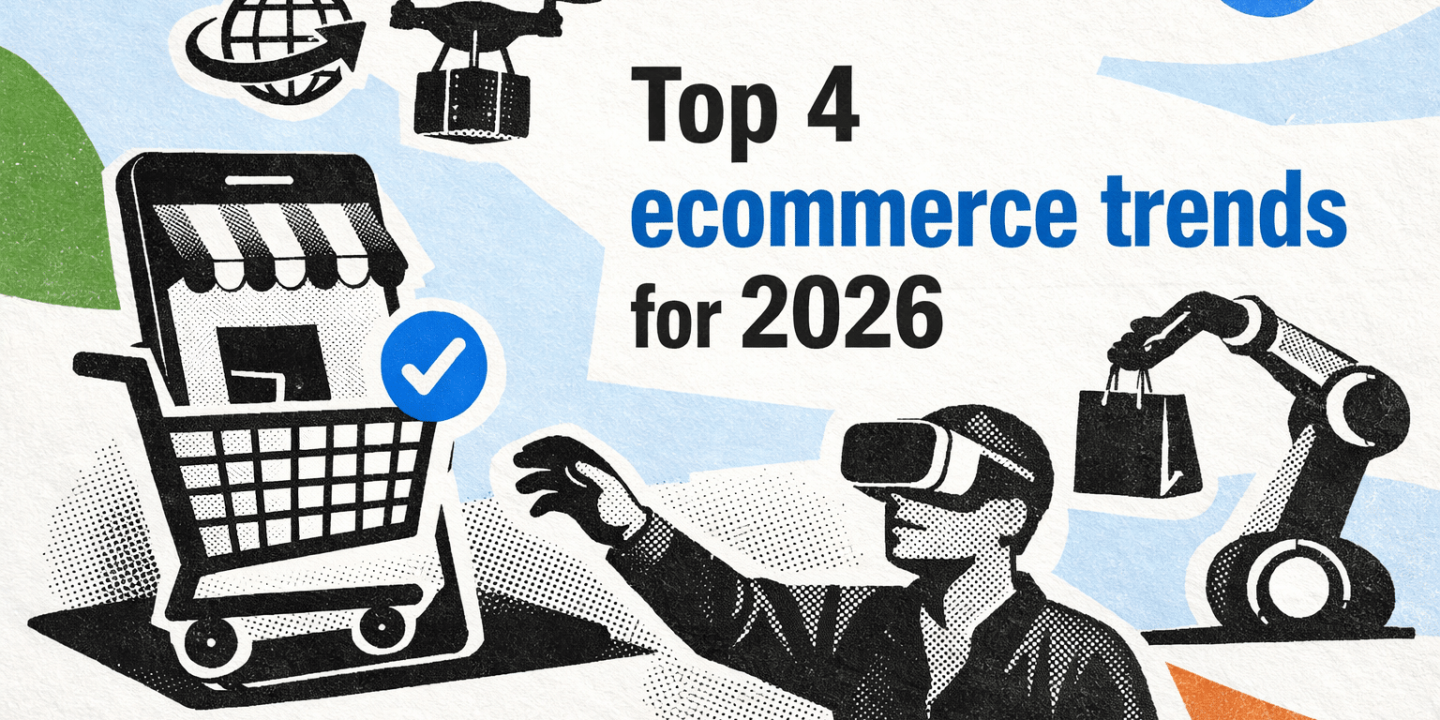
Consumers and brands are reimagining ecommerce in 2026.
With more shopping options and tools than ever before, consumers are making the most of where and how they shop. Some are doubling down on TikTok Shop, while others are trying out new technology like AI.
Your customers search everywhere. Make sure your brand shows up.
The SEO toolkit you know, plus the AI visibility data you need.
Start Free Trial
Get started with

Brands that want to stay competitive are creating end-to-end infrastructure that presents one seamless, personalized experience to the consumer. This type of strategy relies on unified backend systems fed by data from customer service, marketing, and in-store locations.
These four ecommerce trends summarize the most important shifts happening this year. Here’s what you need to know today.
1. The growing role of AI agents
Exploding Topics data shows search interest in “AI agent” has tripled in the past year.

A growing number of consumers already trust AI to pick out products, and surveys indicate that agentic shopping is likely to be the next big shift in consumer behavior.
For example, Akeneo reports that almost half of Americans in 2025 said their ecommerce purchases had been influenced by AI recommendations, and nearly one-third of US shoppers said they’d used ChatGPT on their way to making a purchase.
Data from Adobe echoes this survey, showing traffic from AI engines to retail sites was up 4,700% YoY as of July 2025.

Consumers say one of the main benefits of using AI for shopping is efficiency. More than 30% of shoppers say AI speeds up the shopping process.

Right now, about one-third of consumers say they’d let AI make a purchase on their behalf, but as AI features and safeguards improve, watch for that number to climb.
This means that ecommerce brands are no longer just marketing to humans; they’re marketing to AI algorithms too.
Implementing strategies like answer engine optimization (AEO), schema markup, and agentic checkout modules will ensure that AI engines can find your brand, understand your brand, and buy from your brand.
During the past few years, brands have focused on improving omnichannel customer experiences. This unified the shopping experience between physical stores and ecommerce shopping.

But, for many retailers, the results have been disappointing. The frontend and backend are operating in silos. This traps critical data regarding inventory, customer behavior, and core analytics.
In this coming year, look for retailers to trade in omnichannel strategies and pick up unified commerce platforms. These platforms merge the front-end and back-end of operations so that data flows across channels in real time. The entire tech stack is included, from in-store POS systems to mobile commerce technology to marketing platforms.
However, unified commerce is still a work in progress for most companies.
Only about half of retailers with annual revenue over $150 million currently have the technology they need to fully support their unified commerce goals, according to a survey from Bain & Company.
But those ecommerce retailers that have successfully implemented unified commerce solutions are seeing results across their operations. Shopify reports that adopting a unified commerce approach increases annual sales by an average of nearly 9%.

3. TikTok’s continued dominance
Social commerce makes up about 7% of total ecommerce, but that number is growing and predicted to hit nearly 10% by 2029. Much of that growth can be attributed to TikTok. In 2024, TikTok Shop sales grew by more than 400%. Last year, sales grew by another 108%, reaching a total of $15.82B. This year is likely to be even bigger.

TikTok continues to be one of the most critical marketing channels for successful ecommerce brands.
Take Based Bodyworks, for example. It’s a digital-first brand focused on men’s self-care. Search interest in the brand has grown by more than 570% in the past two years.

The brand’s founder, Lance Baker, has 1.6M TikTok followers, while the brand’s main TikTok page has 3M followers. In February, the brand brought in $5M in sales from TikTok Shop, which put it in the top five TikTok beauty brands of the month.
The dominance of TikTok Shop is likely to drive marketers to take advantage of TikTok-specific analytics platforms, like Countik, FastMoss, and Kalodata. Search interest in each of these platforms has more than doubled in the past 24 months.

For the past few years, there’s been a lot of buzz about livestream shopping but very little true implementation by ecommerce brands in the US. It has been a dominant retail channel in China since 2018, bringing in about $1.2T in sales last year. That’s massive compared to the $120B in sales generated by US livestream shopping in 2025.

However, with its unique blend of real-time entertainment, product discovery, and purchasing, livestream shopping could have a big year in 2026. Data from eMarketer shows that the number of livestream buyers jumped more than 21% YoY in 2025. Social media platforms and Amazon Live are the main sites for live shopping in the US right now, but eBay Live has been gaining momentum since the middle of 2025.
There’s also Whatnot, a standalone livestream shopping platform that launched in late 2019. Consumers made more than $6B in purchases on Whatnot in 2025. Google search volume for the platform could surpass 1M monthly searches by the end of this year.

The startup recently raised $265M at a valuation of nearly $5B.
In all, estimates show that livestream shopping in the US could hit a 47% CAGR and reach $680B by 2030.
Making the trends work for your brand
The most important ecommerce trends of 2026 reflect the shrinking distance between brands and consumers, made possible by advanced data capabilities and AI.
See the complete picture of your search visibility.
Track, optimize, and win in Google and AI search from one platform.
Start Free Trial
Get started with
Brands are empowered by two central developments: more sophisticated, personalized, and frequent touchpoints with consumers, and more detailed, accurate, and reliable data that paints a picture of the entire customer lifecycle.
To win customers and keep your competitors at bay, you need to both own your customer knowledge and act on it. Drive conversions by serving up the perfect, data-driven experiences to customers at the right time, and you’ll gain a loyal base prone to repeat purchases and even referrals.
#Top #ecommerce #trends1777419328