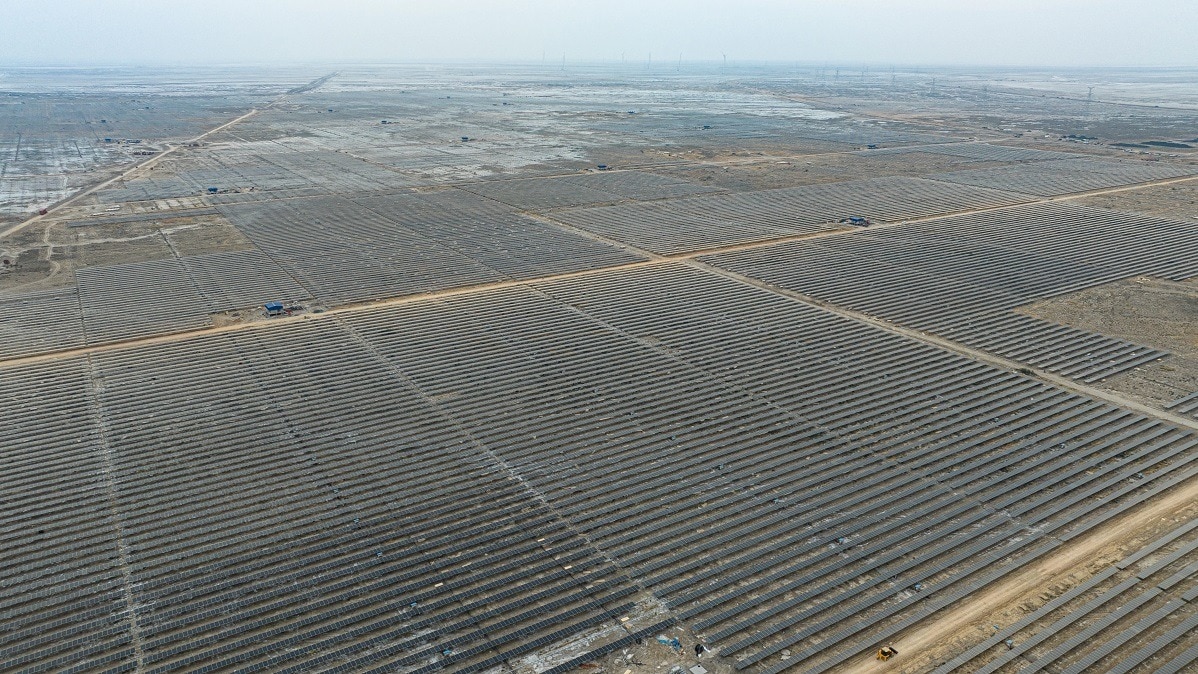
Just 50 km from the India-Pakistan border, a vast, desolate stretch of the Thar desert is transforming into the epicenter of India’s green energy ambitions. The Khavda renewable energy project spans 726 sq km of saline marshland — an area five times the size of Paris. Once a barren no-man’s land, this heavily secured zone now hosts a massive infrastructure blitz capable of generating a staggering 45GW of power, with 30GW slated for the national grid by FY30.
Security here is tight. A three-hour drive from Bhuj city, the site sits in such close proximity to the western border that visitors require special permits to enter. The area’s strategic vulnerability was highlighted in May 2025, when drone intrusions were recorded during Operation Sindoor.
Viewed from an elevated watchtower at the edge of the site, the true scale of the project comes into focus. Giant wind turbines, sprawling solar fields, and advanced battery units converge into a single frame, charting a highly ambitious, matter-of-fact reality of India’s march toward clean energy.
Today, the project has completely reshaped the local landscape, triggering massive infrastructure development along the border posts, including heavy-duty roads that now accommodate hundreds of salt-laden trucks alongside energy transport vehicles.
A drive through the project reveals a surreal landscape where massive wind turbines, endless solar arrays, and high-voltage transmission lines stretch to the horizon. During hot afternoons, intense dust storms frequently whip across the plains, turning the visibility hazy but doing little to slow down operations. While public and private players like NTPC and Coal India hold stakes in the site, Adani Green Energy emerges as the dominant force driving the development.
The Khavda facility boasts a series of global and national milestones. It is the world’s largest renewable energy plant and features India’s largest 5.2 MW wind turbine technology. Adani’s specific footprint within the hub will comprise 4GW of wind energy and 26GW of solar power.
Out of a planned 770 wind turbines, 420 are already operational. The structures are massive engineering marvels, featuring a 160-meter rotor diameter, a swept area of 20,106 square meters, and a tip height of 200 meters — making them some of the most powerful onshore turbines on earth.
Moreover, Adani Wind, a subsidiary of Adani New Industries Limited (ANIL), recently received type certification from WindGuard GmbH, clearing the path for series production targeting global markets.
To combat the inherent intermittency of renewable power, the site houses the largest battery storage setup outside China, currently standing at 3.37 GWh — constructed in a record eight months. Adani plans to add 14 gigawatt-hours (GWh) of battery storage this fiscal year, scaling it up to 50 GWh over the next five years.
This aggressive expansion aligns with the wider group’s growth; earlier in April, Adani Group reported a 35% year-on-year surge in operational capacity to 19.3 GW in FY26, having added 5.1 GW of greenfield renewable capacity. Notably, Khavda alone accounted for 4,613 MW of that operationalized capacity across solar, wind, and hybrid projects.
Building at this scale under extreme environmental conditions presents severe challenges. Engineers must erect infrastructure on shifting, saline marshland, where individual windmills weigh up to 650 metric tonnes. Summer temperatures regularly touch 50 degrees Celsius. The site currently supports a workforce of 15,000 laborers who live in specialized tin-roofed camps.
The extreme weather also tests the delicate technology. The battery storage systems, mostly imported from China, require precise climate tuning to maintain efficiency. Because the battery energy storage systems are in their first operational year, the company is monitoring every variable closely to ensure stability in the harsh climate.
“All climatic conditions and parameters are monitored closely. There are internal cooling systems like ACs that automatically turn on when the system reaches a temperature threshold and these are powered by renewable sources,” said Rajat Seksaria, CEO, Battery Energy Storage and Green Hydrogen, Adani Group.
Renewable energy, green infrastructure, solar power, wind turbines, battery storage, sustainability, clean tech, engineering, border development#times #Paris #worlds #largest #renewable #energy #project #IndiaPakistan #border1781435769

battery storage
Border
border development
clean tech
Energy
Engineering
green infrastructure
IndiaPakistan
largest
Paris
project
Renewable
renewable energy
solar power
Sustainability
times
wind turbines
worlds