This post was sponsored by Peec AI. The opinions expressed in this article are the sponsor’s own.
Which prompts should I prioritize tracking for AI visibility?
Does exact wording change which brands AI engines recommend?
Do I need to track every way someone might phrase a prompt in AI search?
Marketers often panic about the infinite ways users might phrase questions to AI engines. But a recent study from Peec AI reveals a much more predictable reality.
How Prompt Wording Impacts AI Brand Visibility
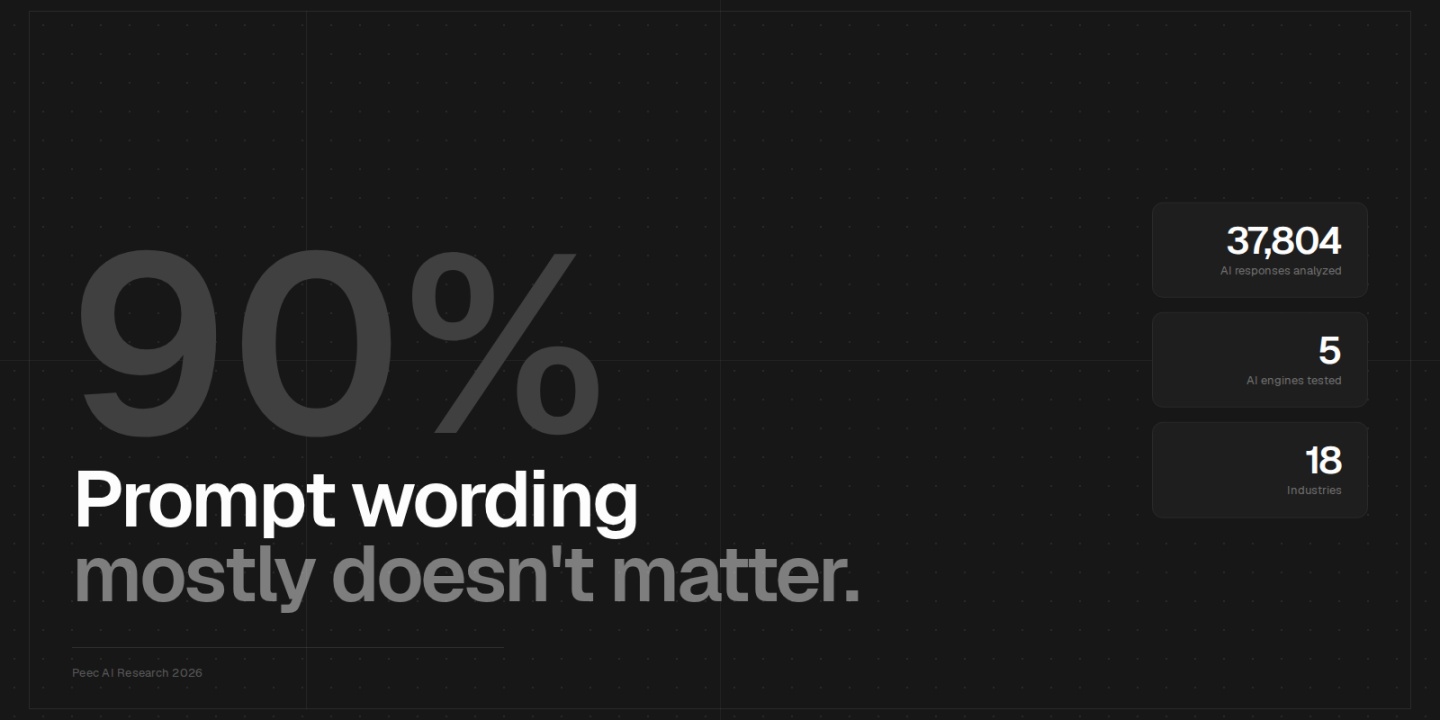
- Variation is limited, not chaotic: users phrase things differently. But over 90% of those variations have very similar meaning.
- Wording matters less than intent: you don’t need to worry about the exact words used. Brand mentions hold steady as long as the core intention stays the same.
- Style matters as much as meaning: concise keywords or “list” requests prompted the AI to surface up to 20% more brands in its answers compared to open-ended prompts.
- Wording Variation Hits Hardest in the Middle-of-Funnel: top- and bottom-of-funnel queries are relatively stable against phrasing tweaks. Unbranded, commercial middle-of-funnel discovery is less. Because wording variation dictates winners here, capturing reality requires absolute phrasing precision and potentially a larger share of your tracking volume.
Two people can ask an AI the exact same commercial question using completely different words.
One asks for the “best noise-cancelling headphones under $200.” Another asks, “Which budget over-ear headphones have good noise reduction?” The wording changes. The underlying need mostly does not.
This distinction matters for AI brand visibility. On the surface, user phrasing looks chaotic. Under the surface, these questions are close in meaning – until they drift just far enough to trigger a completely different set of brands.
To find that breaking point, Peec AI analyzed 1,754 prompts, 37,804 AI responses, five sectors, and 18 sub verticals across ChatGPT, Gemini, Perplexity, Google AI Mode, and Google AI Overviews.
Methodology: How We Tested This
If your tracking tool says you show up for a specific query, does that visibility hold up when a real user types a variation with the exact same intent?
To measure this drop-off, we ran two parallel studies.
- Study A: 288 human-written prompts from Rand Fishkin’s followers for two different intents, resulting in 17k+ chats. The authors thank Rand for making the dataset available to us.
- Study B: 54 base prompts from 18 different verticals. For each we generated dozens of variations in tiny cosine-similarity steps, resulting in 1k+ total prompts and 20k+ chats.

Study A gives us a glimpse into how varied the prompting style of humans is. Study B allows us to observe the impact of tiny changes in prompts.
In study A we analyzed the difference between every pair of prompts (within each intent). In study B we analyzed the difference introduced by every small step (within each industry and intent).
Please note: we ran every prompt multiple times to account for the inherent variance of LLM responses.

Why Tracking Keywords Misses How People Actually Prompt
In AI search, exact keyword matching only plays a minor role. “CRM software” and “customer relationship management tool” share almost no characters but point at the same goal.
To measure this, we converted every prompt into a semantic embedding. We quantified the semantic distance using cosine similarity, which evaluates meaning rather than raw text length. Applying this to the human-written prompts yielded a precise similarity value between 0 and 1.

Instead of guessing how different two prompts are, we can quantify the semantic distance.
Insight 1: Human Prompts Only Look Different On The Surface (Mostly)
We used two different embedding models on the 288 human-written prompts (all-MiniLM-L6-v2 and all-mpnet-base-v2). Both showed the exact same pattern: most human prompts clustered tightly with high cosine similarity. People use different words to express the exact same intent. The percentage of prompts showing large semantic drift was surprisingly small – accounting for less than 10% of the variations.

- ~88% to 92% of human prompt pairs sat above a cosine similarity of 0.50.
- ~95% sat above 0.40.
The takeaway: People phrase the same commercial need in many different ways. But mathematically, most of those phrasings end up being fundamentally similar.
Insight 2: Changes in Wording Only Impacts Brand Mentions Past a Threshold
In study A we took all the brands mentioned during all the runs of the base prompt. We then observed how the average visibility of all these prompts changes when changing the prompt in tiny steps.
Against a near-identical reference group, the average probability of a brand being mentioned across our dataset was 4.9%. However, when prompts drifted into the lowest similarity bin (0.35 to 0.39), visibility dropped by 2.40 percentage points (pp) – a roughly 50% relative decrease.

That is a massive drop, but notice where it lives: entirely in the left tail.
As long as prompts stayed above 0.50 to 0.60 cosine similarity, depending on the AI Engine, brand visibility remained stable. While AI outputs inherently fluctuate, the largest wording-driven visibility losses only happen when a prompt’s core meaning drifts significantly. Because most humans naturally type well above that threshold, prompt tracking exposure to this risk is narrower than it seems.
The takeaway: Prompts with the same intent and same semantic characteristics largely lead to mentions of the same brands at the same frequency.
Beware Of The Semantic Blind Spot!
High similarity doesn’t equal matching intent. “Car rental Charleston” and “Car rental Charlestown” are 95% similar but serve entirely different commercial goals. If a core qualifier changes, treat it as a new intent. Typical qualifiers are locations, products, demographics, and brands.
For larger prompt sets, use an LLM-as-a-judge to check for these shifts automatically.
Insight 3: Prompt Style Influences Brand Visibility

What you prompt is only half the equation. How you prompt – the style, not just the intent – changes what the AI surfaces.
- Format matters. Asking for a comparison, table, list, or ranking consistently surfaces more brands than open-ended questions. A ranking prompt leads to significantly more brand mentions in the answer (+20% average visibility).
- Keywords beat conversations. Despite AI’s conversational interface, concise, keyword-style prompts (e.g., “best CRM small business 2026”) lead to more brand mentions (up to +25% average visibility). Keyword prompts preserve a sharp commercial retrieval anchor, whereas persona-engineered prompts (“You are an IT consultant…”) often broaden the query into educational paths that are less brand-dense.
- Answer engines react differently to constraints. Adding budget or feature constraints leads to different outcomes depending on the model. In ChatGPT and Perplexity, constraints reduce the number of brands shown. In Gemini and Google AI Overviews, constraints actually increased the number of brands. Potentially by triggering additional fanout queries.
- Length doesn’t matter. Typing more filler or conversational words has effectively zero impact on which brands are shown in the answer.
The takeaway: If you mix these styles in your prompt tracking, you should tag them by format.
Insight 4: Middle-Of-Funnel Prompts Are Where Wording Actually Decides Winners
Prompt wording doesn’t matter equally across the buyer journey (and which prompts you choose to track matters more than their exact phrasing):
- Top-of-funnel (Low Sensitivity): Broad category questions like “What is a CRM?” are highly stable. Small phrasing differences rarely alter which brands appear.
- Middle-of-funnel (High Sensitivity): Unbranded commercial queries (“best CRMs for a small remote team“) are highly sensitive to small details. We can observe significant changes of mentioned brands already in the 0.60 to 0.65 similarity bucket.
- Bottom-of-funnel (False Stability): BOFU prompts are often branded. Their stability towards wording changes is probably a result of everything being anchored around the brand or product name(s).
The takeaway: To capture the full picture you should track more variations of your MOFU prompts. For TOFU and BOFU fewer prompts are enough. In practice that could mean 25% TOFU, 50% MOFU, and 25% BOFU.
Insight 5: Answer Engines Don’t Behave The Same Way
While the wording effect’s direction is consistent across all engines, the severity differs:
- Gemini: The effect fades fastest, concentrated in the lowest similarity buckets.
- Google AI Overviews: Show the most persistent middle-of-funnel sensitivity. Small wording changes impact visibility much more than in any other engine.
- ChatGPT, Perplexity, & Google AI Mode: Visibility penalties span a wider range of variations. On ChatGPT, middle-of-funnel brand loss triggers the moment phrasing slips below the 0.60 to 0.64 bucket
The takeaway: Treat carefully when aggregating data across models.
The Takeaway: 6-Step Measurement Playbook
- Segment by funnel stage early. Top-of-funnel queries provide a stable baseline for category awareness, and bottom-of-funnel prompts monitor branded retrieval environments. However, because wording variation actively dictates the winners in the commercial middle-of-funnel, capturing reality there requires absolute phrasing precision and a larger share of your tracking volume
- Anchor on your buyer’s actual phrasing. There is no universally “perfect” base prompt. The right anchor matches your target intent and persona. Do a quick reality check: ask a few colleagues how they would naturally type that exact query. If their answers risk dropping below the crucial 0.50 similarity threshold, your phrasing is too narrow and you need to track an additional anchor.
- Don’t mix prompt styles. Format, archetype, and constraint levels each shift the baseline – a list prompt and an open-ended prompt do not share the same starting line. Tag your prompts by format so you can compare apples to apples
- Watch constraint details in the middle-of-funnel. Without a brand anchor, minor constraint shifts – adding an integration, team size, or budget limit – can completely change which brands surface. Track multiple prompts that capture these nuances within the same persona.
- Don’t track the left tail. Human variation clusters naturally, and visibility only drops sharply when prompts drift into the 0.40 to 0.50 similarity range. Focus your tracking budget on the dense semantic middle where most real buyers actually type.
- Report each AI engine separately. Get the per-engine picture before creating any blended views. That’s how you tell whether a visibility change is a broad market shift or an algorithm quirk in one system.
What This Study Doesn’t Prove
These patterns were consistent across 37,804 AI responses. But keep these caveats in mind:
- Trends are not guaranteed. These percentages reflect the strong patterns we observed. They are not static rules for every query.
- Regulated industries may vary. We tested 18 subverticals. It is possible that regulated categories like healthcare behave differently due to stricter AI safety guardrails.
- Engines constantly change. The exact percentages will shift as models evolve or grounding systems change. Only the core mechanics (wording threshold, middle-of-funnel sensitivity, and style baselines) will remain.
How To Track AI Prompts Without Chasing Every Variation
If you are hesitant to track prompts because “every prompt is unique” and “you do not know how exactly your audience is typing”, you can relax. The wording space isn’t a flat, chaotic spread of random variations; it has shape and structure.
There is no need to monitor every single phrase or chase an endless list of variations. You only need to know the intent and the relevant contexts you want to monitor. Look at the true meaning, separate the style, segment by funnel stage, and read the AI engines one by one.
Image Credits
Featured Image: Image by Peec AI Used with permission.
In-Post Images: Images by Peec AI Used with permission.
Digital Marketing,Generative AI,SEO,SEO Strategy,Sponsored Posts#Matters #Prompt #Intent #Keywords #sejournal #maltelandwehr1781544450

Recent Post



Gallery






Featured Videos