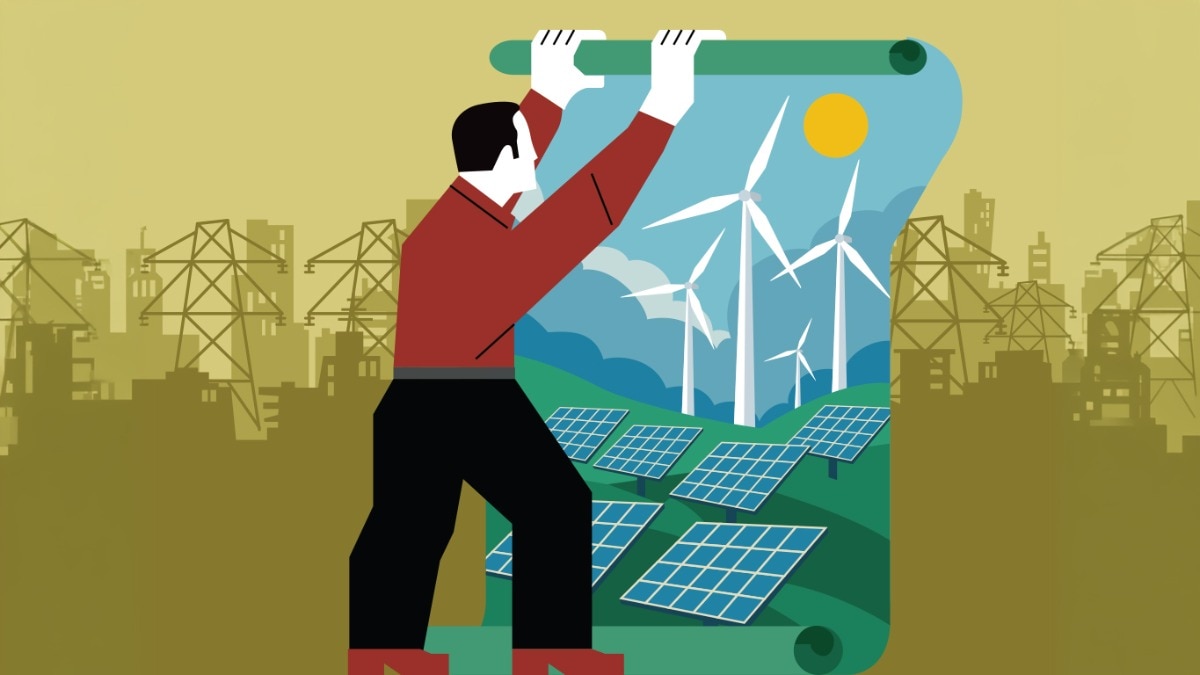
May 2026 was witness to two events in India’s power sector. The real-time market price recorded 0 INR/kWh and the high price day ahead market price touched the upper ceiling of INR 20/kWh. What more, May also recorded the highest day curtailment in RE of up to 80% of RE generation in Rajasthan. Summer also has been recording a new high every day with the peaks coming close to 260 GW.
The grid is being time tested every day for its resilience and inertia. It is easier now when the renewable penetration in the grid, in terms of energy supply, is hardly 15% compared to when this increases to 47% as estimated by CEA. At that time, it will not be sufficient with the present grid resources, and the requirement of a buffer which can absorb shocks will be much more pronounced.
CEA, or Central Electricity Authority, in its generation adequacy mix study forecasts that for India to sustain such high amount of RE in the grid, will require 888 GWh of energy storage capacity installed. 321 GWh of that will be in form of battery storage and 567 GWh in forms of pumped hydro capacity.
Energy storage has been the talk, with 250 GWh of tendering activity already done as of May 2026. India has been taking the right steps to make this sunrise sector grow fast and be prepared when the grid requires it the most. Various enablers have been brought upon to make this initiative a success through viability gap funding (VGF) scheme for standalone battery energy storage system (BESS).
Also, helping the sector are interstate transmission system (ISTS) waivers and PLI schemes to ensure that India becomes self-sustainable in its storage journey. Discussion on approved list of battery manufacturers (ALBM), minimum local content (MLC) for BESS installations and a separate scheme being discussed for long duration storage.
One such initiative which grew from pillar-to-pillar is standalone BESS, from being around 1 GWh tendered capacity in 2021 to 63 GWh as of May 2026. A lot of its success story dials around the VGF scheme, which was rolled out in 2023.
What helped the sector was the significant drop in battery costs globally. A risk-free business model made it more appealing as a sector to invest in. Many new players entered the market, in 2025 alone 50 new players entered the standalone BESS market.
Of course, this kind of competition will always result in aggressive bidding, and players often over committing themselves with aggressive assumptions and forward-looking prices.
The story was almost like a fairy tale but like every fairy tale, it has a villain too! The prices of lithium carbonate—a key ingredient for lithium-ion batteries—has gone up by 135% from Jan to May, almost rising to 2023 levels. Analysts believe the cost will keep rising till Q3CY26 after which a slight correction can be expected.
This has resulted in increasing battery costs. What was around $35-40/kWh in August 2025 has risen to $55-60/kWh as of now. This price rise has put a lot of projects at risk.
Till date, India has 32 GWh of BESS projects in construction, 11 GWh in awarded stage and a lot of these are VGF projects. Maybe around 40-50% of such project will not see the light of the day. In this scenario, what has been a ray of light is the merchant BESS projects which has come up, and some grid-tied projects which got commissioned. As of May, India has an installed BESS capacity of 7.4 GWh with more 2-3 GWh expected to be commissioned by year-end. New business models have also emerged, with commercial and industrial (C&I) BESS and data centres becoming some of the most sought-after opportunities.
Amidst all these discussions, what remains a matter of concern is that India still relies heavily on China for its battery supply. While India has tried to domesticate battery manufacturing, it has been facing challenges with China controlling over 90% of the supply chain. What has grown in India is assembling capacity. Yes, I often say battery is just the solar story run at 2X speed. Here’s hoping for a self-reliant BESS ecosystem in India.
Views are personal
BESS, India, IESA, Debamalya Sen, lithium-ion batteries, renewable, sustainability, bt indias most sustainable companies, indias most sustainable companies, sustainable, India Energy Storage Alliance,
#fairytale #BESS #India #IESA #President #Debamalya #Sen1781703339

BESS
BT India's Most Sustainable Companies
Debamalya
Debamalya Sen
fairytale
IESA
India
India Energy Storage Alliance
indias most sustainable companies
lithium-ion batteries
President
Renewable
Sen
Sustainability
Sustainable