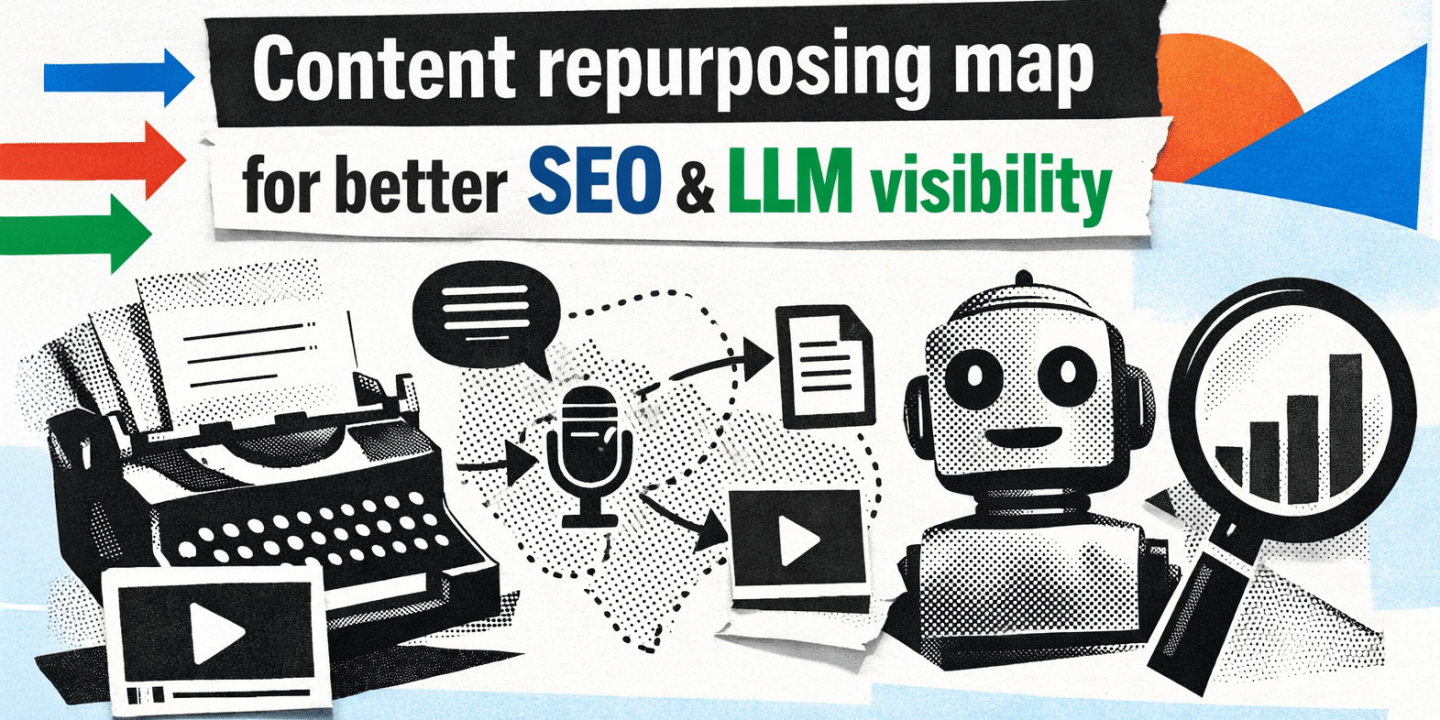
Content repurposing takes a single piece of existing content, such as a blog post, video, or webinar, and transforms it into multiple formats for various channels. Your content repurposing map is your production plan: It outlines how you’ll break down an idea and prepare it for distribution across channels.
Intentional content repurposing turns content into assets that drive business value across channels. When you have a map for this process, you can keep track of content assets, increase brand visibility, and ensure each piece works hard for the business. And when your content creates business value, you can secure more marketing budget.
Without a map, however, content is a one-and-done activity. It might be worthwhile in the short term. But once you’ve created and published it, content decays and loses visibility by the day.
Your customers search everywhere. Make sure your brand shows up.
The SEO toolkit you know, plus the AI visibility data you need.
Start Free Trial
Get started with

In this guide, we’ll explore how you can repurpose content to maximize visibility in traditional search and in AI search results. We explore what large language models (LLMs) prioritize, which content formats perform best, and how to build a repurposing map that drives visibility.
What do LLMs like?
You likely already know how to write for SEO and how to create a multichannel content marketing strategy. But to repurpose content that drives visibility across AI engines, you need to know what LLMs like ChatGPT and AI search tools like AI Overviews (AIO) tend to look for.
Content freshness
Overall, LLMs appear to prefer fresh content that was recently published or updated and that reflects current information, trends, or data.
Content published in the last five years receives 94% of LLM crawler hits, according to Seer Interactive. And the majority of LLM crawler hits target content from the past year.

What does this mean for your content repurposing map? You should:
- Update content with new data, stats, and examples, so it stays current.
- Stagger the production of new and repurposed content on a topic across time to maintain consistent freshness signals.
- Repackage older high-performing content into new formats. For example, turn a high-ranking blog post into a video that you can embed and upload as a separate, more recent content asset.
Original data and statistics
LLMs seem to prioritize content that incorporates original data and statistics. Content that includes statistics and qualitative statements results in 30–40% higher citation rates, according to data compiled by Onely.
This makes sense because AI systems’ training data predates current trends and recent facts. So, when someone runs a search that requires up-to-date information, the AI tool looks for a trustworthy source and cites it.
Citations are links to the sources the AI engine references as it synthesizes answers. Here’s a screenshot from AIO showing a Reddit citation:

When adapting content for LLMs, SEO Kevin Indig recommends feeding AI models with:
- Original research like benchmarks, surveys, and internal studies
- First-party data like “We analyzed 12 billion emails and found …”
- Subject matter expert (SME) quotes, complete with name, title, and credentials
Pro tip: Most AI tools use Common Crawl to feed their LLMs. You can search the Common Crawl index to see if it includes your new or repurposed content.
What does this mean for your content repurposing map? You should:
- Incorporate first-party data, research, or internal analysis wherever possible
- Highlight key statistics and data points clearly so LLMs can easily extract and cite them
- Include SME quotes with names, titles, and credentials to strengthen authority
- Reuse original data across multiple assets to reinforce credibility and increase citation likelihood
Structured content
LLMs also seem to prefer structured content with clearly organized information and on-page elements. For example: headings, bullet points, tables, definitions, and step-by-step formats. Well-structured content is three times more likely to receive accurate citations, according to Snezzi.
Content chunking is one way to structure content. Chunking is:
“The practice of organizing information into smaller, digestible sections that allow both human readers and search engines to better process and understand your content.”
In some cases, chunking is mistakenly reduced to paragraphs and headings. While these elements are important, they don’t convey the full extent of this concept.
Chunking is about more than just readability or formatting. It directly influences how AI engines retrieve and understand your content.
OpenAI has been clear about how it processes content.The LLM doesn’t store or retrieve entire pages. Instead, it splits content into smaller overlapping segments.
Then, OpenAI embeds and stores these chunks in a database. When a user asks a question, the LLM retrieves only the most relevant chunks, not the full document.
What does this mean for your content repurposing map? You should:
- Break content into clear, self-contained sections that answer specific questions or topics
- Look for opportunities to repurpose key insights into lists, tables, or definitions to improve extractability and citation potential
- Repurpose individual content chunks into standalone assets like FAQs, social posts, short videos to increase visibility across formats
Top-cited domains
No matter how well your content follows AI visibility best practices, LLMs do seem to have a bias toward certain domains. However, research from Semrush indicates that major LLM platforms may be rebalancing their citation mix.
Reddit, LinkedIn, and Wikipedia are among the most-cited domains on LLMs overall:

However, ChatGPT sharply reduced citations to Wikipedia and Reddit in Q3 2025.

What does this mean for your content repurposing map? You should:
- Repurpose core ideas into forum discussions, social posts, and thought leadership content. Distribute relevant content across platforms that LLMs frequently cite, such as Reddit, LinkedIn, and industry publications.
- Prioritize earning placements on high-authority domains through public relations (PR), guest posts, and partnerships.
- Align messaging across channels so the same ideas reinforce each other wherever they appear.
Different content formats you can use to repurpose content
Your content needs to exist in multiple formats to maximize visibility for SEO and AI search. Various search platforms favor different types of content, so repurpose to expand your presence across multiple surfaces. In doing this, you’ll ensure visibility everywhere your audience is.
Here are some examples of different formats you can use to repurpose content:
- Long-form content or blog articles on your own website: In-depth evergreen content can build authority and perform well in organic and AI search. Often, long-form content serves as the basis for repurposing. You can repurpose one blog into a range of content assets.
- Webinars: Use expert-led, long-form webinar content to drive engagement in real time. Then, reuse clips across multiple channels. Embed webinars on blogs, share the videos on social media, and upload them to platforms like YouTube, and publish transcriptions to improve AI visibility.
- Videos: Create highly engaging long-form video content for platforms like YouTube and LinkedIn and short-form videos for social media platforms like TikTok, Instagram, and Facebook. Get more out of videos by embedding them within relevant articles on your website.
- Social media posts and threads: Short, digestible insights like a LinkedIn post can drive awareness and engagement. These posts may pique your audience’s interest in subjects you cover in greater depth on your website, encouraging audience click-through. Social media posts can also rank in Google and drive visibility in AI answers.
- Forum posts and threads: Community-driven discussions on platforms like Reddit are useful for reaching niche audiences and answering specific questions. Although there have been declines in citations to Reddit, your brand can still earn AI citations via posts on the platform.
- Custom images, charts, and infographics: Visual assets that simplify complex ideas and perform well across many marketing channels. They can also boost visibility in traditional and AI search.
- Email blasts and email newsletters: Direct communication with your audience helps distribute content and nurture engagement. You can share many content assets in the form of an email, from article snippets with a “read more” call to action (CTA) or entire emails dedicated to your original research and thought leadership.
- Case studies: Data-driven content that showcases results can work well on your website, in sales materials, and in marketing campaigns. Case studies can help your brand show up for specific prompts in AI search and build trust when shared alongside services or products, as they prove what you can do.
- Podcasts: Audio content suited to platforms like Spotify and Apple Podcasts is ideal for building regular audience engagement. You can edit podcast episodes into bite-sized assets and then share them on social media or embed them in relevant blog posts.
- Guest posts: Content published on external sites helps expand your reach and tap into new audiences. Your guest posts help build consistency and trust across the web since you’ll write the same sentiment in them as you do on your own site.
- Press releases and media outreach: Coverage on news and industry sites can establish credibility and brand awareness. Press helps build brand authority, and you can share media mentions on social media or in emails to boost trust.

Content repurposing map for SEO & LLMs
Here’s a step-by-step workflow to creating a content repurposing map for SEO and LLMs.

Step 1: Start with a core topic or idea
Every content repurposing map begins with one central idea: the topic that anchors your content. It should have enough depth that it allows you to expand and distribute content across multiple formats and channels.
Choose a topic that:
- Aligns closely with your product, service, or core offering
- Has a clear search demand or reflects real audience questions
- Can expand into multiple angles (e.g., how-tos, comparisons, FAQs)
- Has enough relevance to support ongoing updates and repurposing
- Offers opportunities to include insights, data, or expert commentary
Step 2: Identify a primary asset
Once you’ve defined your topic, start with a single, in-depth piece of content that allows you to explore the topic fully.
This primary asset acts as the foundation for all repurposed content and should provide enough depth, insight, and structure to support multiple formats. It’s usually a long-form asset, such as a blog post, webinar, or video.
Tips for creating your pillar asset:
- Cover the topic comprehensively, including key questions, subtopics, and use cases.
- Include original insights, data, or examples to strengthen authority.
- Structure the content clearly with a table of contents, headings, sections, and takeaways.
Step 3: Plan how you’ll break content into formats and distribution channels
Before you create your primary asset, break it down into smaller components and map each to the most suitable format and platform. This is where your content starts to expand beyond a single piece, becoming a multichannel asset through reformatting and distribution.
Tips for mapping content to formats and channels:
- Identify key elements such as insights, stats, quotes, and questions.
- Match each element to a suitable format. For example, quotes can become social posts, while stats can serve as the basis for infographics and visual explanations.
- Choose distribution platforms based on where your target audience is most active. Note the specifications, such as dimensions and character counts, required for that platform.
Tip: Planning all necessary assets can save time and expedite content creation. When you know what you need to create, you can arrange for designers and writers to create them simultaneously. For example, you can create and resize images for social media platforms as your team writes content.
Step 4: Plan your publishing cadence
Create a plan to release your content over time. Rather than publishing everything at once, a staggered approach may help maintain visibility and keep your topics active across channels. This results in more recent publications, which can receive more hits from AI crawlers.
Tips for planning your cadence:
- Publish your primary asset first to establish the core topic
- Stagger supporting content over days or weeks to extend reach
- Where possible, align timing with campaigns, launches, or seasonal trends
Step 5: Define your update cycle
While some content is evergreen and rarely needs updates, other content benefits greatly from frequent edits. How often you edit your content will depend on your industry and the type of content.
For example, financial content needs more frequent updates than travel guides and blogs do, according to research by Seer Interactive.
Tips for setting your update cycle:
- Update fast-changing content like trends and stats often. Try quarterly to start.
- Review more stable content annually.
- Refresh outdated data, examples, and references.
- Republish or redistribute updated content to signal freshness.
Step 6: Track performance and refine
Once content is live, track performance to understand which formats, platforms, and topics deliver the most value. You want to know what performs best so you can create more content that drives visibility. If something isn’t performing as expected, you can try altering it or stopping it completely.
Tips for tracking and refining:
- Monitor traffic, engagement, and conversions across formats using tools like Google Analytics
- Identify which content types drive the most visibility
- Look for patterns in what gets shared, cited, or reused
- Double down on high-performing formats and channels
- Use insights to inform future topics and repurposing strategies
The table below breaks down the different types of content, their purposes, formats, the platforms you’d share them on, repurposing opportunities, expected SEO, and potential AI value.
| Content type | Primary purpose | Format | Core platforms | Repurposing opportunities | SEO / AI value |
| Blog articles | Authority, education, and organic visibility | Long-form | Your website | Social posts, videos, email, and infographics | Very high |
| Webinars | Engagement, expertise, and lead generation | Long-form | Your website, YouTube, and LinkedIn | Clips for social, blog embeds, and email content | High (especially when embedded and transcribed) |
| Videos | Engagement, reach, and brand visibility | Short- and long-form | YouTube and social media | Clips, blog embeds, social posts, ads | Very high |
| Social media posts and threads | Awareness, engagement, and distribution | Short-form | LinkedIn, X, Instagram, TikTok, and Facebook | Can expand into blogs, videos, and newsletters | Medium |
| Forum posts and threads | Niche reach, authority, and problem-solving | Short form | Reddit and niche forums | Can inspire blogs, FAQs, and content ideas | Medium |
| Custom images, charts, and infographics | Simplification, shareability, and visual engagement | Visual | Website, social, and email | Embedded in blogs, social posts, and PR | Medium |
| Email blasts and newsletters | Nurture, retention, and distribution | Short form | Repurpose blogs, videos, and case studies | Low | |
| Case studies | Trust, proof, and conversion | Short form | Website, sales materials, and email | Social proof posts, sales decks, and ads | Medium |
| Podcasts | Engagement and thought leadership | Audio and visual | Spotify, Apple Podcasts, and your website | Clips, blogs, social posts, and email | Medium |
| Guest posts | Reach, authority building, and backlinks | Medium- to long-form | External websites | Repurpose into owned content, and social media | High |
| PR | Credibility, brand awareness, and authority | Short to medium | News sites and industry publications | Social sharing, website mentions, and email | Very high |
Measure and grow your AI visibility
It’s one thing to publish great content. But it’s another to produce a range of content assets that create additional business value.
See the complete picture of your search visibility.
Track, optimize, and win in Google and AI search from one platform.
Start Free Trial
Get started with
As AI search continues to evolve, understanding where and how your content appears is key. By building a structured content repurposing map, you can increase your chances of being found, cited, and trusted across both search engines and AI engines.
To see how your content is performing in AI search, try Semrush One. This all-in-one search solution helps you track visibility, identify opportunities, and refine your optimization strategy for traditional and AI SEO.
#Content #repurposing #map #SEO #LLM #visibility1781904751