


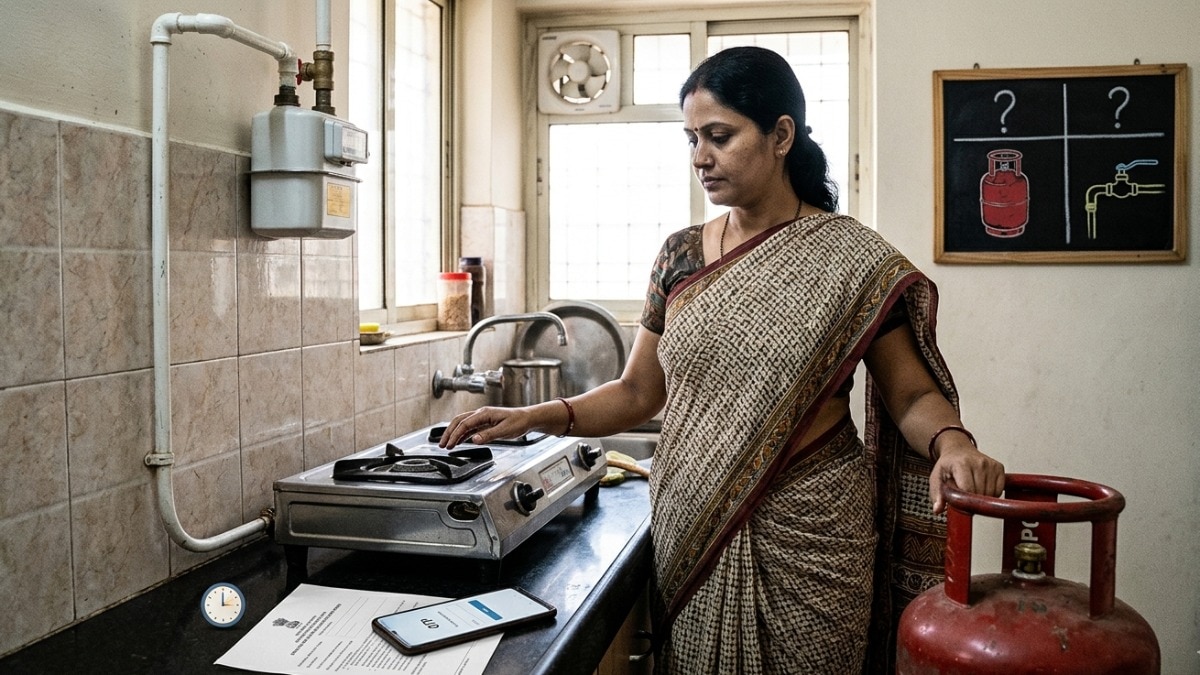
Millions of Indian households will soon have to rethink how they light their stoves. A new government mandate is reshaping the country’s cooking gas landscape, forcing a strict choice between Liquefied Petroleum Gas (LPG) cylinders and Piped Natural Gas (PNG).
The policy targets customers of Indane, BharatGas, and HP Gas. It aims to eliminate duplicate connections, streamline subsidies, and redirect cylinder supplies to rural and semi-urban areas lacking piped gas infrastructure.
The 30-day surrender rule
The core of the shift is the Liquefied Petroleum Gas (Regulation of Supply and Distribution) Amendment Order, 2026, notified on May 25.
Under these amended regulations, households that adopt a PNG connection must surrender their existing LPG connection within 30 days. For instance, a family getting a PNG connection on June 1 must terminate their LPG account by July 1.
Failure to comply with this window will result in restrictions on LPG refills and the potential deactivation of the account. The government intends to enforce this strictly to discourage dual domestic gas usage and free up cylinders for regions without pipeline access.
Safety net for relocating families
To support migrant workers, tenants, students, and employees with transferable jobs, the government has introduced a transfer-voucher mechanism.
Consumers who surrender their LPG connection after switching to PNG can secure a voucher. This document allows them to quickly restore an LPG connection in the future if they relocate to a town or area that lacks PNG infrastructure. The measure addresses a major consumer anxiety regarding losing access to cooking fuel during inter-city moves.
Refill timelines remain unchanged
Officials have dismissed recent social media speculation regarding altered cylinder booking schedules. The existing LPG refill lock-in periods remain completely unchanged:
- 25 days, 35 days, or 45 days (depending on the specific connection type and geographic location).
While dual-connection restrictions are now live, the permissible frequency for standard cylinder bookings stays exactly as it was.
One Household, One Gas Connection policy
The broader strategy relies on a strict “One Household, One Gas Connection” model. Oil marketing companies are actively auditing databases to identify customers holding both utility types, prompting them to transition fully to PNG where networks exist.
Why the crackdown? Officials state that eliminating duplicate connections curbs black marketing, prevents the misuse of subsidized commercial cylinders, and optimizes fuel distribution for households solely dependent on LPG.
The policy rollout has faced initial friction, with public discussions revealing widespread consumer confusion. Many households initially misread the directive as a cap on individual cylinder volumes rather than a restriction on holding simultaneous PNG and LPG accounts.
Tightened digital delivery controls
Alongside the infrastructure shift, authorities have tightened delivery verification protocols.
- OTP Verification: Consumers must now provide a valid One-Time Password (OTP) sent to their registered mobile number before a delivery agent can hand over a cylinder.
- Digital Booking: Online cylinder bookings now constitute the overwhelming majority of transactions as the government pushes for a fully digital tracking ecosystem.
Households currently holding or planning to install a PNG line should immediately contact their distributor or log into their provider’s digital portal to initiate the LPG surrender process. Keeping registered mobile numbers updated is critical to avoiding disruptions under the stricter OTP delivery system.
LPG, PNG, gas cylinder rules, Indane, BharatGas, HP Gas, cooking gas, LPG surrender, piped natural gas, gas connection, fuel policy, household energy, LPG refill, gas booking, OTP delivery, oil ministry, subsidy reforms, India energy, domestic gas, consumer rules #LPG #PNG #Indias #30day #gas #rule #means #millions #households1781963497

30day
BharatGas
consumer rules
cooking gas
domestic gas
fuel policy
Gas
gas booking
gas connection
gas cylinder rules
household energy
households
HP Gas
Indane
India energy
Indias
LPG
LPG refill
LPG surrender
means
Millions
oil ministry
OTP delivery
piped natural gas
PNG
rule
subsidy reforms