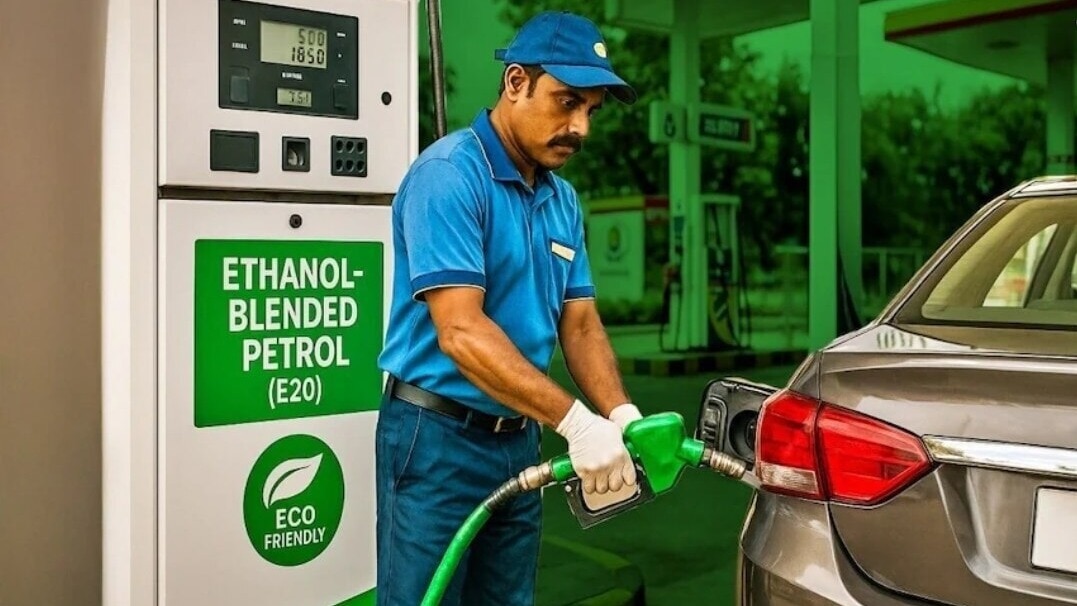
While India is gunning down on its ambitious ethanol-blending programme, the same entusiasm has encountered a road bump beyond its borders. Bhutan has declined an offer from Indian Oil Marketing Companies (OMCs) to supply E20 petrol, citing concerns that go beyond engine compatibility.
The Himalayan kingdom has said its fuel storage infrastructure is not equipped to safely handle ethanol-blended fuel, highlighting how geography and infrastructure can shape energy policy just as much as environmental goals, according to local media reports.
The decision comes as India has accelerated its ethanol blending programme to reduce crude oil imports, lower emissions and support domestic biofuel production. E20 petrol contains 20% ethanol and is now being rolled out widely across India as part of the country’s clean fuel transition.
Why Bhutan rejected E20 petrol
According to Bhutanese authorities, the issue is not opposition to cleaner fuels but the practical challenge of storing them safely.
MUST READ | Centre denies reports claiming E20 programme was termed an ‘experiment’ before Supreme Court
Ethanol is hygroscopic, meaning it readily absorbs moisture from the atmosphere. This property makes storage significantly more demanding than conventional petrol. If water enters storage tanks, ethanol-blended fuel can separate into different layers, reducing fuel quality and potentially affecting engine performance.
Bhutan says this is particularly problematic because many of its fuel storage facilities are located in mountainous regions where seepage and moisture intrusion are difficult to eliminate. Storage tanks in such terrain are more susceptible to water contamination, increasing the risk of fuel degradation before it even reaches consumers. The concerns were reported in a report by The Bhutanese, citing officials familiar with the discussions.
Infrastructure before transition
The development underlines an often-overlooked aspect of the global shift towards cleaner fuels: infrastructure readiness.
DON’T MISS | Govt waives excise duty on petrol with higher levels of ethanol
While India has invested heavily in expanding ethanol production and adapting its fuel supply chain, neighbouring Bhutan would need to upgrade storage tanks, fuel depots and handling systems before it can safely adopt higher ethanol blends. Until then, conventional petrol remains the more practical option.
The decision also illustrates that fuel transitions cannot follow a one-size-fits-all model. Countries with challenging terrain, smaller fuel networks or older infrastructure may require different timelines, even if they support the broader objective of reducing fossil fuel dependence.
What it means for India
For India, Bhutan’s response is unlikely to affect the overall ethanol programme, which is driven primarily by domestic demand. However, it offers an important lesson for future regional energy cooperation.
DO CHECKOUT | Petrol, EV or Flex-Fuel? Here’s which car makes most sense for your road trips in 2026
As India expands exports of cleaner fuels and promotes energy integration with neighbouring countries, infrastructure compatibility may become just as important as fuel availability. A blend designed for one country’s storage and distribution network may not be immediately suitable for another without significant investment.
Bhutan, E20 petrol, ethanol blending, Indian Oil Marketing Companies, ethanol fuel, hygroscopic fuel, fuel storage, Himalayan terrain, India-Bhutan energy ties, petrol infrastructure #Bhutan #turns #E20 #petrol #Indian #OMCs #Hers039s #science #decision1783089090

Bhutan
decision
E20
E20 petrol
ethanol blending
ethanol fuel
fuel storage
Hers039s
Himalayan terrain
hygroscopic fuel
India-Bhutan energy ties
Indian
Indian Oil Marketing Companies
OMCs
petrol
petrol infrastructure
science
turns
Recent Post



Gallery






Featured Videos