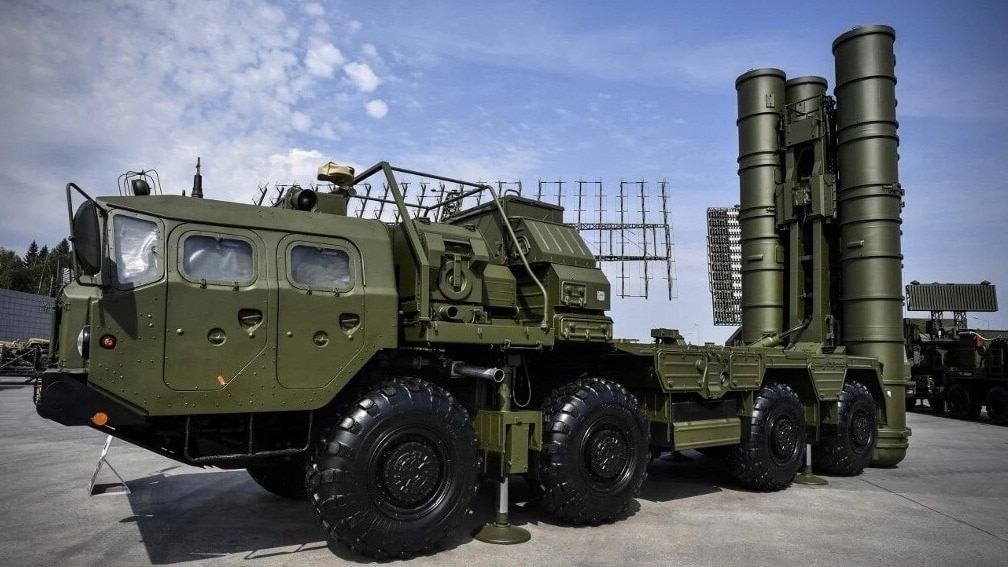
A Chinese military video opens with precision rocket launches. Moments later, India’s S-400 air defence batteries are shown being overwhelmed in a coordinated strike. There are no real explosions, no battlefield casualties — only a carefully scripted simulation.
But the message is unmistakable. Through its latest propaganda release, China’s People’s Liberation Army (PLA) is attempting to demonstrate that even one of India’s most formidable air defence systems can be neutralised.
The simulation showcases the PLA’s PCL-191 Long-Range Multiple Launch Rocket System (MLRS) targeting the Russian-made S-400 “Sudarshan Chakra” deployed by India near the Line of Actual Control (LAC).
More than a display of military hardware, the video appears designed as a psychological operations (PsyOps) campaign, projecting China’s confidence in countering one of the Indian Air Force’s most critical strategic assets.
Aimed at India’s air defence shield
At the heart of the simulation is the PLA’s PCL-191, a long-range precision rocket artillery system capable of firing guided munitions to distances between 350 km and 500 km. Such ranges theoretically place fixed air defence installations deep inside India’s border deployments within striking distance.
The video also highlights another key aspect of Chinese military thinking — using precision saturation attacks. Rather than relying on a single missile, the concept involves launching multiple guided rockets simultaneously to overwhelm an air defence network’s radar tracking and interception capacity.
For the PLA, the message is clear: even highly capable systems like the S-400 can be challenged if subjected to large-scale, coordinated rocket attacks.
Why the S-400 matters
The S-400 remains one of the world’s most advanced long-range air defence systems, capable of engaging aircraft, cruise missiles and ballistic missiles at extended ranges.
India currently operates four S-400 squadrons deployed across its western and northern fronts to guard against threats from both Pakistan and China. A fifth squadron is expected from Russia, completing the acquisition under the bilateral defence deal.
China, however, is also an S-400 operator. The PLA is believed to field at least six squadrons of the same Russian-built system. That shared ownership gives Beijing an unusual advantage — it is familiar with the platform’s operating characteristics, radar architecture and potential vulnerabilities.
Such knowledge could be used to develop electronic warfare techniques, suppression tactics and precision strike options specifically designed to degrade the system’s effectiveness.
Timing follows India’s operational success
The release comes against the backdrop of growing attention on India’s S-400 capabilities.
During previous military confrontations, India’s S-400 reportedly achieved one of the longest combat intercepts recorded, engaging an airborne early warning and control (AEW&C) aircraft at a distance of around 300 km. The intercept reinforced the system’s reputation as a critical component of India’s integrated air defence network.
Against that backdrop, the PLA’s simulation appears intended not only to demonstrate Chinese capabilities but also to counter the perception that the S-400 provides an impenetrable defensive shield.
How India is adapting
The Indian Air Force has already begun modifying its deployment doctrine to reduce vulnerabilities associated with fixed air defence positions.
One of the most significant changes is the adoption of “shoot-while-moving” tactics. Instead of remaining stationary after deployment, S-400 launch vehicles can operate while moving slowly — typically between 5 and 7 km/h—making them significantly harder for satellites and long-range surveillance systems to locate and target.
India has also strengthened the protection of its air defence units by integrating them into a broader Counter-Unmanned Aircraft Systems (C-UAS) network. The objective is to prevent drone swarms from acting as reconnaissance assets or overwhelming air defence batteries through coordinated saturation attacks.
At the same time, New Delhi is accelerating work on Project Kusha, an indigenous long-range air defence programme intended to complement the S-400. The domestic system is expected to diversify India’s radar and missile architecture, reducing dependence on a single platform while making it more difficult for adversaries to exploit known system characteristics.
China PLA, People's Liberation Army, India China tensions, S-400 Sudarshan Chakra, S-400 air defence system, PCL-191 MLRS, Chinese military propaganda, India air defence, India China border, Line of Actual Control, LAC, rocket artillery, precision strike, saturation attack, psychological warfare, PsyOps, Indian Air Force, Project Kusha, C-UAS, military technology, defence news, China military, India defence, Russia S-400, air defence systems, strategic weapons, border security, electronic warfare, missile defence, geopolitics#China #039Sudarshan #Chakra039 #PLA039s #latest #bold #claim #India039s #S4001783617974

039Sudarshan
air defence systems
bold
border security
C-UAS
Chakra039
China
China military
China PLA
Chinese military propaganda
Claim
defence news
electronic warfare
geopolitics
India air defence
India China border
India China tensions
India defence
India039s
Indian Air Force
LAC
latest
Line of Actual Control
military technology
missile defence
PCL-191 MLRS
People's Liberation Army
PLA039s
precision strike
Project Kusha
psychological warfare
PsyOps
rocket artillery
Russia S-400
S-400 air defence system
S-400 Sudarshan Chakra
S400
saturation attack
strategic weapons
Recent Post


Gallery






Featured Videos