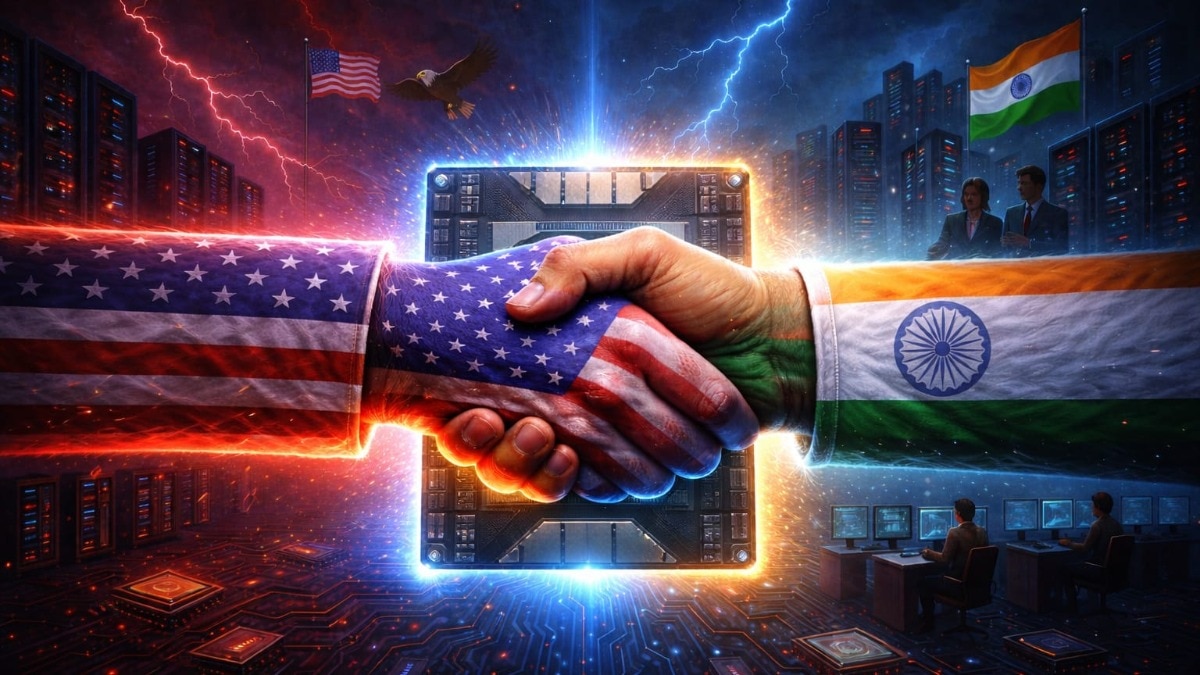
The global battle for artificial intelligence (AI) is increasingly being fought over one piece of hardware: graphics processing units or GPUs.
The US crackdown on advanced AI chips for China has reshaped supply chains and unsettled markets. For India, an emerging AI power building sovereign compute capacity, the fear was simple: if geopolitical winds shifted, could access to high-end GPUs suddenly narrow?
For an ecosystem still scaling up, that wouldn’t be a speed bump. It would be a stall.
The latest interim agreement on reciprocal and mutually beneficial trade between the US and India now offers what industry observers describe as strategic reassurance. It does not change export rules overnight. But it signals alignment.
Where India stands in the global AI race
Beyond diplomacy, India’s AI ambitions must be measured against capacity.
“According to the 2025 Stanford University Global AI Vibrancy Tool, India has emerged as a top-three global power in AI, ranking third overall behind the US and China. India jumped from seventh place in 2023, driven by strong performance in talent, startup ecosystem, research, and government AI initiatives,” said Danish Faruqui, CEO at Fab Economics.
The government has begun closing compute gaps through the IndiaAI Mission, securing roughly 38,000 GPUs nationwide so far.
Yet the gap with the global leaders remains stark.
“The US leads the AI index with 78.6 points, China follows at 36.95, and India stands at 21.59, highlighting how far behind the top two countries are in overall AI capacity, a roadmap that can only be leapfrogged by sustained multi-year commitment towards India’s AI mission, strategic and open partnerships with the US and allied nations,” Faruqui added.
When India was almost Tier-2
The anxiety stems from recent history. Last year, the Biden administration proposed a “Framework for Artificial Intelligence Diffusion,” placing India in a Tier-2 export category alongside many non-allied nations. The rule would have capped and slowed access to cutting-edge GPUs.
“The 2025 rule placed India in the “second tier” for the US chip exports, meaning Indian companies could import cutting-edge AI chips only with US export licenses and in limited quantities. In practice, this would have constrained India’s AI compute expansion, with an effective cap of approximately 50,000 GPUs nationwide under the rule,” explained Purushothaman KG, Partner and Head, Technology Transformation and AI, KPMG in India.
Large cloud providers would also have faced limits, restricted to deploying no more than 7% of their global AI capacity in any Tier-2 country.
Although the proposal was later rescinded by the Trump administration, it rattled India’s technology ecosystem. Had it remained, sovereign AI projects and data-centre expansion plans could have slowed significantly.
KG added that high-end chips for Indian AI projects would have required case-by-case US approval, delaying critical upgrades and increasing dependence on US policy decisions, resulting in fewer GPUs, slower deployments, and a material drag on India’s AI ambitions.
What the interim agreement actually signals
The joint statement following high-level talks between the two governments refers to “significantly increasing trade in technology products, including GPUs and other goods used in data centres,” and deeper cooperation in advanced technologies.
To be sure, the interim agreement does not change anything immediately. India currently faces no export restrictions on advanced AI chips. NVIDIA and AMD GPUs are legally sold in India.
But the issue was never legality…it was risk.
“The statement primarily serves as a confidence-building signal, reassuring investors and industry that India will not face sudden AI hardware export restrictions akin to those imposed on China. It suggests policy stability, not a legally binding commitment,” said Manish Rawat, associate analyst at TechInsights.
He added that the agreement signals preferential alignment, with India likely to be treated more favourably than geopolitically strained partners. But any priority access to GPUs will flow through commercial contracts, OEM relationships, and distributors, not government allocation mandates.
Why GPUs are India’s gating factor
For India, GPUs are not just components. They are the foundation of its AI strategy.
The IndiaAI Mission seeks to build sovereign compute, support homegrown foundation models and empower startups and researchers. None of that scales without dependable access to high-performance accelerators such as NVIDIA’s H100 and next-generation processors.
“To enable AI adoption at a population scale, India will need to expand its data centre capacity to 6–9 GW over the next 5–7 years and deploy millions of GPUs, making faster and easier access to high-end chips and advanced technologies a critical enabler of this growth,” said Sunil Gupta, Co-Founder, CEO and MD, Yotta Data Services.
Gupta added that India is already importing roughly 20,000–25,000 high-end GPUs annually (about $2 billion worth), but population-scale AI adoption across governance, fintech, healthcare, and language ecosystems will require this number to multiply exponentially.
The limits of reassurance
“While India could theoretically have faced China-style export controls in a severe geopolitical breakdown, the probability was always low. But had such controls occurred, the impact would have been significant,” TechInsights’ Rawat added.
He explained that indigenous AI development would have slowed sharply. Restricted access to advanced GPUs would force reliance on older hardware, offshore model training, or narrower domain-specific systems, limiting India’s ability to build competitive foundation models.
The interim agreement does not eliminate that structural dependency. Future US administrations could still recalibrate AI chip policy depending on global geopolitics.
But at a moment when AI supply chains are increasingly divided along strategic lines, India appears to have positioned itself firmly on the trusted side of that divide.
For now, however, India has secured something critical in the AI race: strategic reassurance that its access to the world’s most important hardware is unlikely to be abruptly cut off.
India US trade deal, GPU, semiconductor manufacturing, India US interim trade deal, India US interim trade agreement, Donald Trump, Narendra Modi, data centres, artificial intelligence, AI, tech exports#Geopolitics #GPUs #USIndia #interim #deal #shields #Delhis #ambitions1770795507

AI
ambitions
Artificial intelligence
data centres
deal
Delhis
donald trump
geopolitics
GPU
GPUs
India US interim trade agreement
India US trade deal
India-US interim trade deal
interim
Narendra Modi
semiconductor manufacturing
shields
tech exports
USIndia
Recent Post



Gallery






Featured Videos