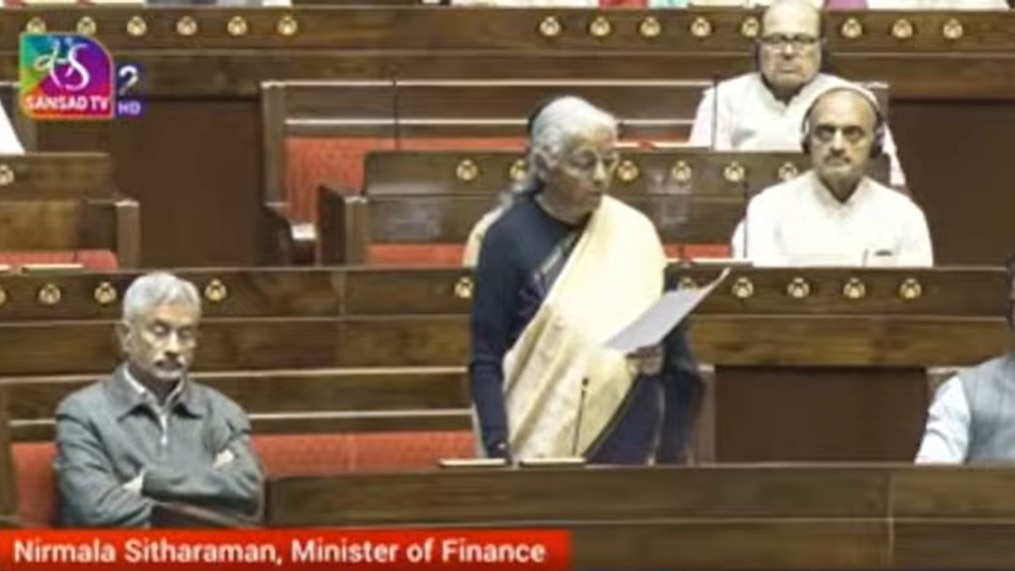
Finance Minister Nirmala Sitharaman told the Rajya Sabha on Thursday that high personal income tax collection in India should not be interpreted as a sign of the middle class being suppressed. Addressing concerns during the Union Budget 2026-27 debate, she stated there is no indication that tax policies are negatively impacting the middle class. Instead, she argued that the existing data shows growth in the middle class, highlighting the government’s broader economic objectives and the effectiveness of its distribution mechanisms.
“High personal income tax collection does not necessarily mean that the middle class is being suppressed or crushed in the country,” she said. Sitharaman emphasised that there is tangible evidence pointing to middle-class expansion, not contraction. “There is no evidence of any suppression of the middle class in the country, but there is evidence of middle-class expansion,” she said while replying to a debate on the Union Budget 2026-27.
The Finance Minister outlined that the government’s priority was to ensure the nation’s fiscal health without placing undue burden on any particular demographic. She criticised the opposition for raising alarms about debt levels and borrowing practices. “She further said the Congress sheds crocodile tears on rising debt, as the government does not borrow excessively,” Sitharaman remarked, rejecting criticisms of financial irresponsibility.
Sitharaman reiterated the importance of fiscal discipline, arguing that government resources must be treated with care and respect. “The finance minister said the Centre’s fund is not a free pool of cash that can be used; it is the hard-earned money of citizens.” She emphasised the necessity of prudent policies to safeguard public money and maintain sustainable development.
She cited improvements in welfare delivery through the Direct Benefit Transfer (DBT) system, informing the Rajya Sabha that “the government has sent over Rs 48 lakh crore directly into accounts of beneficiaries through DBT and saved Rs 4.31 lakh crore by plugging leakages.” These measures, according to Sitharaman, demonstrate the government’s commitment to efficiency and transparency in handling public funds.
Addressing the Budget’s guiding philosophy, Sitharaman noted its awareness of past economic challenges and inflationary pressures. “The Budget is never forgetful of past; it remembers fragile days, double-digit inflation,” she said. She called attention to the need for resilience in policy-making informed by historical economic vulnerabilities.
Highlighting the government’s vision, Sitharaman said, “Steps taken in the Budget prove the country’s resolve to build a resilient, self-reliant India and urged the Rajya Sabha members to ask their respective state governments to participate in schemes announced in the Budget.” She encouraged greater state participation and collaboration with the Centre’s policy initiatives.
Drawing a comparison with the UPA years, she said that just Rs 37,000 crore remained unutilised across 14 social sector schemes over the past decade, sharply lower than the Rs 94,000 crore left unspent during the UPA regime.
Sitharaman also dismissed the Opposition’s charge of announcing schemes without adequate budgetary support, arguing that similar instances were common under the previous UPA government.
(With PTI inputs)
income tax, middle class, nirmala sitharaman, budget 2026#High #income #tax #collection #doesnt #middle #class #crushed #Sitharaman #Rajya #Sabha1770909733

budget 2026
class
collection
crushed
doesnt
high
Income
income tax
middle
middle class
nirmala sitharaman
Rajya
Sabha
Sitharaman
Tax