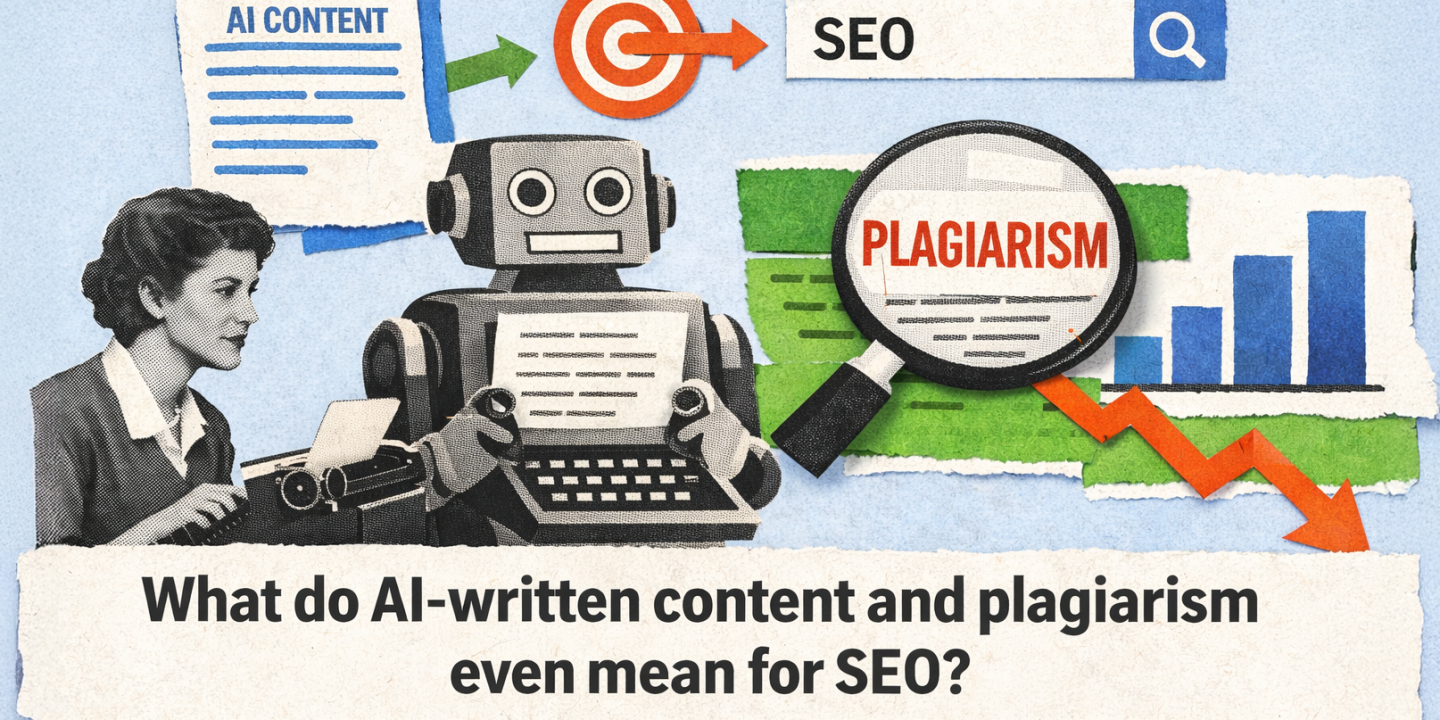
There are numerous ways content can go wrong in today’s digital landscape. Avoiding these missteps requires a clear understanding of what they actually are.
In this article, we’ll focus on two particularly common issues: AI-generated content and plagiarism. We’ll clarify exactly what each one means, why they matter, and how to ensure your work stays free of both labels.
Why detecting AI-written content and plagiarism matters for SEO
AI-written content refers to text that’s generated or significantly assisted by language models like ChatGPT, Claude, or Google’s Gemini. This is not inherently bad, but you don’t want your content to read like a machine wrote it.
Your customers search everywhere. Make sure your brand shows up.
The SEO toolkit you know, plus the AI visibility data you need.
Start Free Trial
Get started with

Plagiarism is using someone else’s work or ideas without proper attribution. For example, copying and pasting content from someone else’s website onto your own.
Grammarly claims that: “AI-generated text may resemble existing sources, which increases the risk of accidental or paraphrasing plagiarism.” Even when relying on AI tools to generate content, there is still a potential risk of plagiarism.
Plagiarism is always bad, but you can avoid it.
AI content detection is the process of identifying whether text was generated by artificial intelligence tools like ChatGPT, Claude, or other language models rather than written by humans. Plagiarism detection has been around for a long time for a lot of reasons mentioned above.

A recent study by Graphite found that more articles are being written by AI than humans. What’s actually important is whether your content helps people solve problems and provides unique value.
AI or not, you want to create genuinely helpful content for reasons that go beyond human readers alone, since Google’s algorithms are built to surface helpful and original insights. You also want to avoid plagiarism, not only because of potential lawsuits and reputational damage, but because true value and original thinking never come from copying someone else’s work.
Think about it this way: if you’re using AI to churn out generic blog posts about “10 Tips for Better SEO” without adding your own expertise, data, or fresh perspective, you’re essentially creating digital noise. Same goes for copying content from competitors or slightly rewording existing articles. Plus, it’s a bad look if you get caught. You’re better than that.
Both approaches can hurt your search visibility and damage user trust signals that modern ranking algorithms heavily weigh, because when users land on repetitive or obviously AI-generated content, they bounce faster than you can say “ChatGPT.”
Using AI as a writing partner is okay
AI writing is becoming more sophisticated and widespread. At the same time, Google’s algorithms are increasingly focused on rewarding original, high-value content that demonstrates genuine expertise and authority — whether it’s written by AI or not.
That is to say that Google’s spam systems are getting more aggressive at spotting low-effort, rehashed material, regardless of whether the author has a pulse.
But creating good, original content is not just about avoiding penalties.
Content quality and originality are crucial
Your brand’s credibility takes a hit every time someone lands on content that feels generic or robotic. Think about your own browsing — you can usually tell within seconds when you’re reading something that lacks genuine human perspective. That “ick factor” translates directly into higher bounce rates and lower engagement signals.
As for plagiarism, imagine how easy it is for the world’s largest search engine to see that your article is just like someone else’s. Or even mostly like theirs. You don’t want to go down for stealing someone’s work, but you also want to know if someone has stolen yours.
The indexing implications are serious. Google’s crawl budget isn’t unlimited, and search engines are becoming pickier about which pages deserve prime real estate in their index. Sites flooded with similar, low-value content may see decreased crawlability and slower content discovery.
E-E-A-T requires a human in the loop
We’re also seeing shifts in how Google evaluates expertise and authoritativeness. The updated E-E-A-T guidelines place heavy emphasis on demonstrating real human experience and knowledge — something that generic AI content simply can’t deliver authentically.
The stakes keep rising as AI-generated content floods search results, making original, well-researched material increasingly valuable for both search engines and users seeking trustworthy information.
How Google guidelines treat AI-written content vs. plagiarism
Google may treat AI-generated content and plagiarism similarly, depending on the final quality of the content.
Content quality is more important than human authorship
Here’s what actually matters: Google doesn’t ban AI content outright. In fact, their official stance emphasizes that content quality is more important than the creation method.
According to Google: “Our focus on the quality of content, rather than how content is produced, is a useful guide that has helped us deliver reliable, high quality results to users for years.”
But there’s a catch.
Google views some AI content as a violation of their spam policies
“Using automation — including AI — to generate content with the primary purpose of manipulating ranking in search results is a violation of our spam policies.”
Think mass-produced pages with no real value, or content that reads like it came straight from ChatGPT that’s full of hallucinations with zero human oversight. The algorithm specifically targets content that exists primarily to game rankings rather than serve users.
The algorithmic fingerprints of AI content are becoming clearer to Google and everyone else. A study from SE Ranking showed that unedited AI content may see initial success but dramatic ranking drops follow.
They summarized their study results this way: “AI content that has been edited and refined by our team continues to perform well, while fully AI-generated content has seen no traffic or visibility for the past six months. The takeaway is clear: fully AI-generated content may deliver some initial results, but it’s unlikely to be a good long-term strategy. If you do use AI to create content, it should always be followed by thorough editing, optimization, and other refinements.”
Plagiarism is not tolerated
Plagiarism, on the other hand, hits different violations entirely. It directly breaches copyright standards and quality thresholds that Google cares about. When you copy someone else’s work, you’re not just creating unhelpful content — you’re potentially violating intellectual property rights and certainly failing Google’s originality requirements.
Fixing plagiarism requires removing or substantially rewriting the offending content, plus often dealing with DMCA complaints.
Google doesn’t have specific documentation on “plagiarism.” But in their Quality Rater Guidelines they do state that “The word “copied” refers to the practice of “scraping” content, or copying content from other non-affiliated websites without adding any original content or value to users.”
So, while both can hurt your rankings, focus on making your content genuinely useful and original, regardless of how you created it.
Common SEO risks tied to AI-written content
AI-generated content poses a range of specific SEO risks that can hurt your rankings and organic visibility if left unchecked. Here’s what happens when content creation gets rushed without proper quality control.

Low value content
Content masquerading as comprehensive content is everywhere now. AI can pump out 2,000 words on any topic, but most of it ends up being fluff — repetitive paragraphs that say the same thing in different ways without adding real value.
It’s not limited to a single article. AI is very good at synthesizing what already exists across the web, but that is precisely the kind of content Google is trying to avoid surfacing. If your page offers nothing more than what someone could get by skimming the top ten search results, there is little reason for Google to rank it.
Cannibalization
This can happen when you’re cranking out AI articles at scale. AI makes it easy to spin up lots of related pages quickly. Without a strong content map, those pages often target overlapping keywords and entities, which leads to multiple URLs trying to rank for the same terms. That’s classic cannibalization.
Factual accuracy issues & hallucinations
These are landmines waiting to explode. AI confidently states outdated statistics, mixes up technical details, or completely fabricates data points. We’ve seen AI pump out drafts claiming “studies show 73% improvement” without any actual study existing. Or linking to a page that no longer exists. Or pulling a number from one part of the page and the words from another, creating garbage arguments.
One wrong statistic that gets called out publicly can tank your reputation with users.
The solution isn’t avoiding AI entirely — it’s using it as a starting point, not the finish line. The sites that win combine AI efficiency with human expertise, original insights, and rigorous editorial and fact-checking processes.
Read more: Learn how to fix AI hallucinations about your brand
Common SEO risks tied to plagiarized content
While Google doesn’t discuss plagiarism directly in their search documentation, they do address “scraping” in their Spam Policies which would cover plagiarism.
“Scraping refers to the practice of taking content from other sites, often through automated means, and hosting it with the purpose of manipulating search rankings.”
So scraping means “copying content from other sites, modify it only slightly (for example, by substituting synonyms or using automated techniques), and republish it” even if it wasn’t done using automation. This is essentially plagiarism.

If Google finds out you’ve been violating their spam policies, they may do the following depending on how severe the plagiarism is:
“We detect policy-violating practices both through automated systems and, as needed, human review that can result in a 1) manual action. Sites that violate our policies 2) may rank lower in results or 3) not appear in results at all.”
In addition to this, if the plagiarism is extreme, you may get into legal trouble.
Manual actions
Manual actions involve real people at Google. A human reviewer evaluates a site and decides whether it violates Google’s spam policies. While automated systems may help flag potential issues, the final decision is still made through a human review, which is why Google classifies these actions as “manual.”
You can find manual actions in Google Search Console.
Here’s an example of a manual action from scraping content.

Algorithmic updates
Algorithm updates do not appear in the Manual Actions report in Google Search Console. These updates are fully automated, and Google does not send notifications when a site’s rankings are affected, whether positively or negatively.
Duy Nguyen from Google’s search quality team says that: “In general, sites with spammy scraped content violate our spam policy, and our algorithms do a pretty good job of demoting them in search results.”
Once you’ve fixed your content, it can take months until your site recovers from algorithmic suppression.
Getting deindexed
Having your site or some of its content de-indexed is SEO death.
When a site receives a manual action, either part of the site or the entire site may be removed from Google’s search results.
Google may also deindex sites or pages automatically via their algorithms.
No matter how Google removed your site from its index (whether through a manual action or an algorithmic update) you will need to address any plagiarism issues to recover.
Legal risks compound your SEO problems
Beyond search penalties, plagiarized content opens you up to DMCA takedown notices and copyright infringement claims. These legal actions can result in immediate content removal, hosting issues, and expensive legal battles.
Even worse? Legal troubles often leave digital footprints that search engines can track, creating additional trust and authority issues.
Signs that content is written by AI
AI-written content often displays specific patterns that search engines and SEO professionals can identify, ranging from generic language structures to lack of nuanced expertise that comes from genuine industry experience. It also makes a lot of rookie writing mistakes.

Here’s what you should be looking out for:
Generic introductions that lack specificity
You know those openings that sound like they could apply to literally any topic? “In today’s rapidly evolving digital landscape…” or “Content marketing has never been more important than it is today.” These cookie-cutter starts scream AI generation.
The best human writers know how important it is to grab your attention from the onset. This is why they will often dive straight into specific problems, stats, or scenarios. They’ll open with something like “Our client’s organic traffic dropped 40% after their site migration” rather than broad platitudes about the importance of SEO. In the writing business that’s called “throat clearing” and AI hasn’t unlearned this bad habit — yet.
Repetitive phrasing and mechanical sentence structures
AI tends to fall into predictable patterns because of the way it was trained. You’ll see the same transitional phrases (“Moreover,” “Furthermore,” “Additionally”) used repeatedly, or identical sentence structures that follow a rigid formula and create a droning effect of more words for the sake of more words.
Human writers naturally vary their rhythm and word choice. If a human writer is using a specific pattern, it’s to capture your attention (in a good way). But AI is often working with a group of set phrases that recur. For example, I’ve left “the key” in this article while editing to show this in practice. Did you notice? If this was my writing tic, I’d have done a bad job of editing it. If I failed to notice AI doing it, you the reader probably wouldn’t miss it.
Watch for content that feels like it’s checking boxes rather than flowing naturally. If every paragraph starts with a similar structure or uses the exact same connecting words, that’s a red flag.
Shallow explanations without tactical depth
Here’s where AI really shows its limitations. It can regurgitate surface-level information but struggles with the nuanced, tactical insights that come from hands-on experience. You’ll see explanations of “what” something is, but minimal insight into “how” or “why” it works in practice.
For example, AI might explain what Core Web Vitals (CWV) are and list the three metrics, but it won’t dive into the specific server configurations that actually impact LCP or the JavaScript optimization techniques that reduce FID in real client scenarios.
Missing entity connections and contextual relationships
Search engines are getting better at understanding entity relationships and topic clusters. AI-generated content may fail to naturally weave in related concepts, brands, or industry connections that would signal deep topical knowledge. Imagine a discussion on crawlability that doesn’t reference indexation.
Human experts naturally reference complementary topics, competing methodologies, useful tools, or industry players when discussing a topic. This is how confident human writers demonstrate real expertise.
Lack of first-hand experience and specific examples
This is the big one. AI hasn’t used Screaming Frog for a 500K page crawl or debugged a specific JavaScript rendering issue. It can’t reference proprietary client data or share war stories from actual campaign management.
Look for generic examples versus specific, named case studies. Human-written content includes messy, real-world details that AI simply can’t fabricate authentically. AI might be able to spin up a case study about the time it “saw” a website recover from a penalty, but crucial storytelling details will be missing or the story may ring false.
The key isn’t avoiding AI entirely — smart SEOs are using it as a starting point while adding the human expertise, specific examples, and industry connections that search engines actually want to see.
Signs that content has been plagiarized or scraped
Because you know better than to plagiarize, you should be on the lookout for content patterns that suggest someone lifted your work — or that your site might be seen as copying others.
Here’s what makes this tricky: Search engines don’t just care about copied text anymore. They’re evaluating content freshness, topical authority, and user engagement signals that can reveal when someone’s gaming the system with recycled material.

Think about it from Google’s perspective. If two pieces of content cover the exact same points in the exact same order, one of them isn’t bringing unique value to searchers.
Mirrored heading hierarchies
These are often the first red flag. When a competitor launches content that follows your exact H2→H3→H4 progression with slightly different wording, they’re basically admitting they used your piece as a template. This becomes problematic because search engines can identify content similarity patterns that go beyond surface-level text matching.
Near-identical paragraph structures
These tell an even clearer story. You’ll see this when someone takes your content framework and just swaps out a few words or examples. The dead giveaway? They keep your paragraph lengths and even your transition phrases. If a competing site mirrors everything from H2 order to bullet point counts — that’s not coincidence.
Outdated examples and data points
These are another smoking gun. If your 2022 article referenced a specific case study or statistic, and competitors are using that same outdated reference in 2026 content, they likely copied off your paper rather than doing fresh analysis. It’s especially obvious when multiple sites reference the exact same obscure example or data point that’s no longer current.
Modern plagiarism in SEO often involves reformatting and repackaging rather than direct copy-paste. Someone might take your comprehensive guide, break it into shorter posts, or combine multiple pieces into one longer article — while maintaining your core information architecture.
Close matches to ranking competitors deserve special attention because they affect your traffic directly. When you notice a competitor’s content closely mirrors your top-performing pages — same keyword targets, similar content depth, matching section topics — that’s often intentional competitive copying.
Tools SEOs use to detect AI-written content
AI detection tools are software platforms that analyze text characteristics to estimate the probability that content was generated by artificial intelligence rather than written by humans. These tools use machine learning algorithms to identify patterns, inconsistencies, and linguistic markers commonly associated with AI-generated text.
Some SEO teams use detection tools for three key purposes: auditing existing content, vetting outsourced work from agencies or freelancers, and monitoring competitor strategies.

The current crop of AI detection tools includes platforms like Originality.AI, Copyleaks, and GPTZero.
But this is a work in progress as LLMs, AI, and the detectors themselves are constantly evolving.
This also means you can get wildly different results from different tools. That’s because each platform uses different training data, detection methods, and confidence thresholds. Originality.AI might flag something as 85% likely AI-generated, while GPTZero gives it a 40%. Human-written content can be flagged as AI simply because it followed a formulaic structure or used common phrases. On the flip side, well-prompted AI content often passes detection when it mimics natural writing patterns.
The key insight here: these tools provide probability-based signals that help flag potential risks, but they should never be treated as definitive proof. Think of them as smoke detectors, not fire confirmations.
How accurate are AI detectors?
Unfortunately, AI detectors are known to be highly unreliable.
This can lead to falsely accusing content writers or other marketers that they’ve written content via AI when they actually wrote it themselves. How unfortunate would it be to fire someone who hasn’t done anything wrong because you received bad information?
Several studies have tested the accuracy of AI detection tools. One study found that “Overall, the tools exhibited 63% accuracy, with a 25% false positive rate.”
These accuracy rates are unacceptable if you’re relying on them to make key business decisions.
If you use any of these tools, consider their results as guidance rather than a final verdict.
Plagiarism detection tools help SEOs identify duplicate content by comparing web pages against vast databases of indexed content, competitor sites, and known sources to flag potential issues.
When someone scrapes your content or when you accidentally publish similar material across multiple pages, search engines notice — and they’re not fans.
Here’s how the detection process works: Tools like Copyscape and Copyleaks crawl the web and compare your content against billions of indexed pages. They’re looking for exact matches, near-duplicates, and paraphrased sections that might trip Google’s quality filters.
The really smart tools go beyond simple text matching. They analyze semantic similarity, sentence structure, and even writing patterns to catch more sophisticated plagiarism attempts. Some can detect when content has been run through translation tools and back again — a common trick content thieves use to avoid detection.
What’s interesting is how these tools handle false positives. Standard industry quotes, common phrases, and boilerplate content can trigger alerts, so the best platforms let you whitelist certain passages and domains. You don’t want to waste time investigating why your privacy policy matches a template, you know?
The frequency matters too. Running plagiarism checks before publication catches issues early, but periodic audits of published content help identify when competitors are lifting your work. Some tools offer monitoring services that alert you when your content appears elsewhere online — basically a content theft watchdog system.
Manual review techniques SEOs trust most
Manual review techniques are systematic methods experienced SEOs use to evaluate content originality beyond what automated tools can detect. These human-centered approaches rely on critical assessment skills to determine whether content provides genuine value or simply repackages existing information.
The reality? Most content today fails basic originality tests. This makes manual evaluation crucial for competitive differentiation.

Here’s how seasoned SEOs separate truly original content from recycled information:
Entity coverage analysis
Smart SEOs examine whether content introduces entities that competitors miss. For example, if everyone writing about “email deliverability” mentions the same three providers, the original piece might cover emerging platforms or regional alternatives. The key is to look for the real new value that the piece will add when you’re creating content.
Intent satisfaction depth
Experienced practitioners evaluate how completely content addresses user needs at each stage. Most content covers surface-level questions, but original pieces anticipate follow-up queries and objections. They ask: “After reading this, what would I still need to Google?”
Unique insight verification
This goes beyond original research. SEOs look for synthesis — connecting dots between seemingly unrelated trends or applying established principles to new contexts. The strongest content often comes from practitioners sharing what they’ve learned from implementation, not just theory.
Source diversification assessment
Original content rarely cites the same five industry blogs everyone else quotes. Manual reviewers check whether authors consulted primary sources, interviewed practitioners, or referenced academic research. Fresh sourcing often correlates with higher E-E-A-T scores, particularly in YMYL topics.
Topical depth evaluation
Rather than covering ten points superficially, original content often explores fewer concepts with greater nuance. SEOs manually assess whether the author demonstrates deep understanding through specific examples, edge cases, or implementation challenges.
The most effective manual reviews combine multiple perspectives. Smart teams rotate reviewers to avoid bias and include both subject matter experts and target audience members in the evaluation process.
How Google evaluates originality and value at scale
Google evaluates content originality and value using a sophisticated combination of algorithmic systems, quality signals, and engagement metrics rather than relying on single AI-detection tools to make decisions.
Yeah, here’s the thing about how Google actually works at scale — it’s way more complex than just running your content through some AI detector and calling it a day. Google processes billions of pages daily, so they’ve built layered systems that look at multiple signals to determine whether content adds genuine value.

Spam detection
First up, Google’s spam systems work as the initial filter. These catch obvious manipulation like keyword stuffing, cloaked content, or scraped material.
Quality signals
Google has “helpful content” systems that analyze depth, expertise, and user satisfaction signals.
Google’s quality raters also play a crucial role here. They don’t directly impact individual rankings, but their feedback trains the algorithms on what constitutes valuable content. This creates a feedback loop where human judgment continuously refines automated systems.
The E-E-A-T framework remains central to how Google evaluates content quality at scale. Experience, expertise, authoritativeness, and trustworthiness aren’t just checkboxes — they’re signals that Google’s systems can detect through link patterns, author bylines, source citations, and topical consistency across your domain.
User engagement
What’s really interesting is how Google weighs user engagement patterns. Click-through rates, time on page, return-to-search behaviors — these metrics tell Google whether people found what they were looking for. Content that consistently satisfies user intent may get a boost, regardless of whether it was written by humans or AI.
Comparative ranking
The search giant doesn’t just look at individual pieces — they’re constantly doing comparative analysis. Your content gets ranked against every other page targeting similar queries. This means Google evaluates originality not just in absolute terms, but relative to what already exists in their index. If 10 pages already cover a topic thoroughly, your content needs to bring something genuinely new to the table.
This multi-layered approach means that simply avoiding AI detection tools isn’t the goal. Instead, focus on creating content that genuinely serves user needs, demonstrates expertise, and adds unique value to the conversation — regardless of how it’s produced.
How to safely use AI in SEO content creation
Safe AI-powered content creation involves implementing human oversight, maintaining editorial standards, and ensuring content quality meets search engine and user expectations before publication. Think of AI as a research assistant, not a replacement for strategic thinking and human judgment.
Here’s the thing — about 85% of marketers are already using AI for content creation, but most aren’t doing it safely. They’re pumping out generic content without proper quality controls, and Google’s getting better at spotting it.
We’re walking a tightrope here. Use AI smartly, and it’ll accelerate your content production while maintaining quality. Skip the safety measures, and you’ll tank your rankings.
The key lies in understanding where AI excels and where humans are irreplaceable. Here’s how you want to do that:
Layer in human expertise at every stage
Start with human strategy, let AI handle the heavy lifting, then finish with human refinement. Your AI might nail the research phase, but it can’t understand your brand voice or spot industry nuances that matter to your audience.
Create content briefs manually before feeding them to AI. Include target keywords, user intent, competitive analysis, and brand guidelines. AI tools for SEO can streamline keyword research and content optimization, but the strategic thinking should come from you.
Always assign a subject matter expert to review AI output. They’ll catch factual errors, spot missed opportunities, and ensure the content actually serves your audience’s needs. We’ve seen too many pieces that read well but completely miss the mark on industry expertise.
Implement original research and data validation
AI can’t access real-time data or conduct original research — that’s your competitive advantage. Layer in fresh statistics, case studies, and proprietary insights that your competitors can’t replicate.
Verify every statistic AI includes. We’ve caught AI models citing outdated numbers or mixing up data sources. Create a fact-checking process where someone validates claims against primary sources before publication.
Content briefs for SEO should specify which claims need original research versus which can be supported by existing data. This helps your writers know where to dig deeper.
Run surveys, analyze your own analytics, or commission industry studies. This original data becomes link-worthy content that establishes thought leadership. Google’s E-E-A-T guidelines favor content with experience and expertise — exactly what original research provides.
Design content around user intent, not AI capabilities
Your content strategy should start with user needs, not what AI can easily produce. Map each piece to specific search intent and user journey stages before touching any AI tools.
Know which content types need more human input — product comparisons, buying guides, and local recommendations typically require hands-on expertise.
Test your AI-assisted content against real user behavior. Monitor engagement metrics, conversion rates, and user feedback. If AI content performs worse than human-created pieces, adjust your process.
Create templates for high-performing content formats, then train AI to follow those patterns while maintaining uniqueness. This gives you scalability without sacrificing quality.
Establish clear sourcing and attribution standards
Transparency builds trust with both users and search engines. Set strict rules about citing sources, especially when AI pulls information from multiple places.
Never publish AI content without proper attribution. Create a sourcing checklist that includes primary sources, publication dates, and authority indicators. Link to original research, not secondary summaries.
Train your team to spot AI hallucinations — those confident-sounding claims that have no basis in reality. Require verification of any statistic, quote, or technical detail before publication.
Use AI to help with research efficiency, not research accuracy. Let it gather potential sources quickly, then have humans evaluate credibility and relevance. This approach leverages AI’s speed while maintaining editorial integrity.
Remember: Human editors remain essential for catching nuanced errors, maintaining brand voice, and ensuring content serves strategic goals. AI might write faster, but it can’t think strategically about your business objectives or understand the competitive landscape like an experienced content professional can.
Building scalable SEO safeguards against low-quality content
Building scalable SEO safeguards involves creating systematic approaches to maintain content quality as your organization grows, preventing low-quality content from diluting your search authority.
You can’t just rely on hope and good intentions when scaling content. Quality drift happens — it’s practically inevitable when you’re publishing at volume. Also remember that thin and duplicate content can negatively affect your site.

Here’s the reality: without systematic safeguards, your content quality deteriorates as you scale. But we can build defenses.
Content standards that actually stick
Content standards work when they’re specific, measurable, and embedded into your workflow — not just posted on a wiki somewhere.
Start with minimum viable quality thresholds:
- Word counts that align with search intent (not arbitrary numbers)
- Readability scores appropriate for your audience
- Semantic depth requirements
For B2B content, that typically means targeting 1,500+ words for comprehensive guides, maintaining 8th-grade readability, and covering at least five to seven semantic subtopics per piece.
Build these into your content management system. Modern tools like Contentful or WordPress can enforce minimum requirements before publishing. You want friction at the right moments — just enough to catch obvious quality issues without slowing down your team.
The key is making quality measurable. Instead of “write engaging content,” specify “include at least three data points, two expert quotes, and one original insight per 1,000 words.” Your writers know exactly what good looks like.
Editorial checks that scale with volume
Traditional editing bottlenecks don’t work at scale. Instead, you need tiered review systems that catch different types of issues at different stages.
Implement a three-tier approach:
- Automated grammar and spelling pre-checks
- Peer review for accuracy
- Editorial oversight for brand alignment
Tools like Grammarly Business can handle basic grammar and tone consistency. Peer reviewers focus on factual accuracy and completeness. Senior editors spot-check for strategic alignment and brand voice.
The magic happens in your routing logic. High-risk content (new topics, junior writers, client-facing pieces) gets full review. Low-risk content (updates to existing pieces, experienced writers, internal documentation) flows through automated checks only.
Originality audits that prevent duplicate disasters
Duplicate content kills SEO performance, especially at scale. You need systematic approaches to catch overlaps before they go live.
Set up automated similarity scanning. Plagiarism detectors can flag potential duplicates during the writing process. But don’t stop there — internal duplicate detection matters more than external plagiarism for most teams.
Build a content inventory system that tags topics, keywords, and themes. Before commissioning new content, check what you’ve already covered. It sounds obvious, but large teams consistently create near-duplicate pieces on similar topics without realizing it.
Audit existing content before creating new pieces to prevent waste and strengthen topical authority. An audit may take a little time, but you’ll earn that back when you realize you can update an underperforming guide rather than creating an entirely new project from scratch.
Create overlap thresholds. For example, flag content with >10% similarity to existing pieces for review. Sometimes overlap makes sense (updating evergreen topics), sometimes it signals a coordination problem that needs fixing.
Periodic content refreshes that maintain authority
Content decay happens faster than most teams realize.
Build refresh cycles into your content calendar:
- High-performing pieces need annual reviews, at least
- Topic clusters around competitive keywords might need quarterly attention
- Set up automated alerts when key pages drop in rankings or traffic
Your refresh process should be systematic: fact-check statistics, update examples, refresh screenshots, and add new insights. Don’t just change publication dates — that’s not fooling anyone, especially not Google.
Build trust with the perfect balance of human & AI
AI in content isn’t the enemy. If you use automation, protect what matters most: originality, trust, and long-term performance.
See the complete picture of your search visibility.
Track, optimize, and win in Google and AI search from one platform.
Start Free Trial
Get started with
Google rewards content that genuinely helps users. AI isn’t the problem — replacing human judgment, expertise, and editorial oversight is. The best content combines technology with real human insight.
Winners in this space use AI responsibly: as a research assistant, draft tool, or editor, never a replacement for human perspective. They work smarter, not just faster, blending automation with authenticity to deliver content that passes both detection tools and readers’ scrutiny.Your next steps? Read our guides on AI-generated content and balancing AI efficiency with human quality for SEO wins.
#detect #AIwritten #content #ampamp #plagiarism #accurately1772236589