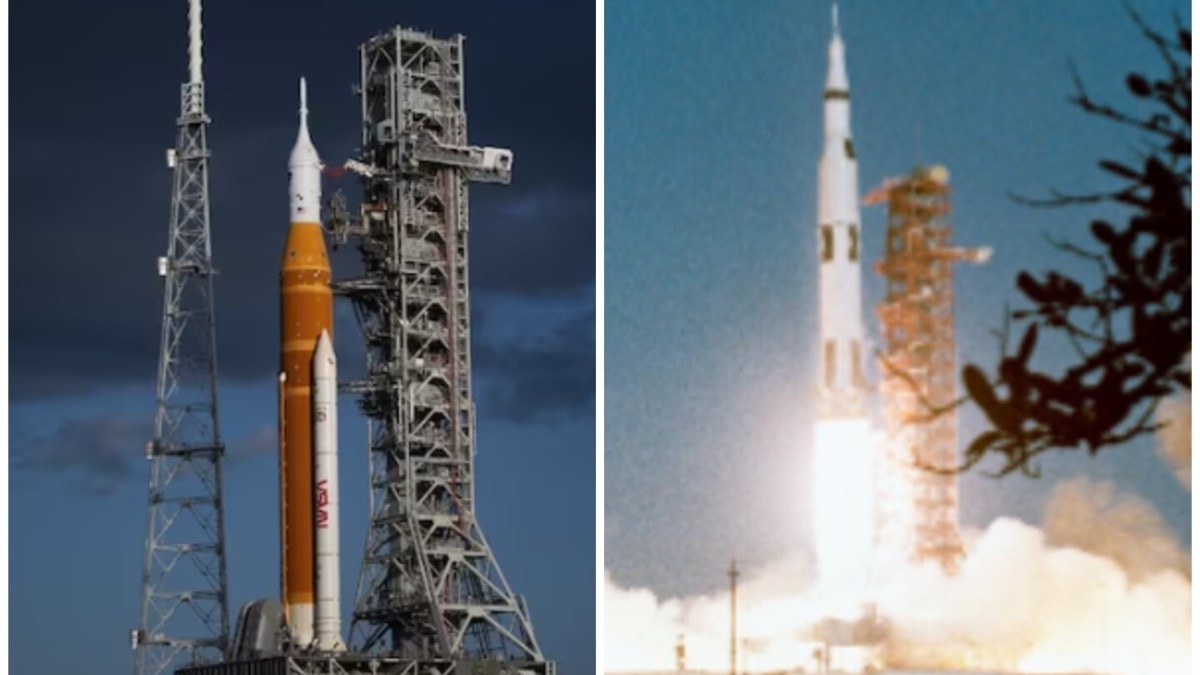
More than half a century after humans first walked on the Moon, the race to return to Earth’s closest celestial neighbour is entering a new era. The historic lunar missions of the NASA-led Apollo program defined the Cold War space race and delivered humanity’s first footsteps on another world. Today, the United States is preparing for its next chapter through the Artemis program, with Artemis II set to carry astronauts around the Moon for the first time since 1972.
While both programs share the goal of expanding human presence in space, the scale, technology, and ambitions of Artemis represent a major leap beyond Apollo.
Apollo: First steps on the Moon
The Apollo era remains one of the most remarkable achievements in the history of space exploration. Launched during the height of the Cold War, the program was driven by the United States’ ambition to outpace the Soviet Union after the launch of Sputnik 1.
The defining moment came on July 20, 1969, when astronauts aboard Apollo 11 successfully landed on the Moon. Commander Neil Armstrong stepped onto the lunar surface and delivered the iconic line: “That’s one small step for man, one giant leap for mankind.” He was joined shortly after by Buzz Aldrin, while Michael Collins orbited the Moon in the command module.
Between 1969 and 1972, six missions successfully landed astronauts on the lunar surface:
- Apollo 11
- Apollo 12
- Apollo 14
- Apollo 15
- Apollo 16
- Apollo 17
These missions collected lunar rock samples, deployed scientific instruments, and dramatically expanded scientific understanding of the Moon’s geology.
Not every Apollo mission ended as planned. Apollo 13 famously suffered an oxygen tank explosion during its journey to the Moon in 1970. The crew — Jim Lovell, Jack Swigert, and Fred Haise — aborted the landing and looped around the Moon before returning safely to Earth. The mission produced one of the most famous lines in spaceflight history: “Houston, we’ve had a problem.”
After Apollo 17 in 1972, humans would not travel beyond low-Earth orbit again for decades.
Artemis: Returning to the Moon
The modern return to the Moon is being led by the Artemis programme, also managed by NASA with international partners including the European Space Agency, Japan Aerospace Exploration Agency, and Canadian Space Agency.
The program began with Artemis I in 2022, an uncrewed test flight that successfully sent the Orion spacecraft around the Moon atop the powerful Space Launch System rocket.
The next milestone is Artemis II, scheduled to carry astronauts on a lunar flyby mission. Unlike Apollo, Artemis is designed as a long-term lunar exploration program rather than a short burst of missions. Artemis II will not land on the Moon but will test life-support systems, deep-space navigation, and crew operations in preparation for future landings.
Apollo vs Artemis: Key differences
- Mission Purpose: Apollo was largely driven by geopolitical competition during the Cold War. Its primary goal was to demonstrate technological superiority and achieve the first human landing on the Moon. Artemis, by contrast, is focused on building a sustained presence in deep space. The program aims to support long-term lunar exploration and eventually serve as a stepping stone for missions to Mars.
- Technology: The Apollo missions relied on the Saturn V rocket, which remains one of the most powerful launch vehicles ever built. Artemis missions use the Space Launch System, an even more powerful heavy-lift rocket designed for deep-space missions. The Orion spacecraft also incorporates modern computing, life-support systems, and advanced navigation technologies that were unimaginable in the 1960s.
- Global Collaboration: Apollo was largely an American effort. Artemis is a multinational project involving several space agencies and commercial partners. The initiative also includes plans for the Lunar Gateway, a small space station that will orbit the Moon and support future missions.
- Future Landings: While Apollo achieved six landings in a span of just three years, Artemis aims to build a long-term presence on the Moon, including human exploration of the lunar south pole—a region believed to contain water ice.
Apollo marked humanity’s first steps beyond Earth, Artemis is designed to ensure those steps lead to a permanent foothold on the Moon — and eventually to Mars.
#Lunar #landings #history #Apollos #giant #leaps #Artemis #IIs #frontier1775528796

Recent Post



Gallery






Featured Videos