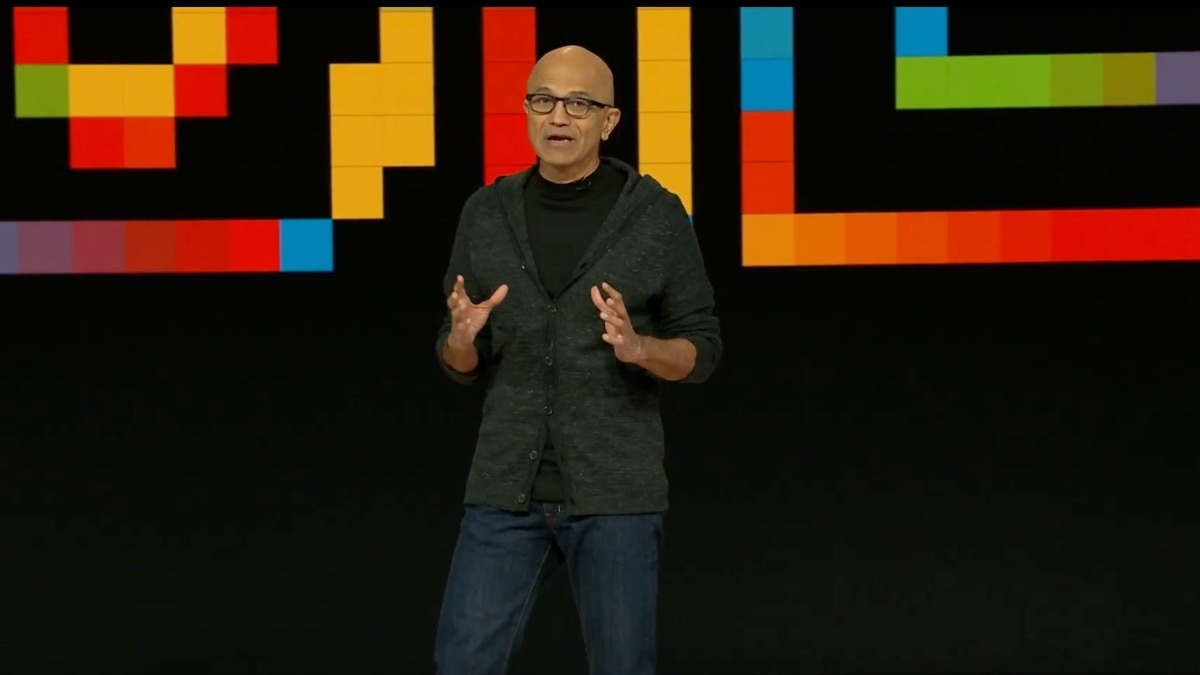
Microsoft Chairman and CEO Satya Nadella has said the long-term success of the artificial intelligence economy will depend less on individual frontier models and more on the ecosystems that organisations build around them.
In a detailed post on X (formerly Twitter) Nadella argued that as the global race to develop more powerful AI models intensifies, companies will need to focus on building systems that help human knowledge and AI capabilities grow together over time.
Nadella said the AI transition is fundamentally different from earlier waves of digital transformation. While previous shifts were aimed at augmenting human productivity, he said AI creates “a real cognitive loop” between people and machines, changing how enterprises create knowledge, innovate and compete. He added that the companies of the future will have to develop both human capital and token capital.
Human capital & token capital
According to Nadella, human capital includes the expertise, judgement, relationships, creativity and pattern recognition of employees, while token capital refers to the AI capabilities that an organisation develops and owns. He said the rise of AI should not reduce the importance of human expertise.
MUST READ | ₹250 an hour to train AI: How Indian workers are shaping the future of robotics
Instead, he argued that human intelligence and agency will become even more important because people define goals, connect ideas across domains and provide the direction that allows AI systems to produce meaningful outcomes. “Without human direction, you have compute running in circles,” he wrote.
The learning loop
A central part of Nadella’s argument was that businesses should build a “learning loop” in which human knowledge and AI systems continuously reinforce one another.
He said that while individual tasks, or even entire jobs, may be automated, organisations cannot outsource the process of learning itself. In his view, the ability to continuously accumulate and apply knowledge through AI will become the defining competitive advantage.
Enterprise AI architecture
Nadella also outlined what he described as the next generation of enterprise AI architecture. Rather than relying on a single foundation model, he said companies should build “agentic systems” that retain and improve institutional knowledge while also allowing organisations to replace the underlying general-purpose models as technology changes.
In this framework, he said, a company’s real intellectual property is not merely its data, but the proprietary learning system built from its workflows, domain expertise and accumulated judgement.
Private evaluation & reinforcement learning
He also highlighted the importance of private evaluation systems and reinforcement learning environments that train AI models on real-world organisational data and business outcomes. Nadella said such systems turn institutional memory into a living knowledge base that becomes more valuable with every interaction.
DON’T MISS | ‘Ultimate weapon…’: Sridhar Vembu urges India to build sovereign AI after US Anthropic curbs
Calling this process a “hill climbing machine”, he wrote that the AI learning loop compounds over time, with each improved workflow generating better training signals and strengthening an organisation’s unique capabilities.
Nadella said companies that establish these feedback loops early will be better placed to maintain an advantage even as the wider AI model landscape changes. In his view, the resilience of an organisation will come from the learning system it owns rather than from dependence on any one model.
Economic and political risks
Beyond the technology itself, Nadella warned about the wider economic and political implications of AI concentration. He cautioned against a future in which a small number of large AI models capture most of the economic value while companies across sectors lose control over their expertise and intellectual property.
Drawing a comparison with the first wave of globalisation, he said that although outsourcing improved aggregate economic indicators, it also hollowed out industrial ecosystems and led to lasting social and political consequences. He argued that a similar concentration of value in AI could create an unsustainable political economy.
“The last thing any of us want is a world where every company across every sector is ceding value to a few models that eat everything they see,” Nadella wrote, adding that there would be little societal acceptance for an AI future that undermines entire industries.
A frontier ecosystem
Instead, Nadella called for a “frontier ecosystem” in which value is distributed broadly across businesses, industries and countries. He said every organisation should own the learning loop that captures and compounds its institutional knowledge, allowing both human and AI capabilities to grow together.
He framed this as an extension of the traditional platform model that has shaped much of the digital economy, where platforms enable others to create more value than the platform itself captures. In the AI era, he said, that approach should help ensure that employees see their expertise amplified rather than replaced, while companies and communities retain ownership of the value they create.
Satya Nadella, Microsoft, AI economy, enterprise AI, learning loop, agentic systems, human capital, token capital, AI models, institutional knowledge#Satya #Nadella #success #hinge #ecosystems #frontier #models1781457718

agentic systems
AI economy
AI models
ecosystems
Enterprise AI
Frontier
hinge
human capital
institutional knowledge
learning loop
Microsoft
Models
Nadella
Satya
Satya Nadella
Success
token capital