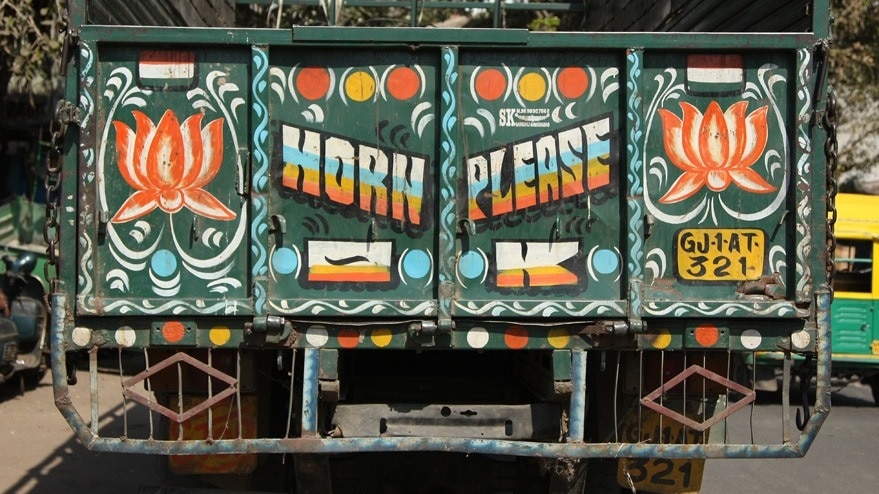
If you have ever driven on an Indian highway, chances are you have spotted the phrase “Horn OK Please” painted in bright colors on the back of a truck. The quirky slogan has become a defining feature of India’s road culture, but its origins remain a subject of debate.
One story that frequently circulates online traces the phrase back to the Second World War. According to this popular account, fuel shortages during the war forced many Indian trucks to run on kerosene instead of diesel. Since kerosene is highly flammable, truck operators supposedly painted “Horn Please on Kerosene” on the rear of vehicles to warn motorists. Over time, the phrase is said to have been shortened, with “on kerosene” eventually becoming “OK,” giving rise to the now-famous “Horn OK Please.”
Is the Kerosene story true?
While the tale is widely shared, historians and language experts have found little concrete evidence to support it. There are no known official records linking the phrase directly to wartime kerosene-powered trucks or proving that “OK” originated as a shorthand for “on kerosene.”
The theory survives largely through oral accounts and internet retellings rather than documented historical sources.
Other theories hehind ‘Horn OK Please’
Several alternative explanations have emerged over the years:
- Overtaking Signal Theory: One of the most widely accepted explanations is that the message encouraged drivers behind a truck to honk before attempting to overtake. Since trucks often carried heavy loads and had limited rear visibility, a horn alert would help the driver become aware of approaching vehicles.
- ‘OK’ Safety Marker Theory: Some transport historians suggest that “OK” was painted prominently as a sign that the vehicle was fit for road use. The word may have been placed in the center of the phrase to draw attention, eventually becoming a standard part of truck artwork.
- Decorative Tradition Theory: Another view is that the phrase evolved as part of India’s vibrant truck-art culture, where slogans, symbols, and messages are painted for both practical and aesthetic reasons. Over decades, “Horn OK Please” became a convention that was repeated across generations of trucks.
Why was honking so important?
The phrase emerged in an era when Indian roads were narrower, vehicles lacked modern mirrors, and highways often accommodated a mix of trucks, buses, bicycles, animals, and pedestrians. Honking served as a crucial communication tool between drivers.
A vehicle approaching from behind would sound its horn to signal its presence, helping the truck driver make room for a safe overtaking maneuver.
Regardless of its exact origin, “Horn OK Please” has transcended its practical purpose. The slogan has inspired films, songs, artworks, and even fashion collections. For many, it represents the colorful, chaotic, and uniquely Indian experience of road travel.
Indian trucks, truck art India, Indian highways, road culture, truck slogans, World War II, kerosene trucks, transport history, Indian transport, highway safety, trucking industry, viral history, road signs#Indian #trucks #Horn #fascinating #mystery #phrase1782051460

fascinating
highway safety
Horn
Indian
Indian highways
Indian transport
Indian trucks
kerosene trucks
Mystery
phrase
road culture
road signs
transport history
truck art India
truck slogans
trucking industry
trucks
viral history
World War II