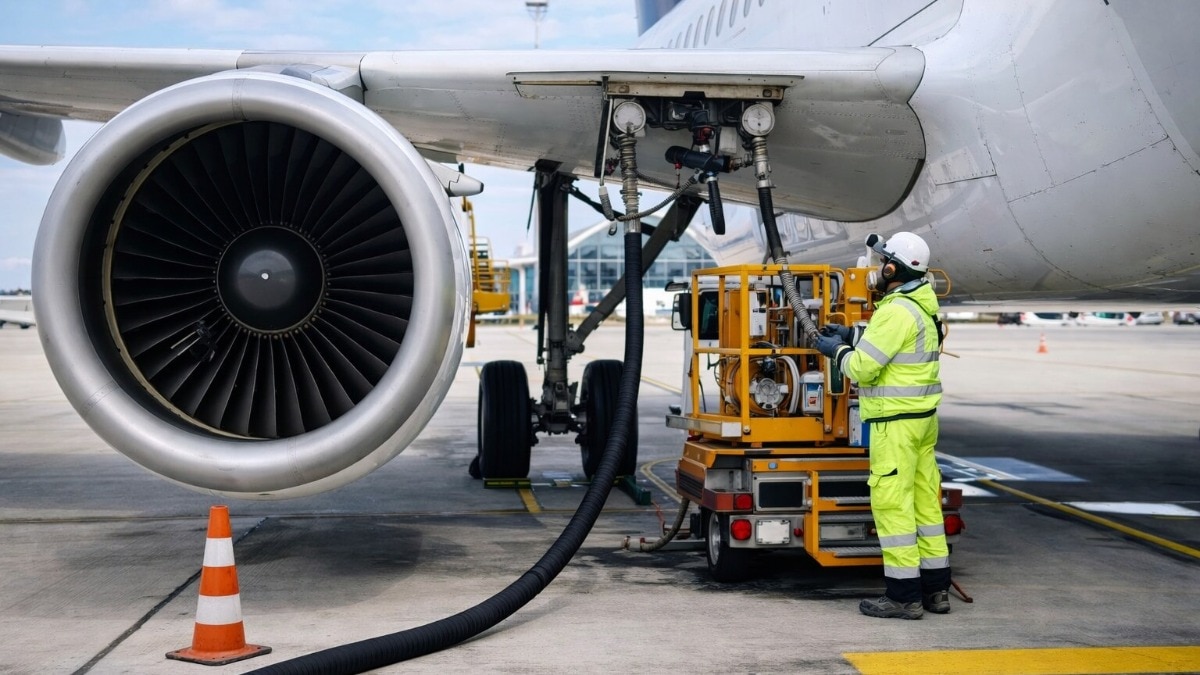
The Ministry of Petroleum and Natural Gas has amended rules governing Aviation Turbine Fuel (ATF), allowing blending with synthetic fuels in a move aimed at supporting cleaner and alternative aviation energy sources. The notification, dated April 17, revises the Aviation Turbine Fuel (Regulation of Marketing) Order to align India’s fuel framework with evolving global standards and technological advancements.
Under the revised framework, ATF has been redefined to include blends with synthetic hydrocarbons, in line with updated Indian Standards — IS 1571 and IS 17081. This marks a significant regulatory shift, as it formally recognises blended and synthetic aviation fuels within India’s legal and operational ecosystem. The changes have been notified under the Essential Commodities Act, 1955, and have come into effect immediately.
The amendment also removes legacy provisions from the earlier order and updates enforcement mechanisms. Notably, provisions related to search and seizure have now been aligned with the Bharatiya Nagarik Suraksha Sanhita, 2023, replacing outdated legal references and modernising regulatory oversight.
MUST READ: Windfall tax: Centre hikes diesel export duty to Rs 55.5/litre, ATF to Rs 42
The move is expected to accelerate the adoption of Sustainable Aviation Fuel (SAF) and other low-emission alternatives, which are gaining traction globally as airlines face mounting pressure to decarbonise operations. By permitting blending under recognised Indian standards, the government has created much-needed regulatory clarity for refiners, fuel marketers, airlines, and suppliers exploring next-generation aviation fuels.
Synthetic and blended fuels can be derived from a range of sources, including biomass, waste feedstock, and renewable energy pathways. These alternatives are seen as critical to reducing aviation’s carbon footprint, especially as air travel demand continues to rise.
India, one of the fastest-growing aviation markets globally, is witnessing rapid expansion in passenger traffic and fleet capacity. Fuel costs remain a major component of airline expenses, accounting for nearly 30-40% of operating costs, according to ICRA. In this context, enabling cleaner and potentially more efficient fuel options is strategically important for both sustainability and cost management over the long term.
MUST READ: Air India issues clarification on ‘no tika, no bindi’ policy for cabin crew
Meanwhile, rising ATF prices have added to industry pressures. Following the escalation of the West Asia conflict, global supply chain disruptions have pushed jet fuel prices sharply higher. ATF prices for international operations have crossed ₹2.07 lakh per kilolitre, while domestic prices have also trended upward.
Amid these challenges, the Ministry of Civil Aviation is reportedly in discussions with states such as Delhi, Tamil Nadu, West Bengal, and Maharashtra to reduce value-added tax (VAT) on ATF. Lower VAT could provide some relief to airlines grappling with elevated fuel costs. Additionally, the government has asked oil marketing companies to stagger price increases for domestic carriers, limiting the immediate pass-through of global price spikes.
Overall, the amendment signals a forward-looking policy shift, balancing regulatory clarity, energy transition goals, and the operational realities of a rapidly growing aviation sector.
#Govt #amends #ATF #rules #synthetic #fuel #blending #aligns #norms #global #standards1776861551

Recent Post



Gallery






Featured Videos