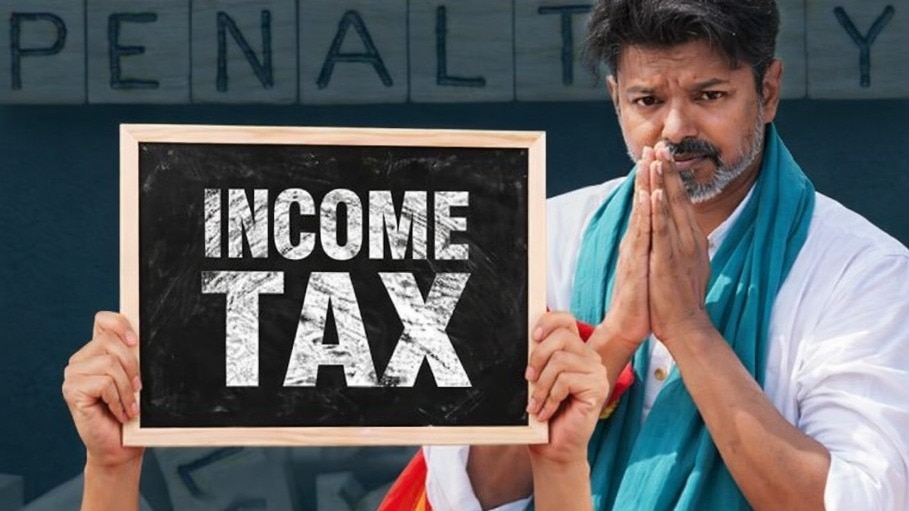
The recent case involving Tamil actor Vijay, where ₹15 crore cash reportedly found at his premises led to a penalty of around ₹1.5 crore, has put the spotlight on something many taxpayers don’t fully understand: income tax penalties in India can be far steeper than expected.
According to TaxBuddy founder Sujit Bangar, most people assume penalties are small — typically around 10%. But that’s a misconception. In reality, the Income Tax Act has a detailed penalty framework, where penalties can range from 10% to as high as 200% of the tax involved, depending on what went wrong and how serious the issue is.
Not all mistakes are equal
Bangar explains that under Section 270A, tax defaults are divided into two categories:
Under-reporting of income: This is when you fail to report some income. The penalty here is 50% of the tax payable on that amount.
Misreporting of income: This is more serious and includes cases where incorrect information is provided deliberately. The penalty can go up to 200% of the tax payable.
This distinction is critical. If your mistake is seen as genuine, the penalty is lower. But if the tax department believes there was intent to hide or mislead, the financial impact can be severe.
When does the 200% penalty apply?
The highest penalty is not for simple errors. It usually applies when there are clear signs of wrongdoing, such as:
Claiming fake expenses or bogus invoices
Not recording cash transactions
Hiding bank accounts or investments
Inflating deductions without proof
Manipulating books of accounts
In such cases, the issue moves from under-reporting to misreporting, triggering the steepest penalties.
Penalties go beyond income reporting
Bangar highlights that penalties are not limited to income disclosure. You can face penalties for several other compliance failures as well:
Not maintaining proper books of accounts → penalty up to ₹25,000
Not getting accounts audited → penalty up to ₹1.5 lakh
Failure to deduct or collect TDS/TCS → penalty equal to the amount involved
Late or incorrect TDS returns → ₹10,000 to ₹1 lakh
There are also strict rules around cash transactions. For example:
Accepting or repaying loans in cash above ₹20,000
Receiving cash above ₹2 lakh
In such cases, the penalty can be equal to the entire amount involved, which can be financially significant.
ALSO READ: Income Tax Dept launches TRACES 2.0 portal to simplify TDS compliance under new tax regime
It’s not just about tax
One of Bangar’s key points is that penalties are not only about how much tax you owe—they are about how you handle your compliance.
Even though the law does not explicitly use the word “intent”, in practice:
If you disclose everything clearly and have proper documents, you are safer
If your claims are unsupported or appear doubtful, the risk of higher penalties increases
This means even a small lapse can escalate if you cannot justify it properly.
ALSO READ: ITR forms updated for AY 2025-26: ITR-1, ITR-4 now allow reporting of two properties
Can penalties be avoided?
There is some relief under Section 273B, where penalties can be waived if you can prove there was a reasonable cause for the failure. However, Bangar notes that this defence is not available in serious cases like misreporting or certain search-related penalties.
What should you do as a taxpayer?
The takeaway is straightforward:
Report all income accurately
Maintain proper documentation and records
Avoid aggressive or doubtful claims
The Vijay case may be high-profile, but the rules apply to everyone. As Bangar explains, India’s tax penalty system is strict, layered, and increasingly enforced. For you, the safest approach is simple: be transparent, stay compliant, and ensure every claim you make can be backed by solid proof.
Vijay income tax case, income tax penalties India 200 percent, Sujit Bangar tax explanation, tax penalty rules India 2026, under reporting vs misreporting tax, income tax mistakes penalty India, tax compliance tips India, TDS cash transaction penalty rules, income tax section 270A explained, how to avoid tax penalties India#tax #penalty #Vijay #tax #case #highlights #penalty #risk #means1776177804

case
highlights
how to avoid tax penalties India
income tax mistakes penalty India
income tax penalties India 200 percent
income tax section 270A explained
means
penalty
risk
Sujit Bangar tax explanation
Tax
tax compliance tips India
tax penalty rules India 2026
TDS cash transaction penalty rules
under reporting vs misreporting tax
Vijay
Vijay income tax case