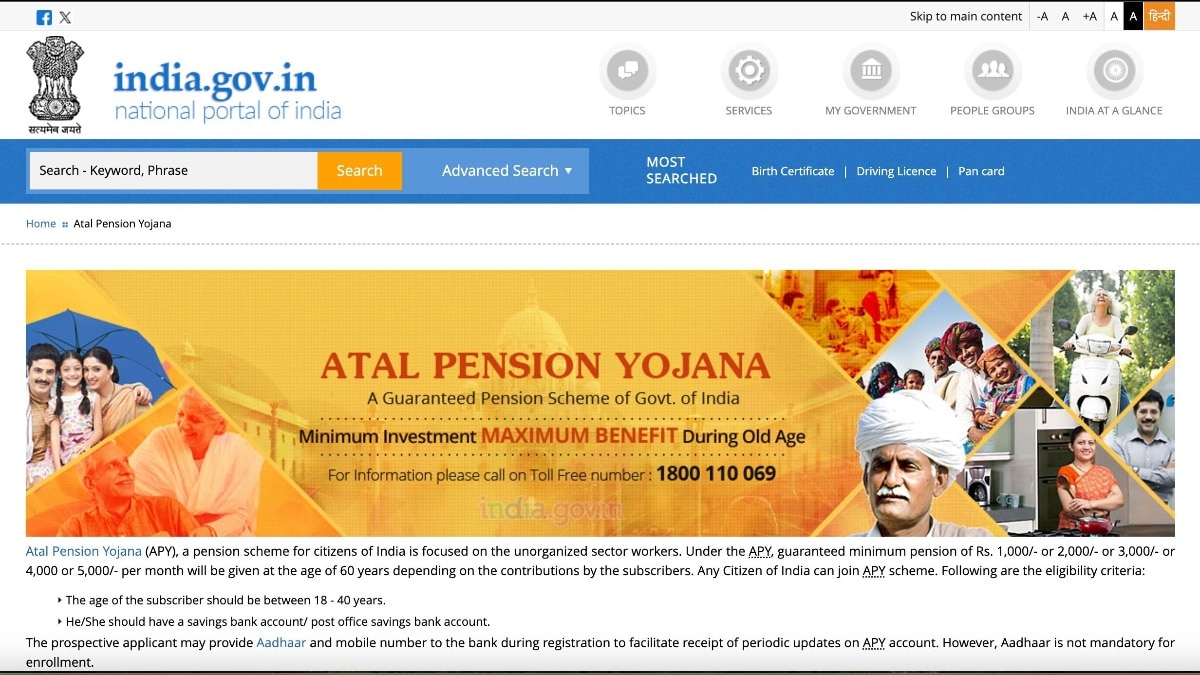
Retirement planning often takes a back seat, especially for workers outside formal employment. However, India’s Atal Pension Yojana (APY) is steadily emerging as a cornerstone of grassroots social security, offering guaranteed income in old age with low entry barriers.
The government-backed scheme has now crossed a major milestone, underscoring its growing relevance among low- and middle-income households.
APY crosses 9 crore enrolments
The Atal Pension Yojana, administered by the Pension Fund Regulatory and Development Authority (PFRDA), has surpassed 9 crore total gross enrolments as of April 21, 2026, reflecting its expanding reach across India’s unorganised workforce .
Notably, FY26 alone saw over 1.35 crore new subscribers, the highest annual enrolment since the scheme’s launch. This surge highlights increasing awareness and adoption, driven by banks, post offices, and government-led outreach initiatives.
Launched on May 9, 2015, APY was designed to build a universal social security framework, particularly targeting workers without formal pension coverage.
What is Atal Pension Yojana and how it works
APY is a voluntary, contributory pension scheme that guarantees a fixed monthly pension ranging from ₹1,000 to ₹5,000 after the age of 60.
MUST READ: The ₹10 crore myth: Here’s how inflation and taxes can derail your FD retirement plan
Subscribers contribute periodically—monthly, quarterly, or half-yearly—through an auto-debit facility linked to a savings bank account. The contribution amount depends on:
Entry age
Desired pension amount
A key feature is the government guarantee. If the returns generated on contributions fall short of the promised pension, the government bridges the gap.
Triple benefit structure
APY is structured to provide what policymakers call a “Sampurna Suraksha Kavach” (complete security cover), built on three pillars:
- Guaranteed pension: ₹1,000–₹5,000 per month post-retirement
- Spouse protection: Same pension continues to the spouse after the subscriber’s death
- Nominee benefit: Entire accumulated corpus is returned to the nominee after both subscriber and spouse pass away
This layered structure makes APY distinct from market-linked retirement products.
MUST READ: Pension meets healthcare: Why NPS Swasthya feels like a timely shift for retirees
Eligibility and key rules
The scheme is open to Indian citizens aged 18 to 40 years with a savings bank account. However, since October 1, 2022, income-tax payers are not eligible to join.
Subscribers must contribute until age 60, after which the pension begins. In case of the subscriber’s death before 60, the spouse can continue contributions and claim the same pension later.
Start early or pay more
One of APY’s most critical insights is the cost advantage of early entry:
At age 18: ₹210/month contribution for a ₹5,000 pension; ~₹8.5 lakh corpus
At age 30: ₹577/month
At age 40: ₹1,454/month
The sharp rise in contributions with age reinforces a simple principle—early participation significantly reduces financial burden.
DID YOU KNOW: PPFAS AMC gets PFRDA nod to manage NPS funds, expands into retirement segment
Flexibility and post-retirement benefits
Subscribers can increase or decrease their pension slab once a year, typically in April, allowing adjustments based on income changes.
After turning 60:
Pension payouts begin
Spouse continues receiving pension after subscriber’s death
Corpus is eventually transferred to the nominee
Why APY matters
IIndia’s workforce remains largely informal, with limited access to structured retirement plans, and the Atal Pension Yojana seeks to bridge this gap by offering predictable, government-backed returns at a low entry cost.
#Atal #Pension #Yojana #crosses #crore #subscribers #FY26 #sees #record #crore #additions1777022849